







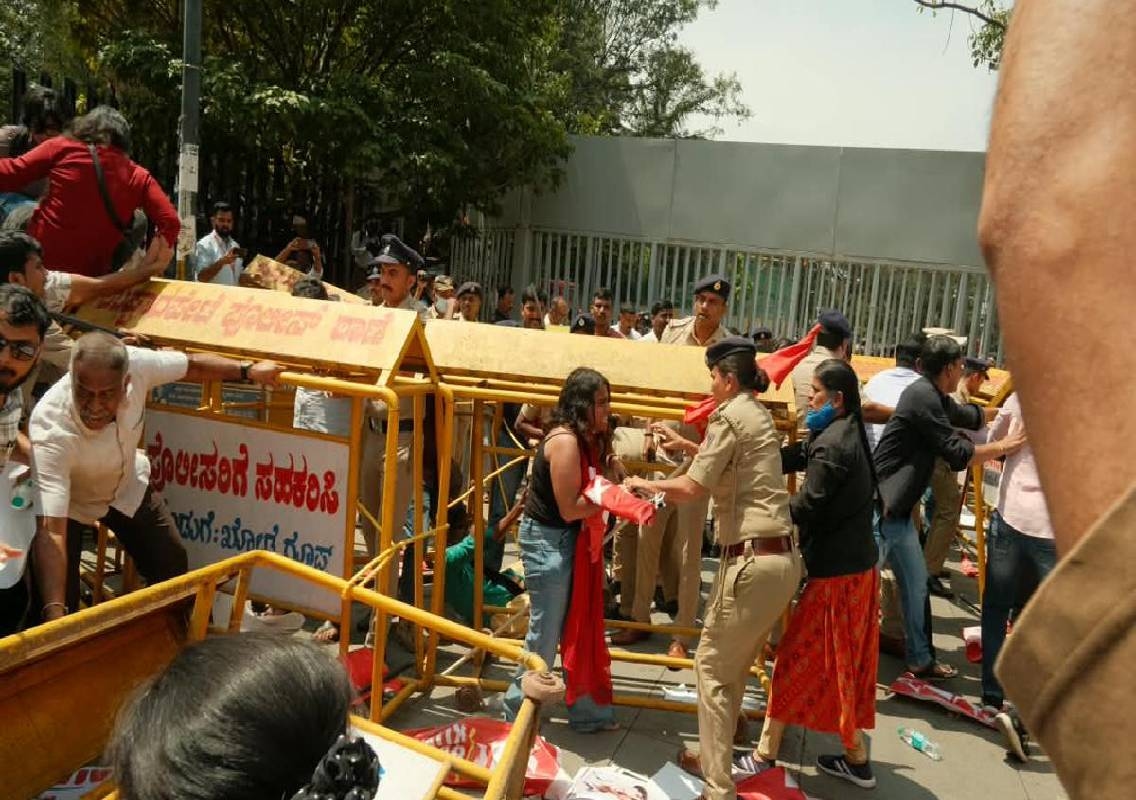


BENGALURU: At least 50 students belonging to the All India Students’ Association (AISA) were detained by Bengaluru city police at Freedom Park on Saturday, October 10, while protesting against the Special Intensive Revision (SIR) of electoral rolls and demanding the resignation of Chief Election Commissioner (CEC) Gyanesh Kumar.
The students had assembled at Freedom Park and planned to march to the office of the Karnataka Chief Electoral Officer (CEO), located a few hundred metres away. Their demands included scrapping the disputed electoral roll revision exercise and restoring names that they said had been wrongly removed from the voter lists.
According to reports, the students alleged that they were detained before their planned march could begin. The incident triggered criticism from AISA Karnataka and other Left student organisations, which questioned the police action and raised concerns about the right to peaceful protest.
Students oppose electoral roll revision
The demonstration centred on the Special Intensive Revision of electoral rolls, an exercise that has prompted objections from several political and civil society groups over the treatment of voter registrations and the potential exclusion of eligible electors.
The protesting students demanded the resignation of Chief Election Commissioner Gyanesh Kumar, alleging irregularities in the revision process. They also called for the cancellation of deletions from the electoral rolls, including names classified as absent, shifted or dead in the draft lists.
According to the reports, the protesters referred to approximately 1.07 crore names marked under these categories at the draft stage and demanded that the deletions be scrapped.
The students argued that changes to electoral rolls must be transparent and should not deprive eligible citizens of their voting rights. Their protest formed part of a wider campaign questioning the conduct and implications of the SIR exercise.
The allegations are the protesters’ stated position and do not, by themselves, establish that the electoral roll changes were unlawful. The concerns have nevertheless become a central issue in their campaign against the revision process.
Planned march stopped at Freedom Park
Freedom Park, a designated protest venue in Bengaluru, was the starting point for the students’ planned march towards the Karnataka Chief Electoral Officer’s office.
The students said they intended to take their demands to the election authorities. However, they alleged that police personnel detained them while they were still inside the park, before they could begin the march.
According to the protesters, barricades had been erected at both ends of the protest site. They maintained that they had neither crossed the barricades nor reached the CEO’s office when the detentions took place.
The police reportedly transported the detained students in different buses. Other AISA members subsequently attempted to contact those taken away to determine where they were being held.
The students said they could not immediately establish whether all the detainees had been taken to one police station or had been distributed among multiple locations.
The circumstances surrounding the detentions became a major point of contention, with AISA members questioning why the police had intervened before the planned march could proceed.
Heavy police deployment reported
AISA members alleged that hundreds of police personnel had been deployed around Freedom Park and that barricades had been placed on roads leading towards the Karnataka CEO’s office.
The office is located a short distance from the park, making the proposed march a direct attempt to present the students’ demands to the state’s election authorities.
The protesters claimed that the police arrangements prevented them from proceeding with the demonstration. They also alleged that some students were detained when they attempted to move past the barricades.
The available reports did not establish a detailed official police explanation for the detentions. Therefore, the students’ account of the sequence of events remains an attributed allegation rather than an independently established finding.
The episode has renewed attention on the arrangements governing demonstrations at designated protest sites and the circumstances in which authorities may restrict or intervene in a march.
AISA condemns police action
AISA Karnataka strongly criticised the detentions, describing the action as an infringement of the democratic right to protest. Other Left student organisations also expressed opposition to the police response.
The student association demanded the release of those detained and called for the removal of barricades that prevented protesters from proceeding towards the election office.
It also urged the Karnataka government to ensure that students and other citizens could express their concerns peacefully.
The organisation argued that a government opposing the SIR exercise at the national level should also address objections raised by protesters in Karnataka.
AISA specifically questioned the approach of the Congress-led state government, comparing its handling of the demonstration with the party’s criticism of restrictions on dissent when it is in opposition elsewhere.
These statements reflect the association’s political criticism of the government and its handling of the demonstration.
Wider campaign against the SIR exercise
The Bengaluru demonstration took place amid a broader series of protests against the Chief Election Commissioner and the electoral roll revision process.
Demonstrators in different cities have raised concerns about voter deletions, the transparency of the revision exercise and the accountability of election authorities. The demands have included changes to the process and action against officials whom protesters hold responsible for the alleged irregularities.
In Bengaluru, the students focused on the reported deletions and sought to deliver their demands directly to the Karnataka Chief Electoral Officer.
The issue is significant because electoral rolls determine who is registered to vote. Accurate records are necessary both to prevent duplicate or invalid entries and to protect eligible voters from wrongful exclusion.
Any concerns about deletions therefore require clear information about the revision procedure, the classification of entries and the mechanisms available to voters to verify or correct their details.
The protesters’ demands underline the need for public communication about how electoral roll revisions are conducted and how affected individuals can seek corrections through the prescribed procedures.
Questions remain over the detentions
The immediate concerns following the demonstration included the whereabouts of the detained students and the circumstances under which they had been taken away.
AISA members said they were trying to establish contact with those detained. They also warned that they could organise another agitation at the police station if the students were not released.
The reports available at the time did not conclusively establish the final status of every detained student or provide a complete official account of the police action.
The incident has consequently raised two related questions: how the authorities handled the planned march and how the protesters’ concerns about electoral roll revisions will be addressed.
Conclusion
The detention of at least 50 AISA students at Freedom Park has brought renewed attention to the dispute over the Special Intensive Revision of electoral rolls and the handling of demonstrations in Bengaluru.
The students are demanding the resignation of Chief Election Commissioner Gyanesh Kumar, the scrapping of disputed deletions and safeguards for eligible voters. AISA and other student organisations have also called for the release of those detained and criticised the police intervention.
The next steps will depend on the authorities’ response to the protesters’ demands, clarification of the circumstances surrounding the detentions and the available procedures for addressing objections to electoral roll entries. Transparent communication and due process will remain important to resolving concerns over both electoral participation and the right to peaceful assembly.