







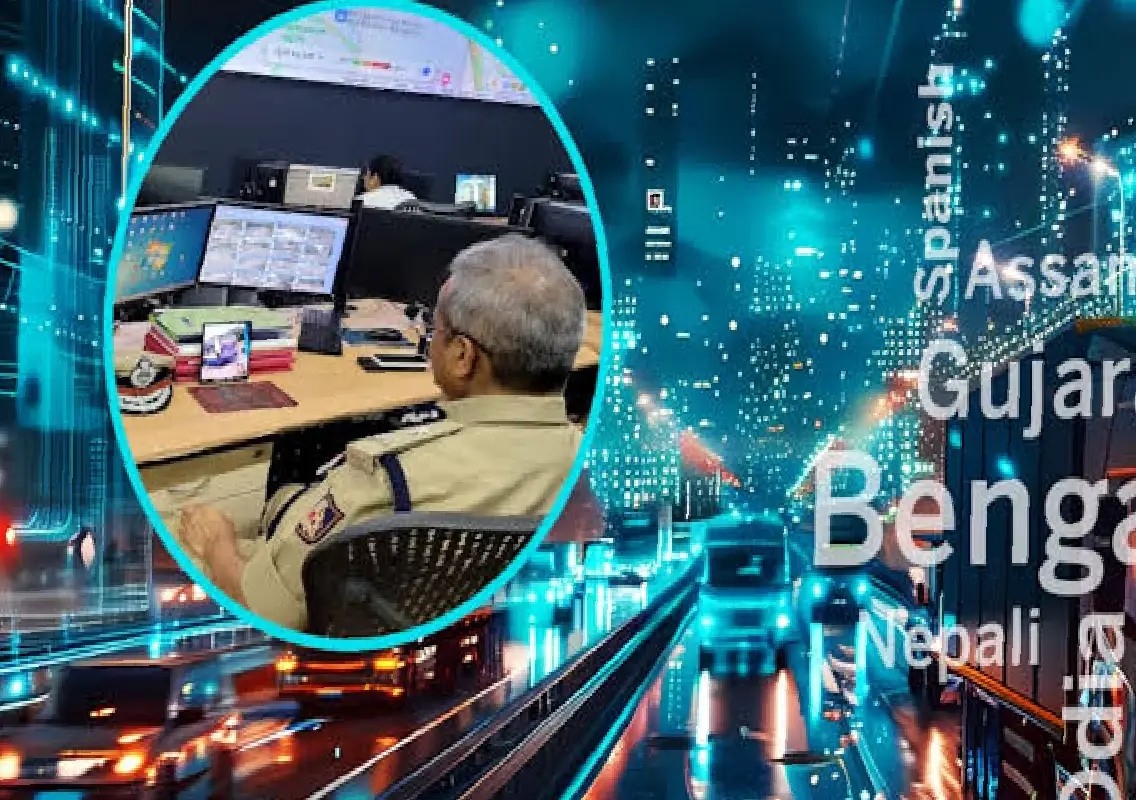


Bengaluru: A late-night distress call from a woman who spoke only Manipuri has inspired an artificial intelligence solution that is now helping Bengaluru Police communicate with emergency callers across multiple languages in real time.
According to Aeos founders Varun Mayya and Achina Mayya, the incident exposed a critical gap in emergency response when police officers struggled to understand the caller because of the language barrier.
One emergency call sparks an idea
The incident left the caller anxious and responders unable to immediately assess the situation. For the Aeos team, which was already working on artificial intelligence, audio and video technologies, the experience highlighted a problem where technology could have an immediate public impact.
The founders said the incident prompted them to explore an AI system capable of interpreting conversations as they happen.
AI helps police understand callers
The resulting technology can translate conversations in real time, allowing emergency call operators to understand people speaking in their native languages without depending on human translators.
What began as an internal experiment eventually developed into a service deployed by Bengaluru City Police and integrated with Namma 112, the city’s emergency response platform.
The system is designed to allow callers to communicate naturally in their preferred language while the AI translates and relays the information to call handlers.
VANKI supports multiple languages
Earlier this year, Bengaluru Police rolled out Multilingual Voice AI for Nationwide Key Interventions (VANKI), an AI-powered upgrade aimed at reducing language barriers during emergencies.
The system currently supports more than 10 languages, including Bengali, Gujarati, Odia, Manipuri, Kashmiri, Nepali and Assamese. It also supports international languages such as Spanish, French and Arabic.
The platform was developed jointly by Monday Ventures and Aeos.
Technology aimed at faster emergency response
Bengaluru’s diverse population includes people from different parts of India and around the world. Police officials said language differences during emergencies can slow communication and affect the speed at which assistance is provided.
The new AI layer is intended to ensure that people seeking emergency assistance are not disadvantaged because they cannot communicate in a language immediately understood by the call handler.
What began with one difficult midnight call has therefore evolved into a technology-driven effort to make Bengaluru’s emergency response system more accessible across languages.