







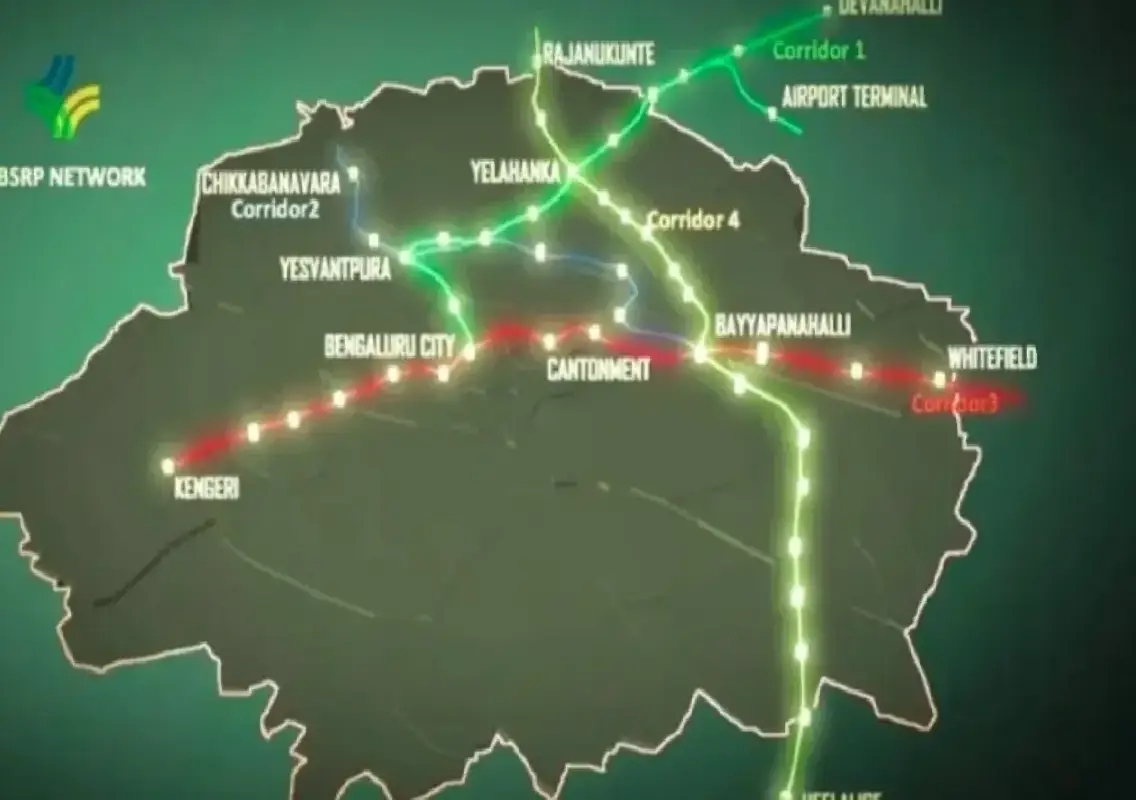


Bengaluru: The Bengaluru Suburban Railway Project (BSRP) is set to transform the city’s urban mobility landscape, with projections indicating that nearly 19 lakh passengers will use the network daily once all corridors become operational. The project is also expected to remove around 40,000 buses from the city’s roads, significantly easing traffic congestion.
The ambitious plan was outlined by Lakshman Singh, Managing Director of Rail Infrastructure Development Company (Karnataka) Limited (K-RIDE), during a presentation titled “Building Tomorrow’s Cities with Integrated Rail Network” at Concrete Panorama & Deminar 2026, organised by the Indian Concrete Institute, Bengaluru Centre.
Valued at ₹23,342 crore, the project spans 148 kilometres and comprises four corridors — Sampige, Mallige, Parijata and Kanaka — collectively branded as ‘Samparka’, meaning connectivity.
Four corridors, 57 stations
According to K-RIDE, the suburban rail network will cover 148 km across the city with 57 stations strategically located to improve last-mile access and reduce travel time. The four corridors are designed to link key residential, commercial and industrial hubs, offering a reliable alternative to road-based transport.
Projections by the Indian Institute of Science (IISc) estimate that the network could handle up to 19 lakh passengers per day by 2027, provided all corridors are completed as scheduled.
Officials said the system would play a crucial role in decongesting Bengaluru’s arterial roads by shifting a substantial number of daily commuters to rail-based transport. By reducing reliance on buses and private vehicles, authorities expect improved travel times and reduced vehicular emissions.
Seamless multimodal integration
A major highlight of the BSRP is its integration with existing public transport systems. The suburban rail network will connect with 17 Metro stations, 22 railway stations and several major bus depots, enabling seamless multimodal travel.
Lakshman Singh emphasised that such integration would drastically cut dependence on road transport and provide commuters with smoother transit options across the city. The unified approach is expected to improve first- and last-mile connectivity while encouraging a modal shift towards public transport.
To support high-frequency services, around 24 level crossings across Bengaluru will be eliminated. In congested localities where constructing conventional flyovers is not feasible, K-RIDE plans to elevate Indian Railways tracks using advanced retaining wall and track-shifting techniques. Officials said this strategy would minimise traffic disruption and prevent large-scale displacement of residents.
Sustainability and green features
Sustainability has been incorporated as a central component of the project. Stations are being designed with universal accessibility features to ensure inclusivity. Solar panels, rainwater harvesting systems and eco-friendly construction methods are part of the infrastructure blueprint.
According to project estimates, these measures could reduce nearly 10 million tonnes of carbon dioxide emissions annually. In addition, the network is expected to harvest around 22 million litres of rainwater every year, contributing to water conservation efforts in the city.
Officials said the suburban railway will not only ease traffic congestion but also improve environmental outcomes by reducing fossil fuel consumption and promoting energy-efficient transport.
Yeshwantpur interchange a key highlight
One of the most notable elements of the project is the proposed Yeshwantpur interchange hub. The five-storey complex will integrate suburban rail, Metro and Indian Railways services under one roof, offering commuters a unified transport experience.
The design includes two basement levels for parking and vertically stacked corridors, with two suburban lines running one above the other — a first-of-its-kind configuration in Bengaluru. The innovative structure is expected to optimise space utilisation in a densely developed urban area.
Transforming urban mobility
Singh underscored that the Bengaluru Suburban Railway Project is a critical step toward building a modern, integrated and sustainable transport system capable of meeting the city’s growing mobility demands.
With a projected ridership of 19 lakh passengers daily and a significant reduction in road traffic, the project is poised to redefine commuting patterns in Bengaluru. If completed on schedule, it could mark a turning point in the city’s efforts to address chronic congestion while improving overall quality of life.