







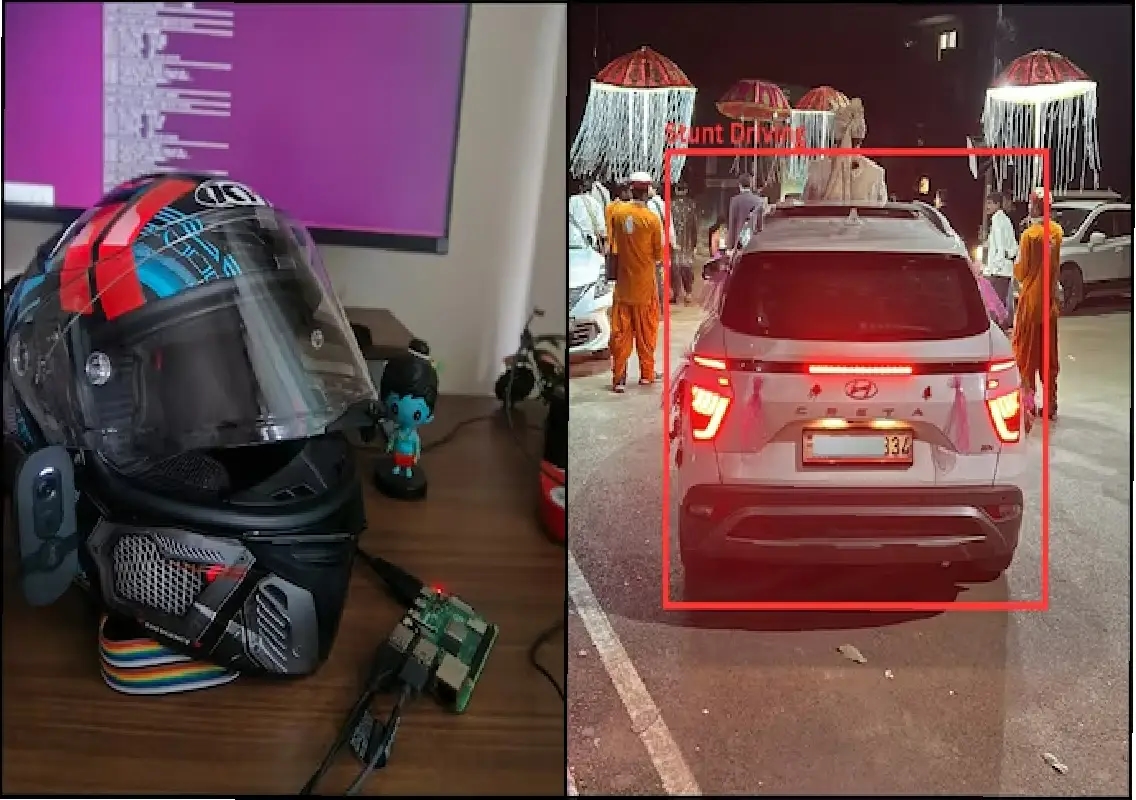


Bengaluru: A Bengaluru-based software engineer whose experimental AI-powered helmet designed to detect traffic violations recently went viral has revealed details of an extensive meeting with senior city police officials, sparking renewed discussion on the role of technology in improving road safety and enforcement. Pankaj Tanwar, the creator of the much-talked-about “AI traffic police” helmet, said he held an in-depth discussion with the city’s Joint Commissioner of Police (Traffic) and other officers on the feasibility of deploying such innovations at scale.
Tanwar shared insights from the nearly two-hour-long meeting through a detailed post on social media platform X, describing the interaction as encouraging and constructive. According to him, the officers were open-minded, engaged deeply with the concept and expressed genuine interest in how emerging technologies could strengthen Bengaluru’s traffic management systems.
Two-hour meeting with senior officers
Bengaluru Tanwar said the meeting involved not just a demonstration of his idea but also broader discussions on policy, infrastructure and enforcement challenges faced by the traffic police. “Met the joint commissioner, Bengaluru, today. Spent approximately two hours in a detailed discussion with officers. Pretty open, thoughtful and they genuinely loved the idea,” he wrote.
He added that the conversation went beyond surface-level appreciation and addressed practical questions about scalability, legal frameworks and integration with existing police systems. The interaction, he said, left him optimistic about the possibility of collaborative innovation between citizens and law enforcement agencies.
Integration with AstraM system discussed
Bengaluru One of the key takeaways from the meeting was the discussion around potential technical integration with AstraM, the backend system used by Bengaluru Police for traffic enforcement, challan generation and data management. Tanwar noted that officers spoke about the possibility of directly integrating such AI-based tools with official Application Programming Interfaces (APIs), provided data security, accuracy and legal compliance requirements were met.
This integration, if explored further, could allow AI-detected violations to seamlessly flow into the official enforcement pipeline, reducing manual intervention and improving efficiency. However, officers reportedly underlined that such steps would require rigorous testing, validation and policy approvals.
Addressing ‘snitching culture’ criticism
Bengaluru The viral nature of Tanwar’s helmet had earlier triggered online debates, with some critics arguing that such tools could encourage a “snitching culture” among citizens. Addressing this concern, Tanwar said the police dismissed the argument as misplaced.
“Snitching culture argument is baseless, goal is deterrence and safety,” he wrote, explaining that the primary objective of enforcement technology is to improve compliance and reduce accidents, not to promote vigilantism. According to him, officers emphasised that visibility of enforcement often plays a more significant role in shaping behaviour than penalties alone.
Behavioural impact more effective than fines
Bengaluru Another notable aspect of the discussion was the emphasis on behavioural psychology in traffic enforcement. Tanwar quoted officers as saying that creating a perception of being observed has a stronger and more sustained impact on driver behaviour than issuing challans alone.
This insight aligns with global research suggesting that consistent and visible enforcement mechanisms can deter violations more effectively than sporadic fines. The AI helmet, officers reportedly felt, could add to this sense of omnipresent monitoring if used responsibly and ethically.
Challenges of scale and compliance
Bengaluru Tanwar said the officers candidly acknowledged the scale of the challenge Bengaluru faces. With its rapidly growing vehicle population running into several lakh and complex traffic patterns, violation detection at scale remains an evolving problem.
He also shared a striking statistic revealed during the meeting: only about 20 per cent of traffic challans issued in the city are actually paid. This low compliance rate, officers said, continues to undermine enforcement efforts and highlights the need for systemic reforms beyond issuing fines.
The police also gave Tanwar a walkthrough of the city’s existing camera-based and AI-enabled surveillance infrastructure. “Crazy to see scale and effort already being put,” he wrote, noting that Bengaluru already has an extensive network of automated number plate recognition cameras and monitoring systems. Officers expressed interest in exploring how his helmet-based solution could complement these systems rather than duplicate them.
Not a revenue-first product
Bengaluru Tanwar clarified that his project is still at an experimental stage and is not being developed as a revenue-driven product. He said the idea, at least for now, has no built-in incentives or monetisation model.
“No incentives, at least for now,” he wrote, adding that if the project moves forward, it would likely require grants, research funding or institutional support. He also said he plans to build an early prototype of a smaller, more refined device and continue improving his AI models.
How the AI helmet works
Bengaluru Tanwar’s helmet first drew widespread attention after he shared a video explaining its functioning. Built using a Raspberry Pi, the system runs an AI agent in near real time while he rides his motorcycle. Using computer vision techniques, the helmet-mounted camera detects traffic violations such as riding without a helmet, wrong-side driving and number plate issues.
Detected violations are highlighted with red bounding boxes labelled “No Helmet” or “Drunk Driving” and tagged with visual evidence and location data. Tanwar has claimed that, in theory, this information could be transmitted directly to authorities for verification and action.
Conclusion
Bengaluru The interaction between a citizen innovator and senior traffic police officials marks a significant moment in Bengaluru’s ongoing efforts to harness technology for public good. While several regulatory, ethical and technical hurdles remain, the openness shown by both sides suggests a growing willingness to explore collaborative solutions to long-standing urban challenges. Whether Tanwar’s AI helmet evolves into a deployable tool or simply informs future systems, the discussion has already ignited a broader conversation on smarter, safer roads in India’s tech capital.