







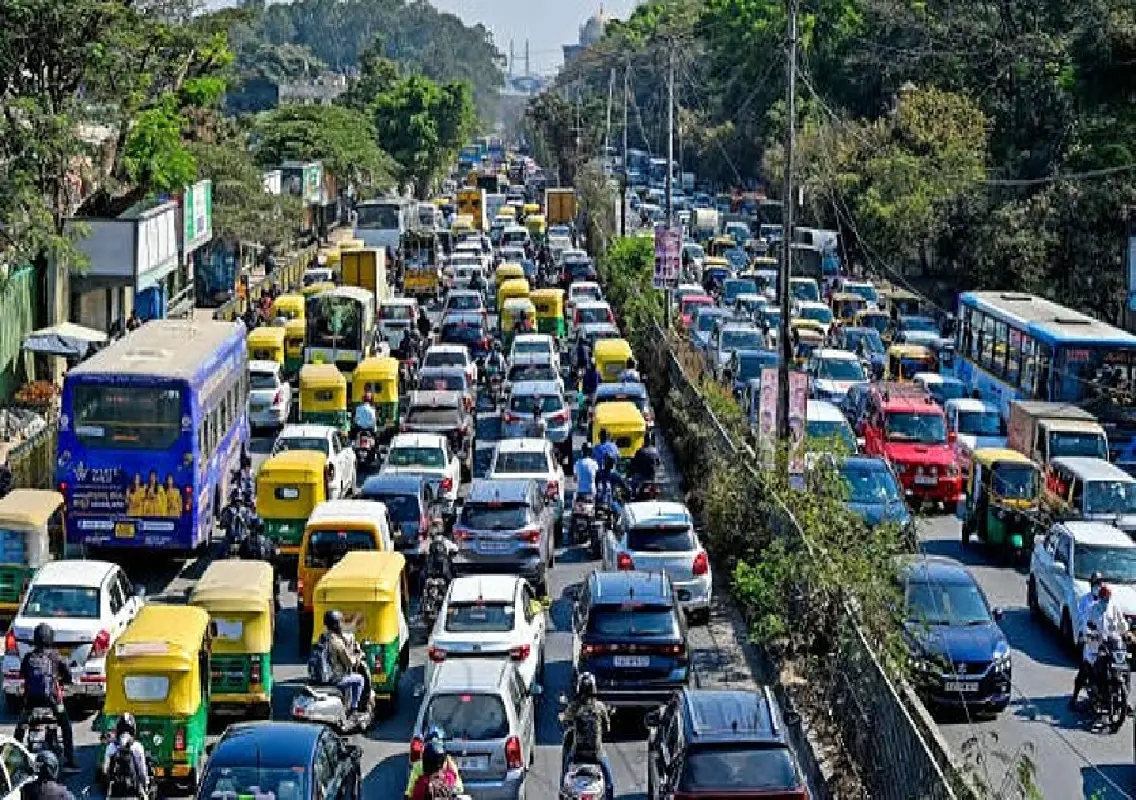


Bengaluru: The city’s ranking as the second most congested city in the world in the latest TomTom Traffic Index has sparked fresh debate, but local traffic authorities say real-time ground data presents a more optimistic picture. An internal analysis based on live mobility tracking suggests that peak-hour travel times are nearly 10% faster than what the global index indicates, prompting officials to question the sampling and methodology used in international congestion studies.
Police data vs global index figures
According to the latest Traffic Index published by TomTom, average peak-hour travel time for 10 km in the city stands at about 38 minutes. However, the city traffic police’s own analytics platform — the ASTraM mobility dashboard — reports a lower average of 34.5 minutes for the same distance during peak hours in 2025.
Officials said this translates to a measurable difference in commuter experience, especially across major corridors. The police analysis also estimates the average rush-hour speed at 18.2 kmph, compared to 15.8 kmph reported in the TomTom study.
Traffic authorities maintain that while congestion remains a serious challenge, the gap between global index estimates and locally validated data should be acknowledged in policy discussions.
How ASTraM collects traffic intelligence
The ASTraM platform used by the city traffic police aggregates real-time and historical movement data from multiple navigation and mapping providers, including Google Maps and MapmyIndia, in addition to TomTom feeds.
Traffic officials argue that because ASTraM combines multiple data streams, its sample size and coverage are broader and more representative of on-ground conditions across junctions and corridors.
Senior officers said app-specific indices may rely primarily on users of a single navigation platform, which could skew samples depending on geography, user profile, and trip type. In contrast, aggregated dashboards are designed to smooth out such bias and present a more balanced picture of traffic flow.
Peak-hour variability shows improvement
Traffic police data also points to improvement in peak-hour variability — a measure of how unpredictable commute times are during rush periods. According to officials, evening peak variability dropped from 17% in 2024 to 11% in 2025.
Authorities attribute this to faster incident response and tighter inter-departmental coordination. They said breakdown vehicles, fallen trees, flooded stretches, and accident obstructions are now being cleared more quickly than before, reducing prolonged choke points.
Continuous monitoring cells and coordinated control rooms have also helped speed up responses during heavy rain and infrastructure-related disruptions.
Government interventions and road works impact
Senior government officials said coordinated interventions by top state leadership — including Siddaramaiah and D. K. Shivakumar — pushed multiple departments to accelerate road repairs, pothole filling, and corridor upgrades.
They noted that earlier phases of large-scale road works had significantly slowed traffic flow, with dug-up stretches and poor road surfaces contributing to bottlenecks. With many of these works completed or streamlined after mid-2025, measurable improvements were observed in corridor speeds.
Both the police analysis and the TomTom index reportedly show that congestion levels moderated after July 2025, coinciding with targeted interventions and project clearances.
Measures credited for better flow
Officials listed several operational measures that helped contain further deterioration in commute times:
- Better signal synchronisation on major corridors
- Metro network expansion and feeder integration
- Faster breakdown and incident clearance
- Road surface quality improvements
- Predictive analytics-based traffic deployment
- Continuous junction monitoring
They emphasised that while travel time has increased year-on-year due to rising vehicle demand, the rate of deterioration has been contained through these steps.
Experts call for on-ground enforcement
Independent traffic experts say differences in measurement techniques can produce varying travel-time estimates, but the focus should remain on practical enforcement and street-level reforms.
They highlight unmanaged roadside parking, lane indiscipline, and bottleneck junction design as key contributors to congestion. Experts recommend stricter parking control, junction redesign, and bus-lane discipline as low-cost, high-impact interventions.
Authorities agree that congestion has not disappeared, but argue that blended data sources show the system has avoided a demand-driven collapse despite rapid vehicle growth. They say future gains will depend more on enforcement and behavioural compliance than on analytics alone.