







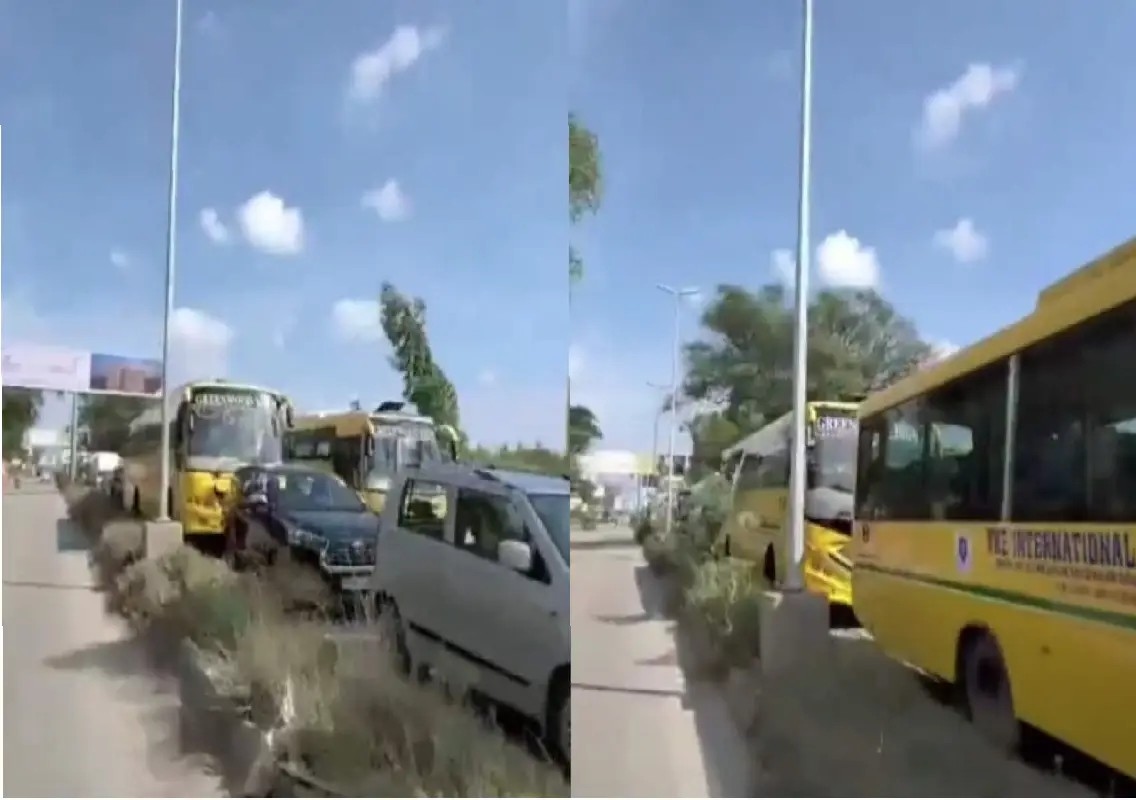


Bengaluru: Students returning home from schools in and around Varthur and Gunjur were caught in severe traffic congestion on Thursday evening, with parents reporting that several school buses took more than two hours to cover barely five to six kilometres.
The traffic chaos was reported along SH-35 near Gunjur on the stretch towards Varthur, where school buses were among the vehicles trapped in the long queues. The situation triggered concern among parents and residents, who said children were spending a significant part of their evenings on the road.
The episode has renewed concerns over traffic management and road infrastructure in Bengaluru‘s rapidly developing eastern suburbs, particularly along routes connecting Whitefield, Varthur and Gunjur.
Parents track school buses amid traffic gridlock
One parent, Ritish Reddy, CEO and co-founder of Zluri, went looking for his daughter after tracking the GPS location of her school bus.
Reddy filmed the traffic situation, with the footage showing several school buses and other vehicles stuck in the congestion.
Sharing his concerns on social media, he said that children travelling from Whitefield were spending more than two hours on what should ordinarily be a short five-kilometre journey.
The incident highlighted the difficulties faced by schoolchildren during peak evening hours, when school buses join the already heavy flow of private vehicles, commercial traffic and other commuters on the Varthur-Gunjur corridor.
According to details shared by parents in residents’ groups, the reported journey times on September 17 included:
- TISB to PLH: 6 km – 2 hours 15 minutes
- Inventure to PLH: 6 km – 2 hours 30 minutes
- Greenwood High: 5 km – 2 hours 30 minutes
- United World Academy: 5 km – 2 hours
The figures have raised concerns about the impact of prolonged traffic congestion on students, teachers, school staff and parents who use the same corridor.
Parents point to road conditions and bottlenecks
Residents have repeatedly raised concerns about the condition of Varthur Main Road, citing potholes, ongoing or delayed road works and bottlenecks as contributing factors behind the congestion.
A resident described the road as a major route used by thousands of people every day, connecting several residential communities with the Whitefield area.
According to the resident, several portions of the road have remained in poor condition for years, with potholes, loose gravel, dust, damaged or inadequate street lighting and maintenance-related issues adding to commuters’ difficulties.
The problems are reportedly more pronounced during the rainy season. Water-filled potholes and muddy stretches can make navigation slower and more difficult, particularly when traffic volumes are already high.
Residents have questioned why a road carrying large numbers of commuters and schoolchildren continues to face infrastructure and traffic-management challenges.
They have called for intervention to improve road conditions, remove bottlenecks and address safety concerns along the corridor.
School founder seeks immediate intervention
The situation has also drawn concern from the education community.
Nooraine Fazal, founder of Inventure Academy, said children and teachers spent as much as seven hours on the road travelling to school and returning home on Thursday.
“We desperately need help,” Fazal said, stressing that the traffic situation should not be viewed as a one-off incident.
She called for a combination of immediate traffic measures and longer-term investments to deal with Bengaluru’s growing mobility challenges.
Among the measures suggested by Fazal was restricting the movement of heavy vehicles on key roads during peak school hours. She also called for stricter enforcement against wrong-side driving and other traffic violations that can contribute to bottlenecks.
Another suggestion was to encourage school buses and shared transportation instead of individual vehicles, potentially reducing the number of cars using already congested roads during school and office peak hours.
Calls for real-time mobility planning
Fazal also highlighted the importance of using real-time mobility data to understand traffic patterns and identify solutions.
She suggested using simulation and “what-if” analysis to assess the impact of different school and office timings and determine arrangements that could reduce peak-hour congestion.
Such an approach, she said, could help stakeholders understand how changes in travel schedules, traffic restrictions and transportation patterns might affect the movement of vehicles across the city.
Along with long-term planning, she called for immediate repairs to potholes, blocked drains and other physical bottlenecks contributing to delays.
The Varthur-Gunjur area has witnessed substantial residential and commercial development, with multiple large communities and educational institutions operating along or near the corridor. The growing concentration of schools means that traffic conditions during school opening and closing hours have a direct impact on thousands of children and commuters.
Demand for long-term mobility solutions
The Thursday traffic situation has renewed the debate over how Bengaluru’s expanding eastern suburbs should manage increasing travel demand.
Residents and education-sector stakeholders have called for greater coordination between civic authorities, traffic agencies, schools and other stakeholders. They have also pointed to the need for better mass mobility and public transport connectivity as residential development continues to expand.
Immediate measures such as pothole repairs, clearing blocked drains, improving traffic enforcement and managing heavy vehicles could address some of the problems faced by commuters. However, the concerns raised by residents also point to broader questions about road capacity and transport planning in areas where development has grown faster than supporting infrastructure.
For parents, the immediate concern remains the amount of time children are spending inside school buses for relatively short journeys.
The traffic congestion on the Varthur-Gunjur stretch has therefore brought renewed attention to the need for coordinated action, combining short-term traffic management with improvements in road infrastructure, public transport and long-term mobility planning.