







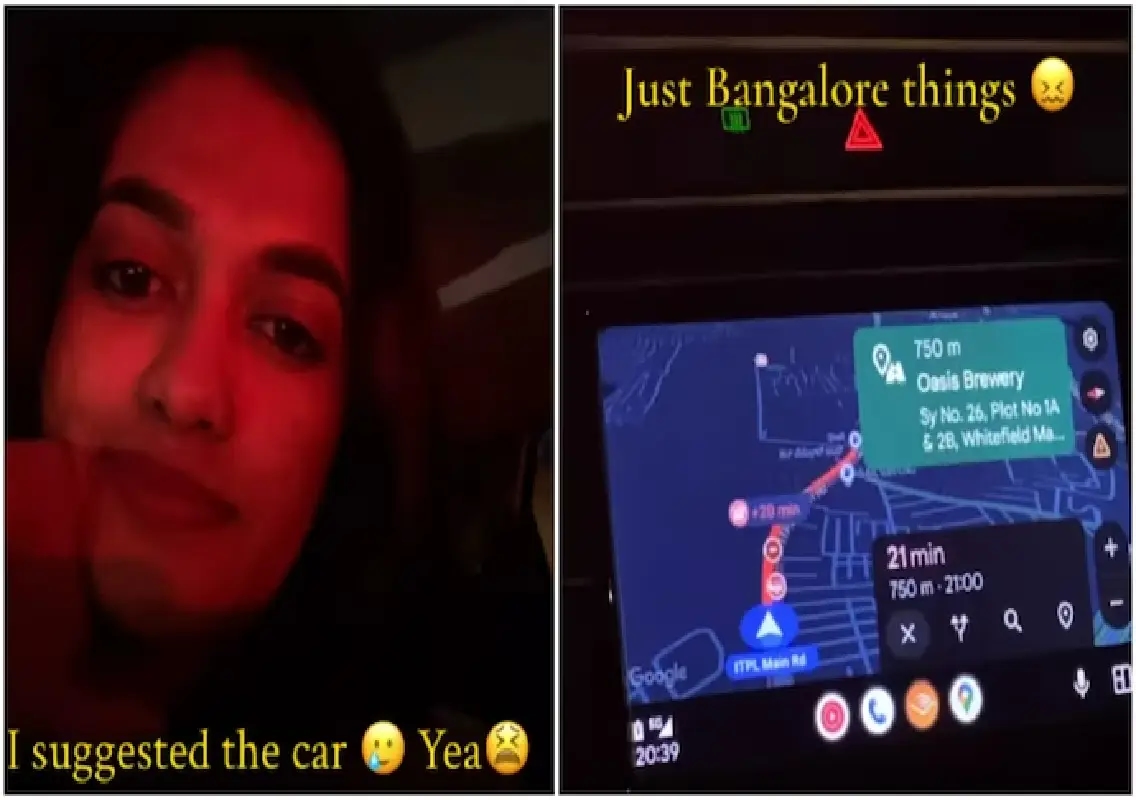


Bengaluru: A Bengaluru woman’s moment of disbelief after blindly trusting Google Maps and getting stuck in traffic for over 20 minutes for a distance of just 750 metres has gone viral on social media, resonating deeply with city residents who battle congestion daily.
The incident, shared on Instagram by a user named Anjali, has once again brought Bengaluru’s notorious traffic woes into the spotlight, with netizens calling it a “painfully accurate” snapshot of urban life in India’s tech capital.
A short distance, a long wait
The viral video, shot from inside a car at night, shows the vehicle’s infotainment screen illuminated with Google Maps navigation. What immediately catches attention is the estimated travel time of 21 minutes for a destination less than a kilometre away.
The map on the screen is flooded with red traffic indicators, diversion markers and frequent route recalculations, clearly indicating severe congestion. Warning lights glow on the dashboard as the car inches forward, if at all, capturing the frustration of being stuck in near-standstill traffic.
Overlay text on the video reads, “Just Bangalore things,” a phrase that instantly struck a chord with thousands of viewers who experience similar situations almost every day.
‘Me, after trusting Google Maps’
Anjali captioned the post with understated humour: “Me, after trusting Google Maps.” The simplicity of the caption, combined with the relatable visuals, helped the video gain traction quickly.
According to her post, what should have been a quick and effortless drive turned into an agonising wait, highlighting how even the shortest distances in Bengaluru can take an unreasonable amount of time to cover — especially during weekend nights, when traffic patterns become unpredictable due to dining, nightlife and events.
The video suggests that despite real-time navigation and traffic updates, apps like Google Maps are often unable to provide effective solutions in a city where congestion can build up suddenly due to roadworks, signal bottlenecks or minor accidents.
Social media users relate instantly
The comments section soon filled up with reactions from users who found the situation all too familiar. Many shared their own experiences of trusting navigation apps only to end up stuck in traffic for extended periods.
“German car on a Bangalore road on a weekend night, wow!” one user joked, poking fun at the contrast between premium vehicles and poor road conditions.
Another commenter quipped, “You should’ve just walked,” echoing a common sentiment among Bengalureans that walking short distances is often faster than driving.
Several users described the clip as an accurate representation of life in Bengaluru, where a commute of a few hundred metres can feel longer than an intercity journey.
Bengaluru traffic: a daily struggle
Bengaluru’s traffic congestion has long been a subject of public debate, memes and frustration. With rapid urbanisation, a growing population and vehicle numbers crossing 1 crore, the city’s infrastructure has struggled to keep pace.
Frequent roadworks, delayed flyover projects, metro construction and poor last-mile connectivity have worsened congestion in many areas. Weekend nights, in particular, see traffic spikes around commercial hubs, pubs and restaurants, often leaving navigation apps scrambling to keep up with real-time conditions.
Urban mobility experts note that while Google Maps and similar platforms rely on live data from users’ phones, sudden diversions, police barricades and temporary road closures are difficult to predict accurately, leading to situations like the one captured in Anjali’s video.
Humour masking a serious issue
While the viral post was shared in good humour, many users pointed out that it highlights a deeper problem affecting productivity, mental health and quality of life in the city.
“Traffic like this eats into personal time and increases stress. When 750 metres takes 20 minutes, something is fundamentally wrong,” commented one user.
Others said such experiences explain why Bengaluru consistently ranks among the most congested cities in India, despite its reputation as a global technology hub.
Why the video resonated
The clip’s popularity lies in its relatability. Almost every Bengalurean who drives has faced a similar situation — trusting navigation, hoping for a quicker route, and then watching the estimated arrival time creep up minute by minute.
The understated caption, lack of dramatic commentary and focus on the navigation screen allowed viewers to project their own experiences onto the video, making it widely shareable.
Conclusion
Anjali’s viral Instagram post may have been meant as a light-hearted observation, but it has once again underlined the everyday frustrations faced by Bengaluru’s commuters. As the city continues to grow, residents hope that better planning, faster infrastructure completion and smarter traffic management will one day ensure that a 750-metre drive no longer feels like a road trip. Until then, trusting Google Maps in Bengaluru remains an act of faith — often followed by regret.