


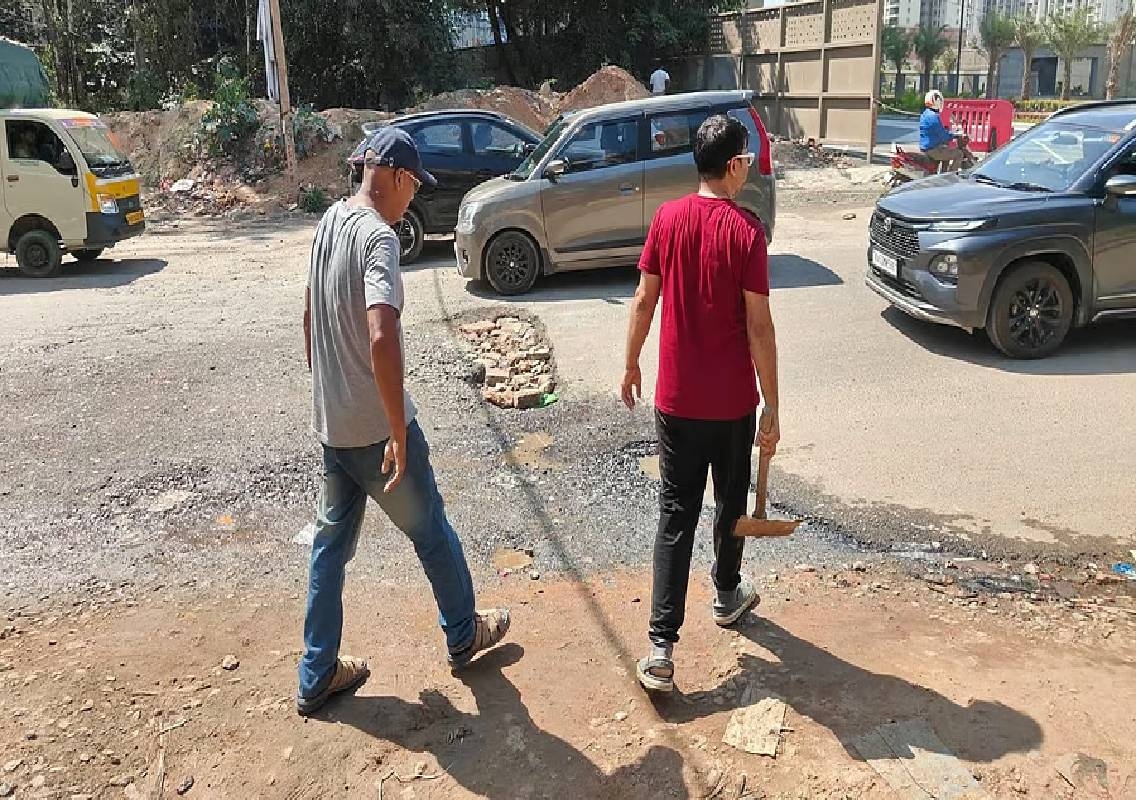


Bengaluru: Rapid urbanisation along the Varthur-Gunjur corridor in east Bengaluru has put growing pressure on roads and civic infrastructure, with severe traffic congestion increasingly affecting residents, schoolchildren and daily commuters.
The 10-km stretch along State Highway 35 (SH-35), connecting parts of Varthur, Gunjur and the wider Sarjapur-Dommasandra belt, has witnessed substantial residential and commercial development over the past decade. However, road expansion and supporting infrastructure have struggled to keep pace with the increase in population and traffic.
The situation has become particularly visible in recent weeks, with reports of school buses taking hours to cover only a few kilometres and authorities imposing temporary restrictions on heavy vehicles during school hours.
School commute exposes infrastructure pressure
The impact of the congestion was highlighted after schoolchildren travelling along the Varthur-Gunjur stretch reportedly spent as much as 2.5 hours covering just 4 km during a particularly congested day.
The corridor is home to numerous schools, and parents have complained that children are spending substantial portions of their day travelling between home and school. Traffic delays have also affected students appearing for examinations, with some schools reportedly having to accommodate late arrivals.
A study by Inventure Academy found that the average daily travel time for its school buses between Dommasandra Circle and Varthur Kodi had increased by 22% over two years, from 92 minutes in 2024-25 to 112 minutes in 2026-27.
The study covered a corridor serving 42 schools, more than 1,000 buses and over 40,000 bus users. It recorded average afternoon bus speeds of just 9.2 kmph, with the slowest routes falling to 6.4 kmph.
Multiple bottlenecks add to the problem
The traffic crisis is not limited to one junction. Dommasandra Circle, Gunjur, Varthur Kodi, Vibgyor Road-Kundalahalli and Gran Carmen have been identified as critical bottlenecks requiring intervention.
The school transport study attributed delays to a combination of congestion, narrow or damaged roads, potholes, standing water, debris, unfinished construction and diversions.
In some locations, buses have reportedly been forced to use unpaved stretches when the main road becomes severely congested. The situation is particularly difficult during afternoon hours when school traffic combines with office and commercial traffic.
The problem is compounded by the fact that the corridor serves a rapidly expanding residential population as well as employees travelling towards Whitefield, Outer Ring Road and other employment centres in east Bengaluru.
Infrastructure projects face delays
Several infrastructure projects have been planned or taken up to improve connectivity along the corridor. However, delays in construction and land acquisition have contributed to continuing bottlenecks.
An elevated corridor between Varthur and Gunjur has been under consideration for several years. A traffic-police officer cited by The Indian Express pointed to pending work on the corridor as one of the factors contributing to the current situation.
Road-widening and other works have also faced challenges involving land acquisition and the shifting of electricity infrastructure.
At a recent review meeting, Bengaluru Development Minister Krishna Byre Gowda directed officials to prioritise pothole repairs and damaged stretches between Brigade developments and Gunjur, including Varthur-Kodi Road. Officials also discussed delays in shifting electricity poles and infrastructure, which have affected road works.
Heavy vehicle restrictions introduced
With schoolchildren particularly affected by congestion, traffic authorities have moved to restrict heavy goods vehicles along parts of the Varthur-Gunjur stretch during school hours.
The measure is intended to reduce the interaction between heavy vehicles and school traffic during peak commuting periods. Officials have also discussed alternative routes and changes to traffic regulations to improve movement.
However, traffic restrictions alone may not address the underlying infrastructure constraints if road capacity remains inadequate for the volume of vehicles using the corridor.
Rapid development and limited road capacity
The Varthur-Gunjur situation illustrates the challenges faced by rapidly expanding parts of Bengaluru, where residential construction and population growth can advance faster than roads, drainage, public transport and other civic systems.
As apartment communities and commercial developments expand, the number of private vehicles, school buses, delivery vehicles and goods carriers using existing roads also increases.
The result is greater pressure on junctions and stretches that were originally designed to handle considerably lower traffic volumes.
The recent traffic episodes have therefore shifted attention from individual traffic jams to the broader question of how urban development is being matched with infrastructure capacity.
Authorities under pressure to deliver improvements
The recent public concern has prompted greater scrutiny of ongoing road projects. Residents have called for faster completion of pending works, better traffic management and more effective coordination between agencies responsible for roads, electricity and civic services.
The Karnataka Road Development Corporation is involved in infrastructure works on the SH-35 corridor, while several other agencies are responsible for different components of the road and utility network.
Officials have also inspected parts of the corridor following the recent congestion and discussed measures such as pothole repairs, heavy-vehicle restrictions and alternative traffic routes.
For residents, however, the immediate concern remains the reliability of daily travel. A short-distance journey that takes hours can affect school attendance, working hours and access to essential services.
Conclusion
The Varthur-Gunjur corridor has emerged as a prominent example of the infrastructure challenges accompanying Bengaluru’s rapid urban expansion. While road projects and traffic measures are being pursued, the recent congestion shows the pressure created when population and vehicle growth outpace transport infrastructure.
The experience of the corridor also highlights the need for infrastructure planning to keep pace with urban development, particularly in fast-growing residential areas where schools, workplaces and housing projects are concentrated.