







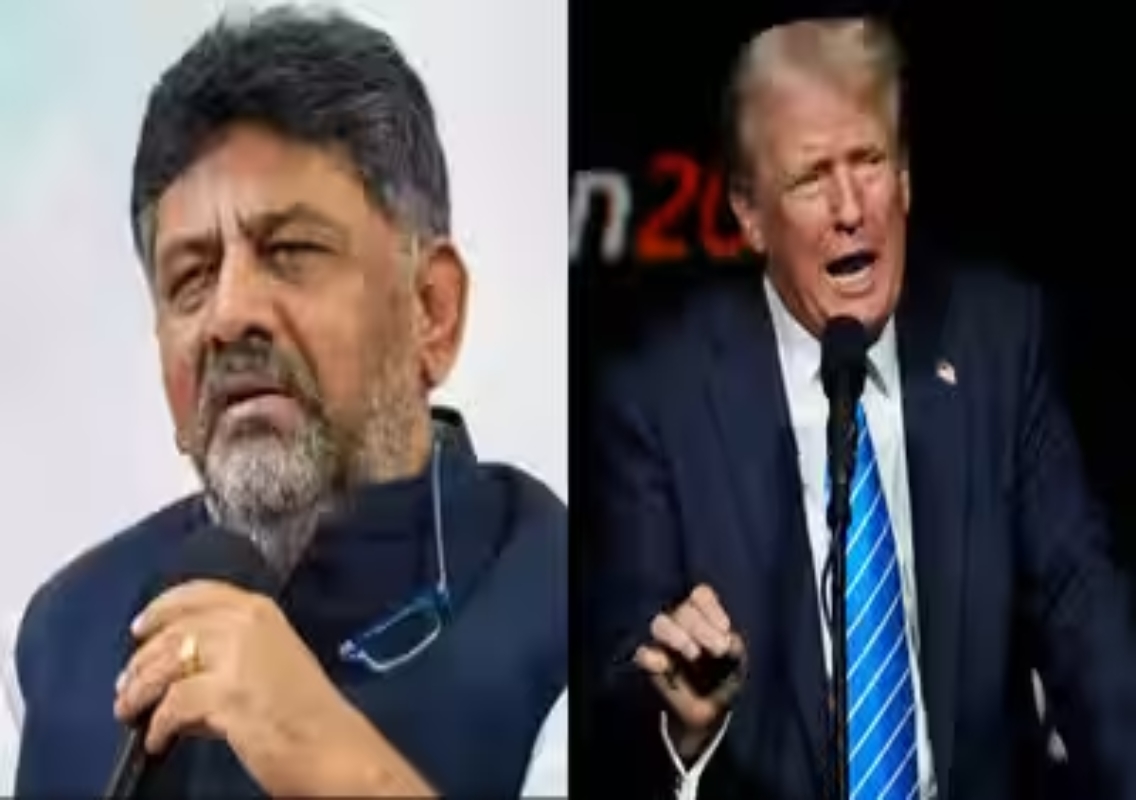


Bengaluru: Karnataka Deputy Chief Minister D K Shivakumar has claimed that the Congress government’s guarantee schemes have become so influential that even US President Donald Trump is now following a similar welfare approach.
Speaking in Bengaluru on Monday, Shivakumar described the Congress government’s welfare guarantees as a “blockbuster” and said several states had adopted schemes similar to those introduced by the Congress government in Karnataka. He also drew a comparison with Trump’s recent proposal to provide $5,000 to every adult American if Republicans retain control of both chambers of Congress in the November midterm elections.
“Now they copied us in Maharashtra, copied us in Madhya Pradesh, in Rajasthan, in Bihar, and now Trump is copying us,” Shivakumar said, referring to the US President. He said the developments demonstrated what he described as the strength and popularity of the Congress model.
Shivakumar highlights Karnataka’s five guarantees
The Congress government’s welfare strategy in Karnataka centres on five major guarantees introduced after the party came to power in 2023.
These include Gruha Jyothi, which provides free electricity up to 200 units to eligible households; Gruha Lakshmi, under which women heads of eligible families receive ₹2,000 per month; Anna Bhagya, which provides foodgrain support to eligible BPL families; Shakti, which allows women to travel free on eligible state-run buses; and Yuva Nidhi, which provides financial assistance to eligible unemployed graduates and diploma holders.
The schemes have become a major political plank for the Congress in Karnataka. According to figures cited in state-level reports, the government had spent more than ₹1.2 lakh crore on the five guarantees by February 2026. The government has also been reviewing beneficiary lists to identify and remove ineligible recipients.
Recent figures indicate the scale of the programmes. Gruha Lakshmi had around 1.24 crore beneficiaries, while Gruha Jyothi covered around 1.64 crore households. The Shakti scheme had also recorded hundreds of crores of free bus journeys by women.
For the Congress, the guarantees have been presented as a direct welfare intervention aimed at reducing household expenses and providing financial support to women, families, students and unemployed youth.
What is Trump’s $5,000 ‘dividend’?
Trump’s proposal is centred on a $5,000 payment to every adult US citizen if Republicans retain control of the House of Representatives and Senate in the upcoming midterm elections.
Trump first announced the proposal at a Republican midterm convention in Dallas earlier this month. He described the payment as a “Trump dividend” and said his administration’s revenues, including money generated through tariffs, would make the payments possible. He later reiterated the proposal while speaking in Ireland, saying the government could afford the payments if Republicans win.
The proposal, however, has not yet become an approved government programme. US House Speaker Mike Johnson has said congressional approval would be required before such payments could be made. Questions have also been raised about the cost and funding mechanism.
With roughly 270 million adults in the United States, a $5,000 payment to every eligible adult could involve a cost of about $1.35 trillion, according to Reuters.
Trump has not provided a detailed implementation framework covering eligibility, timing or the precise mechanism through which the proposed payments would be funded.
Shivakumar sees parallel with Congress welfare politics
Shivakumar’s comparison comes as the Congress government continues to defend its guarantee schemes against criticism over their fiscal cost and implementation.
The Karnataka government has argued that the programmes provide tangible benefits to households. At the same time, authorities have begun efforts to remove ineligible beneficiaries and reduce leakages from the schemes.
In June, Shivakumar directed officials to take action against misuse of the guarantees while ensuring that genuine beneficiaries were not inconvenienced. The state budget had recorded expenditure of ₹1,21,598 crore on the five guarantees up to February 2026.
The government has also faced political criticism over whether welfare spending can be sustained while maintaining allocations for infrastructure, development and other sectors. The debate has increasingly become part of Karnataka’s political discourse ahead of the 2028 Assembly election.
For Shivakumar, however, the continued political appeal of the guarantees is evidence that the Congress has established a model that other governments are willing to emulate.
Political message ahead of Karnataka’s 2028 election
Shivakumar’s remarks also carry significance in the context of Karnataka politics. The Congress is expected to make its welfare record a central part of its campaign narrative for the next Assembly election.
The Deputy Chief Minister has previously maintained that the guarantees were an important part of the Congress victory in 2023. The party is now seeking to demonstrate that the schemes have delivered measurable benefits while simultaneously addressing concerns about ineligible beneficiaries and financial sustainability.
By linking Karnataka’s welfare programmes with Trump’s proposed US payment, Shivakumar has sought to frame the Congress guarantees as part of a broader global trend towards direct economic assistance to citizens.
However, the two proposals are not identical. Karnataka’s guarantees consist of targeted welfare measures covering electricity, food, public transport, women’s financial assistance and unemployment support. Trump’s proposal, in contrast, is a proposed one-time $5,000 payment to American adults conditional on an electoral outcome and would require congressional approval.
Congress uses welfare model as political calling card
Shivakumar’s statement underscores how strongly the Congress leadership continues to associate Karnataka’s political success with its guarantee schemes.
Whether other states have genuinely replicated Karnataka’s model, and whether Trump’s proposal can be considered comparable, is likely to remain a matter of political debate. For now, the comparison reflects the Congress government’s confidence in its welfare agenda and its attempt to position Karnataka’s guarantee schemes as a model with influence beyond the state.
With the 2028 Karnataka election still ahead, the five guarantees are likely to remain at the centre of the Congress’s political messaging, while questions over expenditure, eligibility and long-term sustainability will continue to shape the debate.