







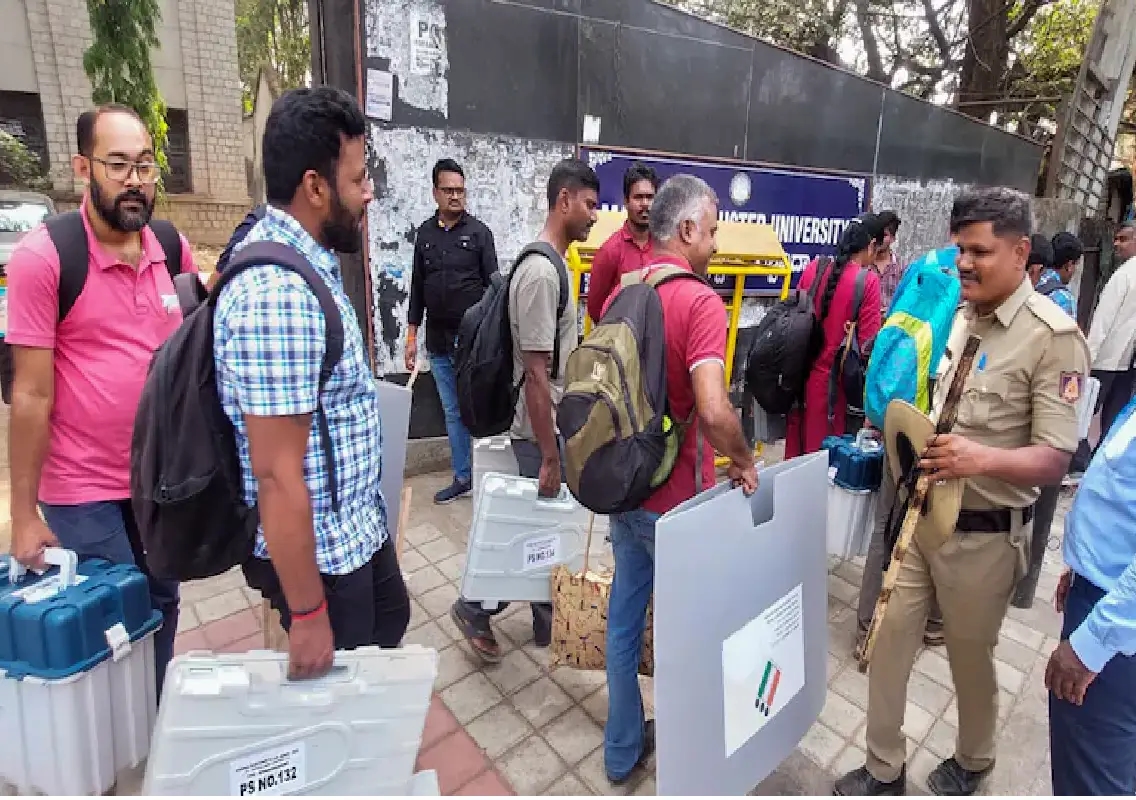


Bengaluru: The Karnataka State Election Commission has indicated that elections to the Greater Bengaluru Authority (GBA) are likely to be held after May 25 and will be conducted using ballot papers instead of Electronic Voting Machines (EVMs). The announcement has reignited political debate in the state, particularly between the ruling Congress and the opposition BJP, over the mode of voting in civic elections.
Karnataka Chief Election Commissioner G S Sangreshi clarified the commission’s position, stating that the decision to use ballot papers is well within the powers of the State Election Commission and is in accordance with existing legal provisions. The clarification comes in the backdrop of sustained objections by the Congress party at both the state and national levels over the use of EVMs, which were deployed in the previous Bengaluru civic polls.
Stand of the Election Commission
Explaining the preparations for the upcoming polls, Sangreshi said the commission is currently undertaking a Special Intensive Revision (SIR) of electoral rolls for the GBA elections. “For this SIR, we are also doing the same process only. We are correcting the list, their names, and details,” he said, emphasising that the revision exercise follows established norms.
On the use of ballot papers, Sangreshi categorically stated that there is no legal prohibition. “These GBA polls will be conducted through ballot papers. The Supreme Court has also said there is nothing wrong with using ballot papers. In GBA also, there is a provision to use it,” he said.
He further underlined the autonomy of the State Election Commission, drawing a parallel with the Election Commission of India (ECI). “The ECI takes its decision; in the same way, the State Election Commission also takes the decision. It will be a hundred per cent success,” Sangreshi said.
Ballot papers not outdated, says Sangreshi
Addressing criticism that ballot papers are outdated, Sangreshi pointed out that several developed countries continue to use paper ballots. “This is not banned. We are doing it. Even developed countries like the USA conduct elections using ballot papers. Only MLA and MP elections are conducted using EVMs,” he said.
Election officials indicated that the choice of ballot papers is aimed at ensuring transparency and public confidence in the electoral process, especially for large-scale local body elections such as those under the GBA.
BJP targets Congress over decision
Soon after the announcement, the BJP launched a sharp attack on the Congress, accusing it of adopting a contradictory stand on voting technology. BJP spokesperson Prakash S said, “It was Rajiv Gandhi who introduced EVMs for polls. But the Congress party, in order to impress Rahul Gandhi, is resorting to ballot papers for local body polls. Whether it is EVM or ballot paper, the defeat of Congress is sure.”
The BJP has maintained that EVMs are reliable and that repeated doubts raised by the Congress undermine democratic institutions. Congress leaders, however, have consistently argued that ballot papers inspire greater public trust, particularly in local body elections.
Draft electoral rolls published
Alongside the announcement on the election mode, the State Election Commission has published ward-wise draft electoral rolls for the five city municipal corporations that come under the GBA framework.
A total of 369 wards have been constituted across Bengaluru Central, Bengaluru North, Bengaluru South, Bengaluru East and Bengaluru West city municipal corporations. Officials said the draft electoral rolls are available at the offices of District Election Officers, commissioners of the five city municipal corporations, Electoral Registration Officers, Assistant Electoral Registration Officers, and all polling stations within the respective limits. The rolls are also accessible on the official website of the commission.
Timeline for claims and objections
The period for filing claims and objections to the draft electoral rolls has been fixed from January 20 to February 3. Disposal of claims and objections will be undertaken between February 4 and February 18, 2026. The final electoral rolls are scheduled to be published on March 16.
Political parties have been requested to appoint one booth-level agent for each polling station in every ward to assist election officials in the verification process during the revision exercise.
Voter statistics across corporations
According to the draft voter list, the Greater Bengaluru Authority has a total of 88,91,411 voters. This includes 45,69,193 male voters, 43,20,583 female voters and 1,635 voters in the ‘others’ category.
Bengaluru Central City Municipal Corporation comprises 63 wards, with 1,305 polling stations and 14,25,483 voters. Bengaluru North City Municipal Corporation has 72 wards, 1,716 polling stations and 19,54,206 voters. Bengaluru South City Municipal Corporation consists of 72 wards, 1,614 polling stations and 17,44,270 voters. Bengaluru East City Municipal Corporation has 50 wards, 916 polling stations and 10,41,738 voters.
Bengaluru West City Municipal Corporation has the highest number of wards at 112 and a voter strength of 27,25,714. Among all wards, ward number 23 of Bengaluru West City Municipal Corporation has the highest number of voters at 49,530, while ward number 16 of Bengaluru East City Municipal Corporation has the lowest number with 10,926 voters.
Conclusion
With the State Election Commission signalling that the GBA elections will be held after May 25 using ballot papers, political activity in Bengaluru is expected to intensify in the coming months. While the Congress has welcomed the decision as a step towards greater transparency, the BJP has criticised it as politically motivated. As the electoral roll revision progresses and preparations gather pace, the focus will now shift to the final schedule announcement and the contours of what is likely to be a keenly contested civic election in India’s largest metropolitan region.