







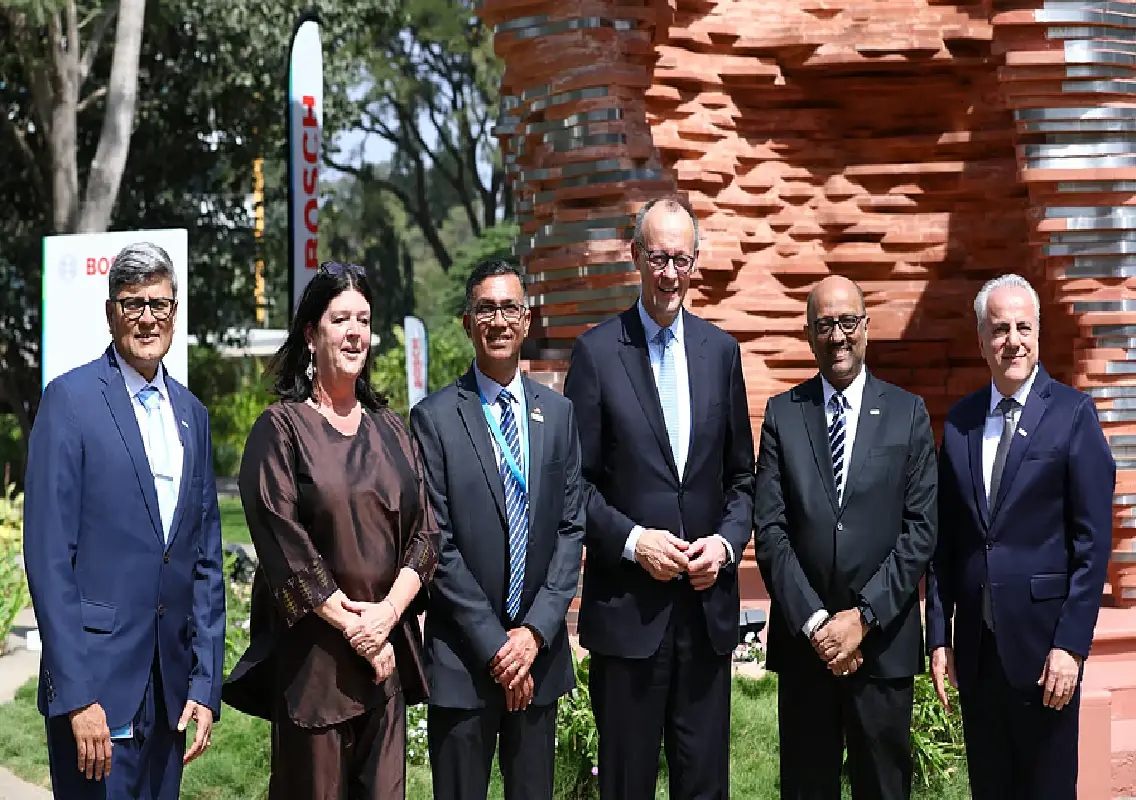


Bengaluru: German Chancellor Friedrich Merz on Tuesday visited the Bosch campus at Adugodi in Bengaluru as part of his official trip to India, underscoring the deepening economic and technological partnership between the two countries. The visit highlighted Germany’s strong industrial presence in India and Bosch’s growing role in advanced software, artificial intelligence and sustainable mobility solutions.
The German Chancellor was received at the Bosch India headquarters by Guruprasad Mudlapur, Managing Director of Bosch Limited and President of the Bosch Group in India. Senior executives of Bosch and members of the German delegation were also present during the visit, which focused on innovation, digital technologies and clean mobility initiatives.
Showcasing advanced software and AI solutions
During the visit, Bosch officials introduced Chancellor Merz to a range of cutting-edge software solutions developed by the company in India. A key highlight was AIShield, Bosch’s proprietary artificial intelligence security solution designed to ensure the protection, robustness and reliability of AI systems.
According to Bosch, AIShield incorporates more than 150 patents related to AI security and is aimed at safeguarding AI models against risks such as data manipulation, bias and cyber threats. The solution is part of Bosch’s broader efforts to develop trustworthy and secure AI technologies for global applications.
Officials said the presentation demonstrated India’s growing capabilities not only as a manufacturing base but also as a global hub for high-end software development and digital innovation.
Bosch leadership welcomes Chancellor
Expressing his appreciation for the visit, Guruprasad Mudlapur said Bosch was honoured to host the German Chancellor at its India campus. “We feel honoured to welcome the esteemed Federal Chancellor, Friedrich Merz, to the Bosch India campus. His presence not only affirms Bosch’s enduring legacy but also reinstates India’s position in the world as a hub of technological innovation and economic growth,” he said.
Mudlapur added that the visit was a moment of pride for Bosch India and reflected the strong partnership between India and Germany, particularly in the areas of technology, manufacturing and sustainable development.
Focus on hydrogen and sustainable mobility
As part of the visit, Chancellor Merz and the accompanying delegation experienced Bosch’s H2ICE demonstrator truck, which features a fully integrated powertrain and telematics system. The hydrogen internal combustion engine (H2ICE) technology is part of Bosch’s push towards zero-emission and sustainable mobility solutions.
Bosch India, in collaboration with Bosch Germany, is actively working on hydrogen-based technologies as part of the global transition towards cleaner energy and reduced carbon emissions. Company officials said hydrogen mobility could play a crucial role in decarbonising heavy transport and complementing electric mobility solutions.
The demonstration highlighted Bosch’s end-to-end capabilities, ranging from hardware and powertrain systems to digital connectivity and data-driven telematics solutions.
Strengthening India–Germany economic ties
In a statement, Bosch said the Chancellor’s visit underscored the deep economic and technological ties between India and Germany, particularly in sectors such as mobility, manufacturing, automation and innovation. The company noted that German enterprises have played a significant role in India’s industrial growth story over the decades.
Observers said the visit also aligned with broader discussions between the two governments on strengthening bilateral cooperation in technology, skills development and clean energy, areas where Bosch has a strong footprint.
Bosch’s long-standing presence in India
The Bosch Group has been operating in India since 1951 and has steadily expanded its presence across the country. Today, Bosch operates through 14 companies in India, with a wide footprint spanning manufacturing, research and development, and application centres.
The company has established 17 manufacturing sites and seven development and application centres across India, catering to both domestic demand and global markets. Bosch India is also a major employer, with a strong focus on engineering talent, software development and advanced manufacturing skills.
Financial performance and workforce strength
According to company data, Bosch reported net revenue of ₹37,345.7 crore in the financial year 2024–25. The company earned revenue from operations amounting to ₹18,087 crore in FY25, reflecting its diverse business portfolio across automotive technology, industrial technology, consumer goods and energy solutions.
As of March 31, 2025, Bosch employed 38,655 associates in India, making it one of the largest German employers in the country. A significant portion of its workforce is engaged in research, software engineering and innovation-led roles, supporting Bosch’s global operations.
Bengaluru as a technology hub
The visit also reinforced Bengaluru’s status as a global technology and innovation hub. With a strong ecosystem of multinational companies, start-ups and research institutions, the city continues to attract global leaders and policymakers.
Industry experts noted that Bosch’s Bengaluru campus plays a key role in the company’s global software and digital strategy, contributing to AI, mobility solutions and Industry 4.0 initiatives.
Conclusion
German Chancellor Friedrich Merz’s visit to the Bosch India campus in Bengaluru marked an important moment in India–Germany relations, highlighting shared priorities in innovation, sustainable mobility and digital transformation. By showcasing advanced AI security solutions and hydrogen mobility technologies, Bosch reaffirmed India’s growing role in global technology development. The visit not only celebrated Bosch’s long-standing presence in India but also pointed to a future of deeper collaboration between the two nations in shaping sustainable and technology-driven growth.