







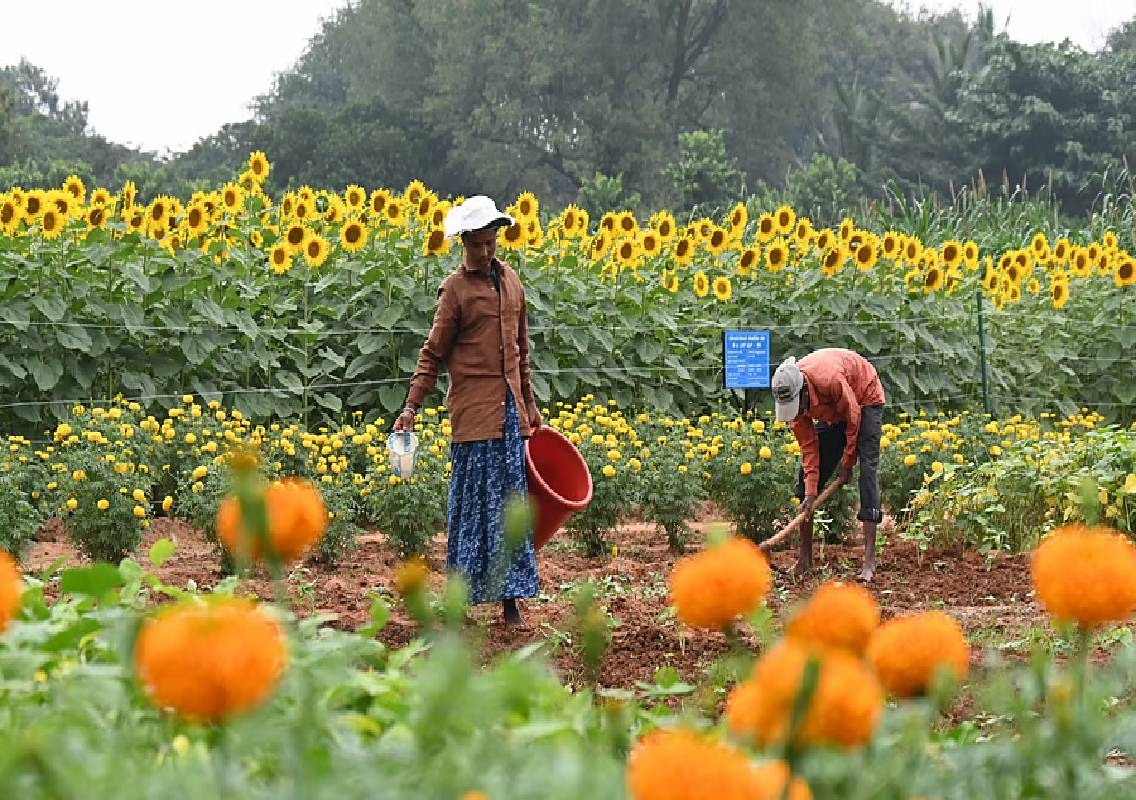


Bengaluru: The annual Krishi Mela at Gandhi Krishi Vignana Kendra (GKVK) in Bengaluru has been reduced from four days to one day this year amid the severe drought affecting large parts of Karnataka. The University of Agricultural Sciences-Bengaluru (UAS-B) has decided to hold the 2026 agricultural fair on November 13 instead of conducting the event over four days as originally planned.
The decision comes as inadequate rainfall has affected agricultural activity across the state, including areas covered by the university. According to the latest report, 34 of the 36 taluks across the six districts under the university’s jurisdiction have been declared drought-hit.
Four-day mela reduced to one day
Krishi Mela is one of the major annual agricultural events organised by UAS-B at its GKVK campus in Bengaluru.
The event traditionally brings together farmers, agricultural scientists, government agencies, companies, self-help groups and agri-technology providers. Demonstrations of crops, farm machinery, irrigation techniques and new agricultural technologies form an important part of the programme.
The 2026 edition was initially planned as a four-day event in November. However, the drought situation has prompted the university to substantially reduce the duration.
The latest decision is to conduct the mela for one day on November 13. The move is intended to reflect the difficult agricultural conditions prevailing in the state rather than proceed with a full-scale four-day programme during a year of significant rainfall deficiency.
The university’s website continues to show November 12-15 as the four-day schedule, indicating that its online event information has not yet been updated to reflect the latest reported decision.
Drought affects agricultural activity
The reduction in the duration of the Krishi Mela comes against the backdrop of widespread drought in Karnataka.
The latest drought assessments have resulted in a large number of taluks being officially classified as drought-affected. A September 22 government notification declared 53 additional taluks drought-hit for the Kharif 2026 season, based on assessments by the Karnataka State Natural Disaster Monitoring Centre (KSNDMC) and ground-truthing exercises. Of these, 51 were classified as severely drought-affected and two as moderately affected.
The drought declarations have continued as the Kharif season progressed. Recent reports indicate that 217 of Karnataka’s 240 taluks have now been declared drought-hit.
Deputy Chief Minister and Revenue Minister G. Parameshwara has said crop losses assessed in 177 taluks were estimated at around Rs 46,000 crore, while the overall loss could reach Rs 50,000 crore to Rs 60,000 crore after assessments in additional drought-hit areas are completed.
34 of 36 taluks under university jurisdiction affected
The drought has particularly influenced the decision at UAS-B because a large majority of the taluks in the university’s jurisdiction are facing drought conditions.
According to the latest report, 34 of the 36 taluks across the six districts covered by UAS-B have been declared drought-affected. The situation has affected agricultural activity, with normal sowing and cultivation disrupted in several areas.
The conditions also create challenges for conducting the type of field demonstrations that are normally a major attraction at Krishi Mela.
The GKVK campus traditionally hosts crop demonstrations and displays that allow farmers to see different varieties and agricultural practices. Water availability is therefore an important factor in preparing demonstration plots.
With rainfall deficient and cultivation affected, the university has chosen to scale down the event this year.
Krishi Mela is a major farmer event
The GKVK Krishi Mela normally attracts farmers and members of the public from across Karnataka.
The 2025 edition, for example, drew more than 54 lakh visitors over four days and featured more than 750 stalls. The event generated business worth about Rs 4.77 crore, highlighting the scale of the annual agricultural fair.
The mela provides farmers with access to agricultural scientists, crop varieties, farm machinery manufacturers, nurseries, self-help groups and farmer-producer organisations.
It also serves as a platform for universities and research institutions to showcase technologies and practices intended to improve farm productivity.
Reducing the 2026 event to one day therefore represents a significant change from the scale of previous editions.
Focus likely to remain on agricultural information
Despite the shorter duration, the one-day event is expected to retain its focus on farmers and agricultural knowledge.
The university has previously used the Krishi Mela to demonstrate climate-smart farming practices, organic farming, soilless cultivation, agricultural machinery, agritourism and other emerging opportunities in agriculture. The 2026 event’s announced theme is “Diversified Agriculture: Next Generation.”
The focus on diversification could be particularly relevant during a drought year, when farmers face greater uncertainty over water availability and crop selection.
Information on water-efficient cultivation, alternative crops, improved farm practices and technologies could help farmers respond to changing weather and rainfall conditions.
Decision comes amid wider farmer distress
The drought has created pressure on farmers across Karnataka, with crop-loss assessments underway in several districts.
The state government has been monitoring drought conditions through KSNDMC assessments, and the Revenue Department has directed authorities in drought-affected taluks to undertake crop-loss surveys and implement relief measures under applicable norms.
Against this backdrop, holding a shorter agricultural fair could also reduce the logistical requirements involved in maintaining a large demonstration area and hosting a very large gathering over several days.
The decision does not mean that agricultural outreach is being discontinued. Instead, the latest report indicates that the university will concentrate the programme into a single day.
Previous drought years have affected Krishi Mela
The GKVK Krishi Mela has faced disruptions during earlier drought years as well.
In 2017, a severe drought forced UAS-B to call off its regular Krishi Mela after water scarcity affected crop demonstration plots on the GKVK campus. The university had noted at the time that it did not have sufficient water to cultivate the crops normally displayed to farmers.
The 2026 decision is different because the event has not been completely cancelled. Instead, the university has chosen to retain the mela in a much shorter format.
This will allow farmers and visitors to continue accessing agricultural information and exhibits while acknowledging the difficult conditions facing the farming community.
One-day event set for November 13
The revised plan means that farmers and visitors planning to attend the GKVK Krishi Mela will need to plan for a single-day programme on November 13.
The change is also significant for exhibitors and organisations that normally participate across the four-day event. Further details on the final programme, stalls and demonstrations are expected to be clarified by UAS-B as preparations continue.
For now, the latest reported decision is that the four-day agricultural fair will be limited to one day because of the drought situation.
Conclusion
The 2026 GKVK Krishi Mela in Bengaluru has been reduced from four days to one day amid severe drought conditions across Karnataka. UAS-B has decided to hold the event on November 13, with the change coming as 34 of the 36 taluks under its jurisdiction have reportedly been declared drought-hit. While the university’s website still lists the earlier November 12-15 schedule, the latest report indicates that the mela will now be conducted as a one-day event.