







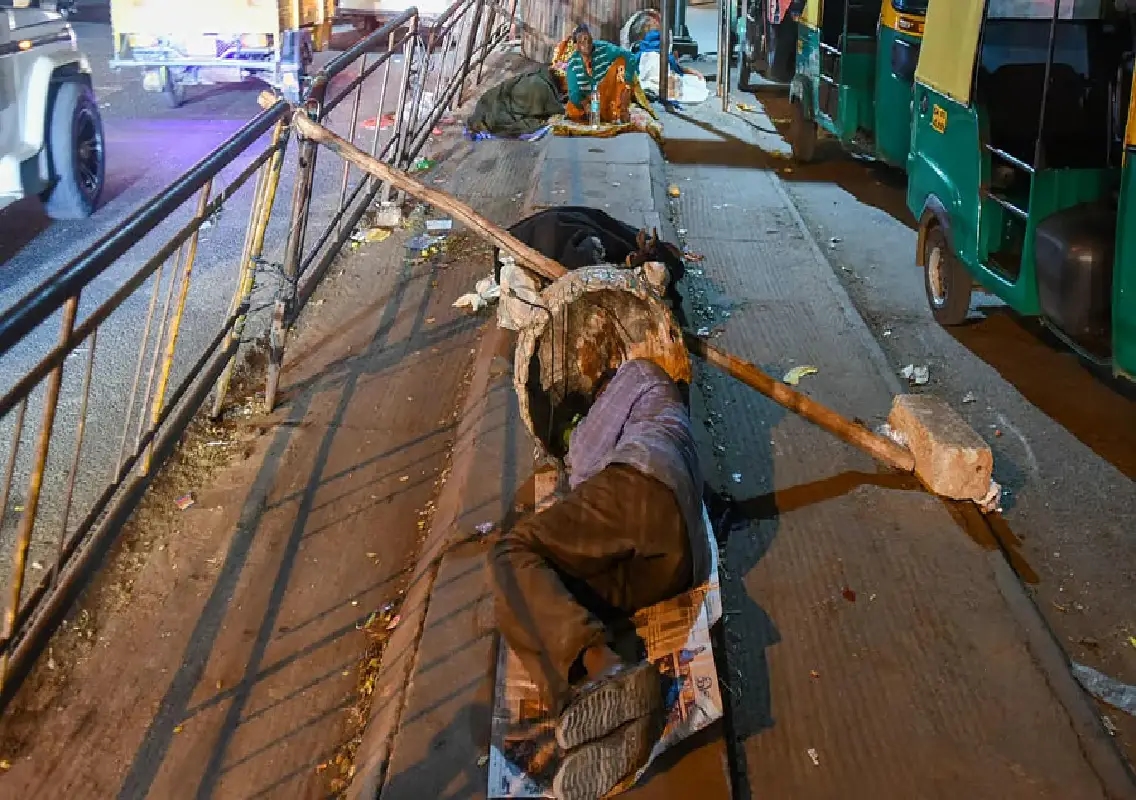


Bengaluru: Invisible amid the city’s crowded pavements and relentless traffic, thousands of homeless people continue to endure Bengaluru’s biting winter cold without adequate shelter, food or security. From Gandhinagar and K R Market to Yeshwanthpur and the City Railway Station area, transit points and commercial hubs have become night-time resting places for men and women who have nowhere else to go.
As temperatures dip, the pavements turn into makeshift bedrooms, exposing the homeless to hunger, illness, violence and neglect. While individuals and non-governmental organisations (NGOs) step in sporadically with food and blankets, activists say the city’s night shelter system has failed to address the scale and dignity of homelessness.
Life on pavements in the winter chill
Gandhinagar, K R Market, Yeshwanthpur, Cantonment and Majestic are among the areas where homeless people are most visible after sunset. Many are migrant labourers and daily wage workers who come to Bengaluru in search of work but end up sleeping on the streets when employment dries up.
Suroj Ali, a member of the NGO Humanity is Religion, said his organisation has distributed more than 500 blankets across Bengaluru this winter. “Most of them are migrant labourers and daily wagers. Some are also alcohol-dependent. They try to cover themselves as much as possible, but this cold can easily make anyone sick,” he said.
Despite such efforts, the need far outweighs the supply. Activists warn that winter illnesses and deaths among the homeless remain underreported, especially among the elderly and the sick.
Why many avoid night shelters
Bengaluru has night shelters meant to provide refuge to the homeless, yet pavements remain full while many shelters are reportedly underutilised. According to officials and shelter caretakers, one reason is that some homeless people refuse to move into shelters.
A source associated with shelter management said, “On the pavements, they get free food and blankets from donors, they are free to beg, and no one insists on hygiene. In shelters, we can provide only one-time food, we discourage begging, and we insist on cleanliness. Some people do not like these conditions.”
However, homeless residents tell a different story.
“I don’t like shelter homes. They are poorly maintained, and I cannot afford them,” said Lingappa, 62, who has lived on Bengaluru’s streets for several years after falling into debt. Though shelters are officially free, he alleged that caretakers often demand money from those who appear able to pay.
Safety and dignity concerns
For many homeless people, fear is a major reason for avoiding shelters. Kumara (name changed), who now sleeps on the streets, said he was stabbed during a brawl at a shelter while he was asleep. “After that incident, I decided I would never return to any shelter home. If I choose the road over a roof, it is because of the poor conditions inside,” he said.
Others say the city’s rapid redevelopment has made survival even harder. “I used to sleep near Cantonment railway station, but due to construction work, I had to move closer to the City Railway Station,” said Nersappa, 54. Even there, he said, security personnel frequently evict homeless people at night.
Shelters sanctioned, but poorly maintained
Within the Greater Bengaluru Authority (GBA) limits, 74 night shelters have been sanctioned. Of these, only 48 are established and operational. Even these shelters are plagued by infrastructure problems.
An appeal by the Impact India Consortium, a collective of shelter management agencies (SMAs), paints a grim picture: unusable beds, bed bug infestations, foul stench, malfunctioning CCTV cameras and smart attendance systems, and broken toilets, bathrooms and water pumps.
The appeal notes that each shelter requires at least ₹15,85,967 per year to function effectively. Yet, many SMAs have reportedly been operating without funds for nearly two years.
Funding trapped in bureaucratic delays
Night shelters are primarily funded by the National Urban Livelihoods Mission (NULM) for the first five years, after which the local corporation is expected to take over. In Bengaluru, this transition has been inconsistent.
Documents accessed show that as of November 2025, NULM owed ₹8.55 crore in operation and maintenance costs within GBA limits. While six shelters that completed five years are expected to be taken over by corporations, the remaining continue to depend on NULM funding.
S S Rajani S S, a consultant working on homelessness, said NULM has asked urban local bodies (ULBs) to release funds from their budgets, promising reimbursement later. “But BBMP or GBA has not released funds. Even though the erstwhile BBMP had reserved ₹4 crore in the 2024–25 budget, it was not utilised,” she said.
She added that the state-level Independent Impartial Committee has directed ULBs to release funds, and GBA officials had promised action two months ago. “Forty-seven shelters, each with four staff, are struggling. Elderly and sick residents are not getting adequate food because there is no budget,” she said.
Rajani also flagged lack of transparency. “RTI rules are not followed. There is no public information on funding status, shelter locations or inmate data. This itself is a violation of RTI norms,” she alleged.
Official response
Suralkar Vikas Kishor, IAS, Special Commissioner (Education & Welfare), GBA, said funding delays would be resolved soon. “If NULM funding is delayed, corporations are expected to cover the costs, which will later be reimbursed. In some cases, NGOs did not extend work orders properly, leading to documentation issues. These are being settled,” he said.
He added that the problem is not uniform across all shelters and that only the West zone has so far released grants to SMAs. He also pointed out that some NGOs quote very low rates during tendering, claiming they will supplement funds through CSR initiatives.
However, NGO representatives counter this claim. “Not all NGOs are eligible for CSR funding. Many staff have not been paid for two years but cannot resign, as they would lose their pending salaries,” said one shelter manager.
Conclusion
As Bengaluru grows and transforms, its homeless population remains forgotten on cold pavements. With shelters underfunded, poorly maintained and mistrusted by those they are meant to serve, activists warn that winter will continue to claim silent victims unless governance, funding and accountability improve. For now, dignity, warmth and safety remain elusive for the city’s most vulnerable residents.