


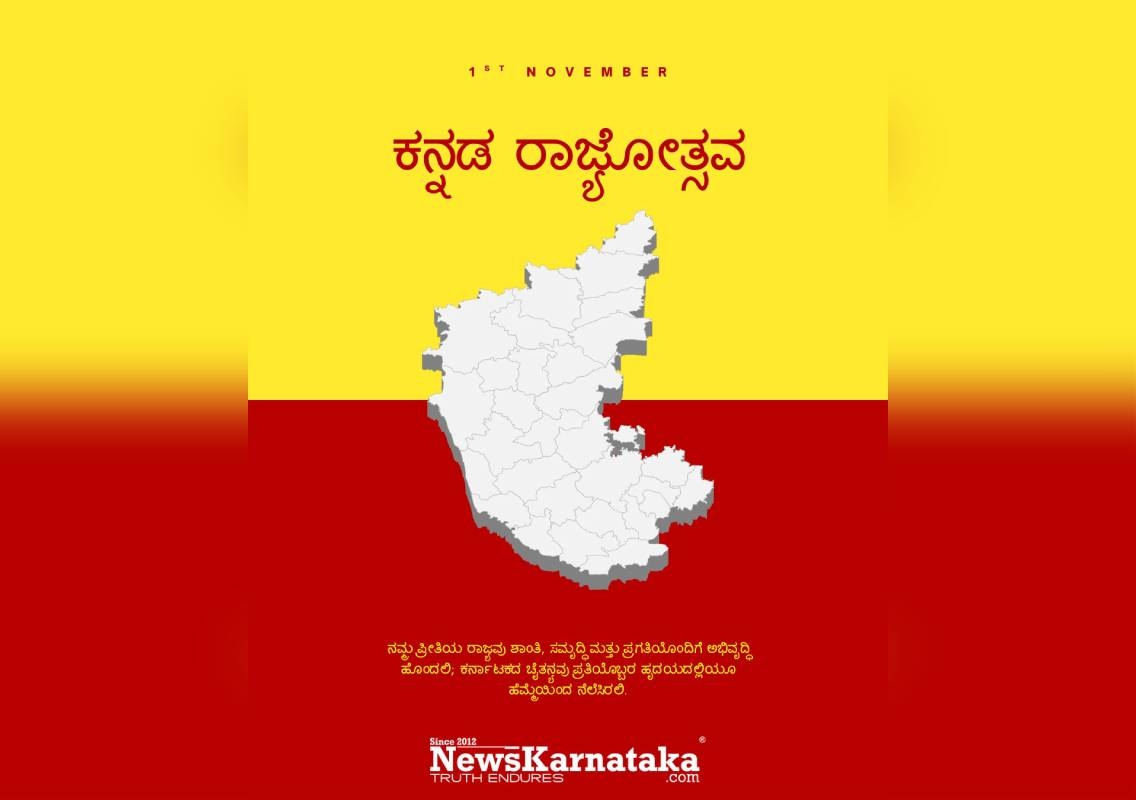


Bengaluru: Karnataka is celebrating its 71st Kannada Rajyotsava on Sunday, November 1, with flag-hoisting ceremonies, cultural programmes, processions and events honouring the Kannada language and the state’s rich heritage.
The celebrations are being held across the state to mark the formation of Karnataka on November 1, 1956, when Kannada-speaking regions from different administrative units were brought together to form the erstwhile Mysore State. The state was officially renamed Karnataka on November 1, 1973.
This year’s Rajyotsava falls on a Sunday, but celebrations have been planned across government institutions, educational establishments and Kannada organisations on the day itself.
State-level celebrations in Bengaluru
In Bengaluru, the main government celebration is scheduled at Kanteerava Stadium, where former Chief Minister Siddaramaiah is expected to lead the official programme with the hoisting of the state flag. Chief Minister D K Shivakumar is also associated with the state-level celebrations, according to reports.
Various Kannada organisations have organised programmes, rallies and cultural events in different parts of the city. A programme titled ‘Kannada Habba-71’, led by Kannada activist Vatal Nagaraj, is scheduled at Mysore Bank Circle.
The city has also been decorated in the traditional red and yellow colours associated with Karnataka. Major buildings, including Vidhana Soudha, have been illuminated as part of the celebrations.
Rajyotsava awards for 71 achievers
One of the important events of the day is the presentation of the Karnataka Rajyotsava Awards to 71 achievers who have made notable contributions in different fields.
The awards ceremony is scheduled to take place at Ravindra Kalakshetra in Bengaluru at 6 pm. The programme is expected to be attended by senior state leaders and representatives of the Kannada and Culture Department.
The awards recognise contributions to the state across areas such as literature, education, arts, social service and other fields. The annual honours are an important part of the Rajyotsava celebrations, acknowledging individuals who have contributed to Karnataka’s development and cultural life.
Schools to observe Rajyotsava despite Sunday holiday
The School Education and Literacy Department has directed government, aided and unaided primary and high schools across Karnataka to organise Kannada Rajyotsava celebrations on November 1, even though the day falls on a Sunday.
The department’s directive states that the celebrations should not be postponed because of the weekly holiday. School Education and Literacy Minister Madhu Bangarappa has also emphasised that the occasion should be observed on its designated date.
The instruction applies to private schools as well as government and aided institutions. However, the directive has raised concerns among some school authorities about the availability of students and teachers on a Sunday.
Kannada identity and cultural heritage take centre stage
Kannada Rajyotsava is marked by the display of the state’s red-and-yellow flag, cultural performances, traditional music, folk dances and processions. Programmes featuring the state anthem, Jaya Bharata Jananiya Tanujate, are also an important part of official celebrations.
The day commemorates the linguistic reorganisation that brought Kannada-speaking regions together in 1956. It also recalls the efforts of the Karnataka Ekikarana movement, which worked towards the unification of Kannada-speaking areas.
The name Karnataka was adopted in 1973, giving the state its present identity. Since then, November 1 has been observed annually as Karnataka Formation Day, popularly known as Kannada Rajyotsava.
Across districts, government offices, educational institutions, cultural organisations and Kannada associations are marking the occasion with programmes celebrating the language, literature, history and traditions of the state.
The 71st Rajyotsava is an occasion to recognise the contributions of those who have worked for Kannada and Karnataka, while renewing the focus on preserving the language and passing its cultural heritage on to future generations.