


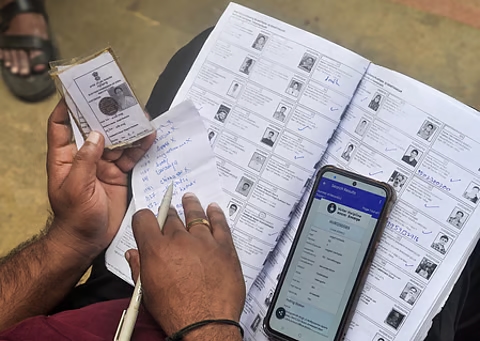


Bengaluru: Karnataka’s Special Intensive Revision (SIR) of electoral rolls concluded on October 27, leaving the state with a final electorate of 4,54,55,689 voters, or approximately 4.54 crore. The revision reduced the electorate by nearly 99.76 lakh from the original count of around 5.5 crore, with 65.45 lakh people classified as permanently shifted during the enumeration exercise.
The final figures reflect a large-scale verification of voter records aimed at identifying people who were absent, had shifted residence, were deceased, appeared more than once on the rolls or fell into other categories requiring verification.
The exercise also recorded 6.83 lakh new voters. Among the voters on the final rolls, approximately 86.56 lakh are in the 20–29 age group.
The revision involved several stages, including household enumeration, publication of a draft electoral roll, the issuance of notices and a claims-and-objections process. Officials examined applications for inclusion, requests to correct voter details and objections seeking the removal of existing entries.
The exercise began in June, with thousands of election officials and booth-level personnel deployed across the state. Recognised political parties also appointed booth-level agents to assist with the enumeration process and raise objections where necessary.
Karnataka’s electorate falls to 4.54 crore
As of June 16, when the electoral rolls were frozen for the SIR exercise, Karnataka had approximately 5.5 crore registered voters.
The subsequent enumeration process resulted in the publication of a draft electoral roll on August 24. At that stage, around 1.08 crore entries, representing approximately 19.48% of the earlier electorate, were removed after being categorised under ASDDO — Absent, Shifted, Dead, Duplicate and Others.
The final electorate following the revision stood at 4,54,55,689.
The difference between the original electorate and the final list amounts to approximately 99.76 lakh voters. The final figure followed the notices and claims-and-objections process, during which officials considered applications and objections relating to voter records.
The reduction in the number of entries does not, by itself, mean that every person removed was found ineligible to vote. The ASDDO classification covers several different circumstances, including voters who may have moved from their registered addresses. The category and verification process are therefore important when interpreting the figures.
Permanently shifted voters account for 65.45 lakh entries
The largest category highlighted in the enumeration figures was that of voters classified as permanently shifted.
This category accounted for 65.45 lakh entries, representing approximately 11.8% of the ASDDO list, according to the supplied figures.
The classification is intended to identify voters who have moved away from their registered addresses. Verifying such entries is a key part of maintaining accurate electoral rolls, particularly in areas experiencing migration, urban growth and changes in residential patterns.
However, a person being marked as shifted on an electoral roll is not necessarily the same as being permanently ineligible to vote. A voter who has moved may need to register at a new address in accordance with the applicable electoral procedures.
The large number of entries placed in this category makes it one of the most significant aspects of Karnataka’s SIR exercise.
The other ASDDO categories include people reported absent during enumeration, deceased voters, duplicate entries and cases classified under other circumstances. Each category represents a different reason for reviewing or removing an entry from the draft roll.
Notices issued to more than 43 lakh voters
The publication of the draft roll on August 24 was followed by a two-month phase involving notices, claims and objections.
Of the approximately 4.46 crore voters on the draft list, around 43.82 lakh were issued notices for verification. Officials examined the cases during the subsequent process.
According to the supplied figures, 43.2 lakh people made it to the final list following the notices phase, while 61,867 voters were excluded from the final roll after the process.
Officials said approximately 60,000 voters were excluded during this stage, broadly corresponding to the reported figure of 61,867.
Claims and objections could be filed during the first month of the phase, until September 23. The process gave voters and other eligible applicants an opportunity to seek inclusion, correct details or raise objections against entries.
The notices stage was particularly important because it allowed officials to review entries flagged during enumeration rather than relying exclusively on the initial classification.
The final figures indicate that most of those who reached the notices stage were retained on the electoral roll, while a smaller number were excluded following verification.
More than 7.87 lakh citizens apply for inclusion
Between June 16 and September 23, around 7.87 lakh citizens applied for inclusion in the final electoral roll through Form 6.
Form 6 is used by eligible citizens seeking to register as voters. The applications formed part of the effort to ensure that eligible people missing from the draft list could request inclusion.
A further 4,530 non-resident Indians applied through Form 6A.
The exercise also recorded 58,475 objections to existing entries and requests for deletion. These applications were filed either by the voters themselves or by members of their families, according to the supplied figures.
Such requests can arise in circumstances including the death of a registered voter or the identification of an entry that requires removal or correction.
The applications and objections were among the records considered during the claims-and-objections phase. Their submission did not automatically determine the outcome, as electoral officials were required to process the requests under the applicable procedures.
Nearly 11 lakh voters seek corrections
Apart from applications for inclusion and deletion, a substantial number of voters sought changes to their existing details.
Around 10.99 lakh people on the draft list applied for modifications. The requests ranged from correcting spelling errors to changing polling booth locations.
Accurate voter information is important for ensuring that people can identify their names on the electoral roll and access the correct polling station during an election.
Changes to names, addresses and other particulars can also help reduce confusion caused by outdated or inaccurate records.
The number of modification requests highlights the administrative workload involved in revising a statewide electoral roll. Each application requires processing so that the final list reflects the appropriate details.
The revision therefore involved not only the removal of entries but also the addition of eligible voters and the correction of existing records.
Thousands of election officials deployed across Karnataka
The SIR exercise began on June 20, with a large network of election officials assigned to carry out the work.
At the start of the process, Karnataka deployed 59,050 booth-level officers (BLOs), 332 Assistant Electoral Registration Officers (AEROs) and 224 Electoral Registration Officers (EROs).
The state also appointed 5,905 BLO supervisors, each responsible for overseeing 10 BLOs.
District commissioners were designated as District Election Officers (DEOs), with 34 officers assigned these responsibilities across the state.
As the exercise progressed, the number of BLOs increased to 60,932, while the number of AEROs rose to 4,258.
These personnel were responsible for supporting enumeration, processing records and assisting with the verification and revision of electoral rolls.
The scale of the deployment reflected the logistical challenge of reviewing millions of voter entries across urban and rural areas.
Political parties appoint 1.33 lakh booth-level agents
Recognised political parties also participated in the process by appointing booth-level agents (BLAs).
Around 1.33 lakh BLAs were appointed during the enumeration phase. Their role included helping ensure that enumeration forms reached voters and assisting political parties in identifying entries that might require scrutiny.
During the claims-and-objections period, BLAs also helped submit objections against entries on the draft electoral roll.
The involvement of political parties formed part of the broader process of monitoring and reviewing voter records. Their agents could raise concerns about entries, while the final decisions on inclusion, deletion and modification remained with the designated election authorities.
The participation of BLAs was particularly relevant given the number of entries classified under ASDDO and the volume of applications received during the revision.
Enumeration deadline extended twice
The enumeration phase began on June 30 and was initially scheduled to conclude on July 29.
However, the deadline was extended twice because of the volume of work involved and the large number of entries requiring ASDDO classification.
On July 15, the Chief Electoral Officer’s office announced a 10-day extension, moving the deadline to August 8. The deadline was subsequently extended by another 10 days.
The extensions gave officials additional time to complete the enumeration and process entries requiring further classification.
The draft roll was eventually published on August 24, after which the notices, claims and objections stage began.
The overall exercise concluded on October 27 with the publication of the final electorate figure.
Final voter list marks the end of the revision exercise
Karnataka’s SIR has reduced the recorded electorate from approximately 5.5 crore to 4.54 crore, with nearly 99.76 lakh fewer entries in the final list. The largest category identified during enumeration was that of permanently shifted voters, accounting for 65.45 lakh entries.
At the same time, the process included 6.83 lakh new voters, applications for inclusion, requests for corrections and objections to existing entries.
The final figures bring the revision exercise to a close, but their significance will depend on the accuracy of the underlying records and the handling of individual cases. Voters should check their names and particulars on the final electoral roll and follow the prescribed process if an eligible person has been omitted or details need correction.