







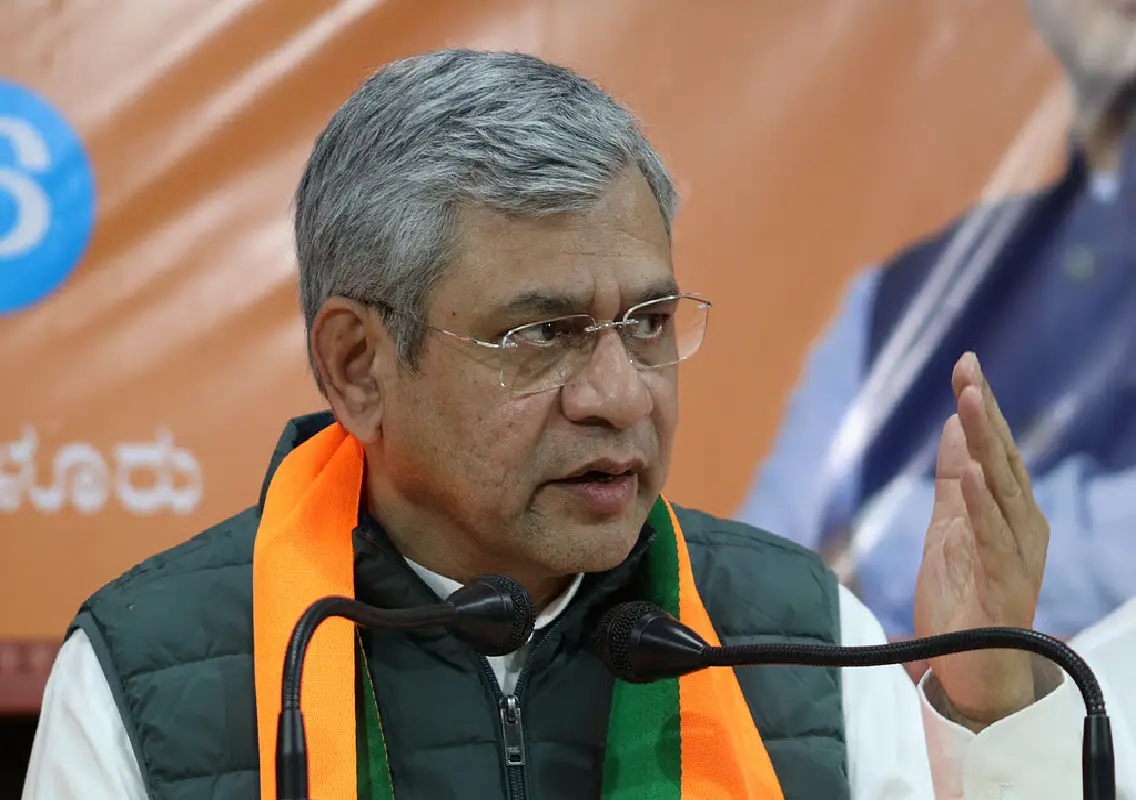


Bengaluru: Union Minister for Railways, Information & Broadcasting, and Electronics & Information Technology Ashwini Vaishnaw on Saturday announced that a Vande Bharat Express train between Mangaluru and Bengaluru will become operational soon, following the completion of railway electrification works on the Hassan–Mangaluru stretch.
Addressing reporters at the BJP office, the minister said key electrification work on the coastal route has been completed and the project has now moved into the testing and safety certification phase. He added that once statutory clearances are in place, scheduling and timetable planning will be finalised before the launch of services.
He also announced that a premium train service between Bengaluru and Mumbai will be introduced soon and said the Centre would consider the proposed Pune–Bengaluru rail corridor.
Tests and safety certification under way
Vaishnaw said that electrification between Hassan and Mangaluru was a major priority and is now complete. However, he noted that multiple technical and safety checks must be carried out before introducing new semi-high-speed services like Vande Bharat.
“Once a section is electrified, many tests have to be done. After the tests, we move to safety certification. After that, we work on the timetable,” he said.
He added that the Vande Bharat service will cover the coastal belt of Karnataka up to Karwar in phases, and inputs from the state budget and local requirements will also be considered while planning operations.
Two dedicated rakes for coastal route
The minister said the coastal sector would get two separate Vande Bharat train sets due to the long distance involved. One rake would operate from the coast towards Bengaluru and another from Bengaluru towards the coast.
“This is unlike many other services where a single rake covers both directions. Because this is a long section, there will be two trains,” he said.
Vaishnaw stated that 12 pairs of Vande Bharat trains are already operational in Karnataka and more routes will be added in the coming years. He said the long-term plan is to expand Vande Bharat coverage across the state.
High-speed rail corridors outlined
Speaking about future high-speed rail development, the minister said that once the proposed Bengaluru–Chennai high-speed corridor is implemented, travel time between the two cities would come down to about 73 minutes.
He said the reduced travel time would enable same-day business and personal trips and significantly improve regional connectivity. He added that the Hyderabad–Bengaluru high-speed link is also planned, with an estimated travel time of around two hours, forming part of a broader high-speed “diamond corridor” network in South India.
Bullet train learning curve cited
Vaishnaw said the Mumbai–Ahmedabad bullet train project was taken up first because of its technical complexity and strategic importance. He noted that operating trains at speeds of up to 350 kmph involves major engineering challenges related to vibration, control, aerodynamics and safety.
“At very high speeds, a partial vacuum is created around the moving train. This requires advanced design and safety features,” he said.
He added that Indian engineers and industry have gained valuable experience through this project and are now better prepared to execute additional high-speed corridors. According to him, seven bullet train projects have been approved in the second phase, with a long-term target of about 7,000 km of high-speed rail corridors under the Viksit Bharat roadmap. Around 4,000 km has already been announced, including the Mumbai–Ahmedabad line.
Bengaluru Suburban Rail project update
The minister also reviewed progress of the Bengaluru Suburban Rail Project and said Corridors 2 and 4 have made significant headway. He credited the recent appointment of a technical expert as Managing Director of K-RIDE, the implementing agency, for improved coordination and execution.
He said designs for all four corridors have been completed, tender documents prepared and necessary approvals secured. A large portion of the network will run on elevated structures, requiring complex engineering since several stretches run parallel to existing railway lines.
He added that technological innovations developed for bullet train projects are being adapted for the suburban rail system as well.
Conclusion
With electrification complete and safety testing under way, the proposed Mangaluru–Bengaluru Vande Bharat service is moving closer to launch, alongside broader plans for premium and high-speed rail connectivity across Karnataka and neighbouring states.