







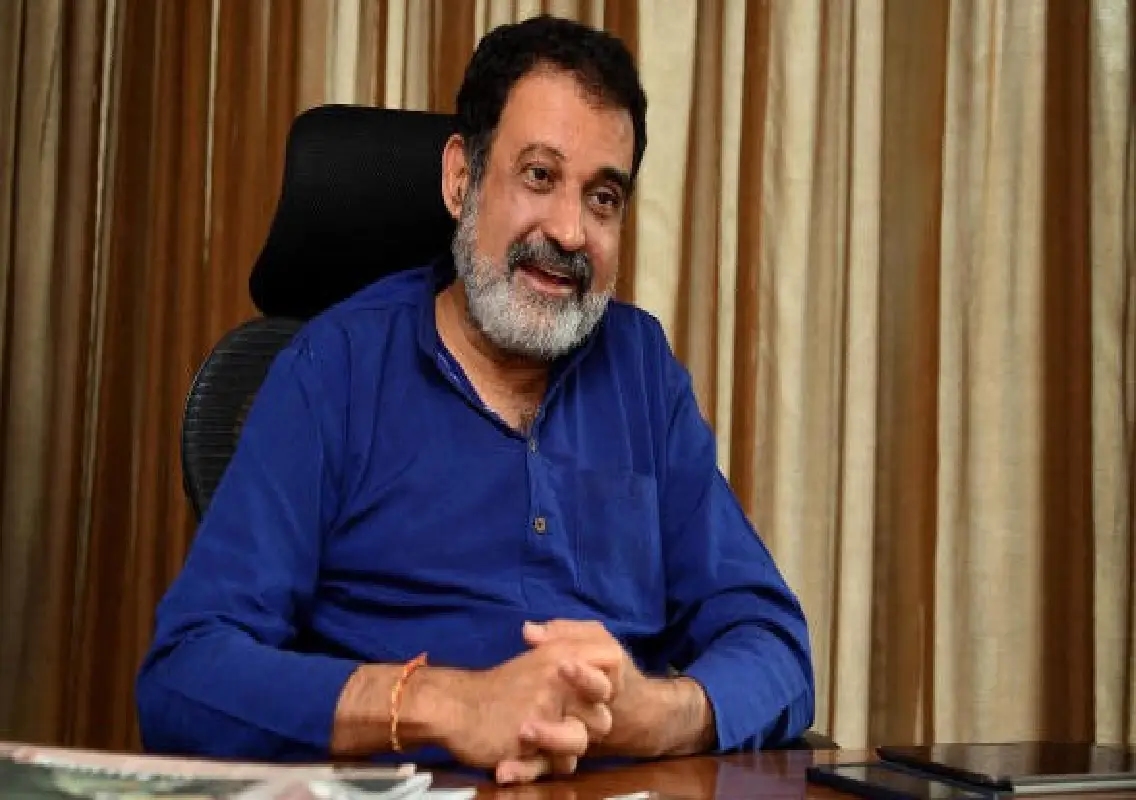


Bengaluru: Businessman and civic activist T.V. Mohandas Pai has escalated his public disagreement with Karnataka Transport Minister Ramalinga Reddy, calling for a direct and transparent discussion on the city’s worsening public transport situation and questioning the state government’s approach to bus services and subsidies.
Call for political accountability
Pai, a vocal commentator on urban governance and infrastructure, asserted that elected representatives must be directly accountable to citizens on matters affecting daily life, particularly public transport. Reacting to suggestions that discussions should be held with officials of the Bengaluru Metropolitan Transport Corporation (BMTC), Pai stated that he was willing to engage in dialogue, but only with the minister himself.
“I am ready for discussion, but not with the MD, with you,” Pai said, underlining his view that policy decisions and accountability lie with political leadership, not bureaucrats. According to him, while officials execute policy, it is ministers and the government who must answer questions from the public.
He argued that delegating responses to senior officials dilutes democratic accountability and avoids addressing core policy failures that have led to persistent transport challenges in the city.
Criticism of the Shakti scheme
Pai also reiterated his criticism of the Shakti scheme, under which women are offered free bus travel on state-run services. While acknowledging the social intent behind the scheme, he argued that it is misleading to call it “free”.
“The Shakti scheme is not free. It is paid for by taxpayers’ money,” he said, stressing that subsidies are funded by public resources and must therefore be evaluated for efficiency, sustainability and outcomes.
According to Pai, the scheme has increased demand on an already overstretched bus network without a corresponding expansion in fleet size or service frequency. He warned that without adequate planning and investment, such schemes risk worsening overcrowding and reducing service quality for all commuters.
Inadequate bus fleet for a growing city
A major thrust of Pai’s criticism centred on the size of Bengaluru’s bus fleet. He pointed out that BMTC currently operates around 7,000 buses, which he said is grossly insufficient for a city of Bengaluru’s scale and population.
Pai estimated that the city needs at least 15,000 buses — including a mix of large, medium and small vehicles — to meet current and future commuting needs. This, he argued, is essential to reduce congestion, cut down travel times and provide reliable alternatives to private vehicles.
“Bengaluru has grown exponentially, but our public transport capacity has not kept pace,” he said, adding that inadequate bus availability forces people to rely on personal vehicles, contributing to traffic congestion, pollution and economic losses.
He also highlighted that better bus connectivity is crucial not just for office-goers but for students, informal sector workers and those living in peripheral areas with limited access to mass transit.
Questioning opposition to private buses
Pai questioned the government’s rigid stance against allowing private bus operators to run services for the general public. He pointed out that many large companies already operate private buses for their employees, demonstrating that private participation in transport is both feasible and effective.
“People are willing to pay for good, efficient services,” Pai said, asking why the government insists that only state-owned entities should operate buses. He argued that a well-regulated, mixed ecosystem involving both public and private operators could significantly improve service coverage and quality.
According to him, such models already exist in several global cities, where private operators function under strict regulation, fare controls and service standards set by the government.
Pai stressed that his advocacy for private participation does not imply dismantling BMTC, but rather strengthening the overall system by supplementing public services where gaps exist.
Demand for an open public discussion
Emphasising that his criticism was constructive, Pai said his only demand was a robust, citizen-centric public transport system. He called on the transport minister to engage in an open, honest and public discussion on the issue.
“I am open to an honest, public discussion,” he said, adding that debates on public policy should not be seen as personal attacks but as necessary conversations in a democracy.
Pai maintained that Bengaluru’s transport crisis affects productivity, quality of life and economic competitiveness, and therefore deserves urgent, transparent attention from the highest levels of government.
Wider debate on urban mobility
The exchange between Pai and the transport minister has reignited a broader debate on urban mobility in Bengaluru, a city that has long struggled with traffic congestion, inadequate last-mile connectivity and delays in expanding mass transit infrastructure.
Urban planners and mobility experts have repeatedly stressed the need for a multi-pronged approach, combining buses, Metro rail, suburban rail, non-motorised transport and policy reforms to discourage excessive private vehicle use.
Conclusion
Mohandas Pai’s sharp remarks underline growing public frustration over Bengaluru’s public transport challenges and the pace of reform. By calling for direct political accountability, questioning subsidy models and advocating a larger, mixed bus ecosystem, Pai has pushed the debate beyond administrative responses to fundamental policy choices. Whether the government responds with engagement or deflection, the issues raised highlight an urgent need to rethink how India’s technology capital moves its people.