







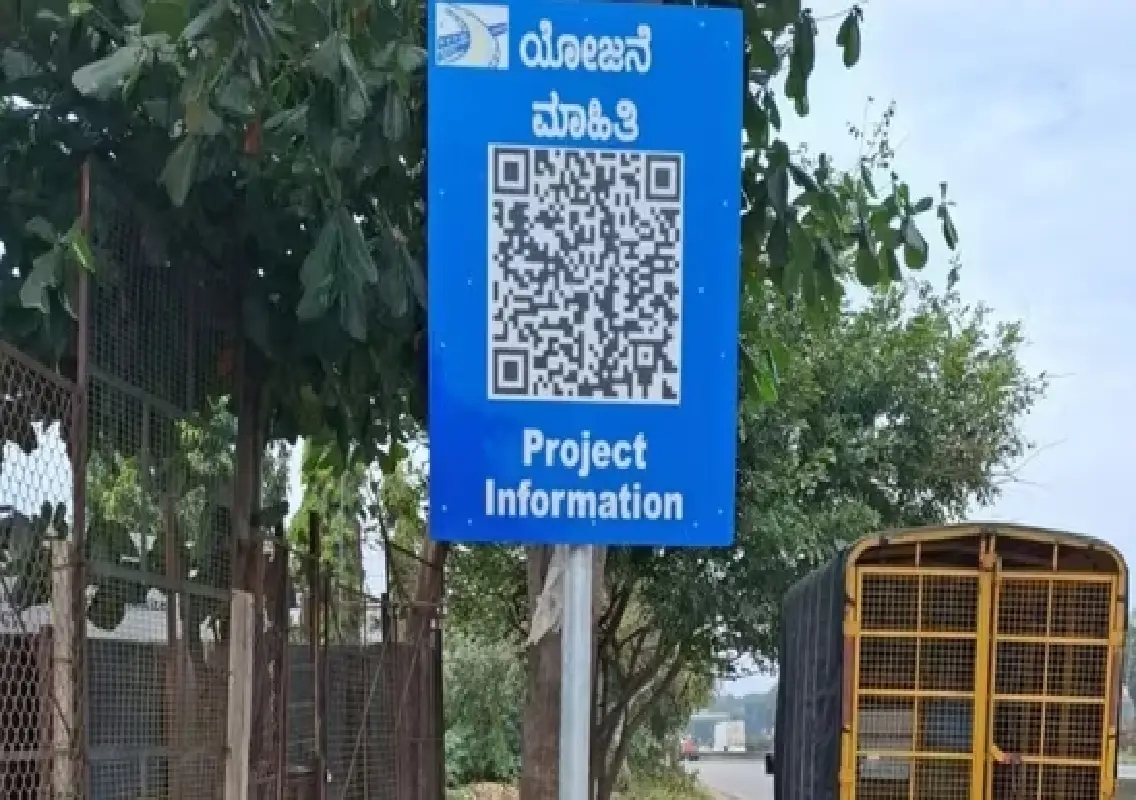


Bengaluru: The National Highways Authority of India (NHAI) has begun installing QR-code-based information boards along select highway stretches around the city, aiming to improve commuter safety, emergency response, and access to essential travel-related information.
Initiative aimed at safer and smarter commuting
The highway authority announced the initiative through its official social media handle, stating that the move is intended to enhance transparency and provide commuters with instant access to crucial information while travelling. By scanning the QR codes displayed on the boards, commuters can quickly retrieve verified data related to the highway stretch they are using.
According to NHAI, the initiative is part of its broader effort to modernise highway infrastructure and integrate digital tools that can assist travellers during emergencies, breakdowns, or medical situations.
Emergency support and key services at a scan
One of the primary objectives of the QR-code boards is to improve emergency preparedness on highways. Once scanned using a smartphone, the code provides direct access to emergency contacts and essential services linked to that particular highway stretch.
These include details of nearby highway patrol teams, local police stations, hospitals, engineers responsible for the stretch, and the NHAI helpline. Officials believe this can significantly reduce response time during accidents or medical emergencies, especially on high-speed corridors where delays can be fatal.
In addition to emergency services, commuters can also find information about nearby toll plazas, wayside amenities, fuel stations, rest areas, and food facilities, making long-distance travel more convenient.
Highway stretches covered in the first phase
As part of the initial rollout, the QR-code information boards have been installed on two key highway sections connecting the city with neighbouring regions.
The first stretch is the Bengaluru–Nelamangala section of National Highway 48, a crucial corridor that connects the city to western and northern parts of the state and witnesses heavy daily traffic.
The second stretch is the Bengaluru–Kolar–Mulbagal section of National Highway 75, which serves as an important route towards eastern Karnataka and neighbouring states.
NHAI officials have indicated that more highway stretches may be covered in subsequent phases, depending on feedback and operational outcomes.
How commuters can use the QR codes
Using the system is simple and requires no specialised application. Travellers only need to scan the QR code using the camera or QR-scanning feature on their smartphone.
Once scanned, the code redirects users to an information page containing verified data about the specific highway segment, nearby facilities, and emergency contacts. NHAI has stated that the information will be updated regularly to ensure accuracy and relevance.
Mixed reactions from social media users
While the initiative has been positioned as a step towards smarter highways, it has also drawn criticism from sections of social media users, who questioned its practical value and transparency.
Some users argued that the QR codes do not address core issues such as accountability for poor road conditions. One user commented that citizens do not lose lives due to a lack of information about hotels or amenities, but because of unsafe roads and the absence of responsibility among contractors and maintenance agencies.
Another concern raised was about road safety itself, with users pointing out that scanning a QR code would require motorists to stop their vehicles, potentially creating congestion or increasing the risk of accidents. Others questioned how NHAI plans to prevent posters or vandalism from obscuring the QR codes over time.
A few users also criticised the initiative for allegedly omitting details such as the name of the contractor, project cost, and maintenance agency, arguing that true transparency would involve making such information publicly accessible.
NHAI’s broader digital push
Despite the criticism, the QR-code initiative reflects NHAI’s broader push towards digitisation and real-time information sharing on national highways. In recent years, the authority has introduced FASTag-based tolling, highway surveillance systems, and mobile applications aimed at improving the overall driving experience.
Officials believe that with refinements and better public awareness, QR-code-based information boards could become a useful tool, especially for emergency response and long-distance travellers unfamiliar with local infrastructure.
Conclusion
The installation of QR-code information boards marks a new experiment in blending technology with highway management. While the initiative promises faster access to emergency services and travel-related information, its success will depend on proper implementation, regular maintenance, and whether it addresses commuters’ larger concerns about road safety and accountability. As feedback continues to pour in, NHAI may need to fine-tune the system to ensure it delivers meaningful benefits beyond optics.