







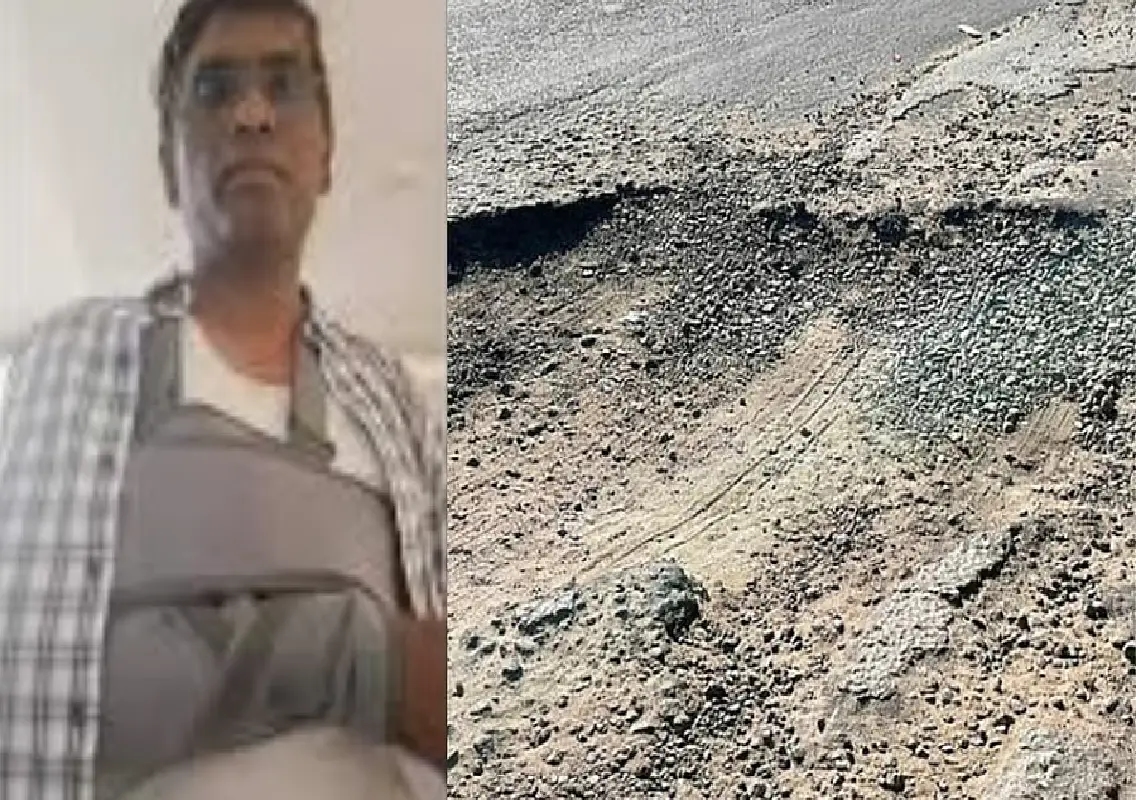


Bengaluru: A senior IT professional’s daily commute turned into a prolonged ordeal of pain, medical treatment and financial stress after his scooter hit a deep pothole in Mahadevapura, once again throwing the spotlight on Bengaluru’s deteriorating road infrastructure and the growing disconnect between official claims and on-ground realities.
The incident occurred on January 12 on the CDP Road connecting Varthur and Panathur, a key arterial stretch in the Mahadevapura Assembly constituency. Sridhar Mudooru, who works in the IT sector and regularly travels along this route, suffered a serious shoulder fracture after losing control of his scooter due to the damaged road surface.
Accident on neglected stretch
According to Sridhar, the pothole that caused the accident had been present for several months, despite repeated complaints by local residents. The CDP Road is frequently used by commuters travelling between Varthur, Panathur and nearby IT hubs along the Outer Ring Road, making it one of the busiest stretches in the area.
Doctors treating Sridhar have advised immediate surgery, with medical expenses estimated to exceed ₹1.25 lakh. In addition, he has been told to take complete rest for at least two months, with full recovery expected to take more than six months. The injury has not only affected his mobility but has also placed a significant financial burden on his family.
“This road has not been repaired for several months. I use the Outer Ring Road daily for work. Had the authorities fixed this stretch in time, the accident could have been avoided,” Sridhar said. “Apart from the financial burden, I now have to live with constant pain for no fault of mine,” he added.
Forced choices amid traffic chaos
Sridhar said the chronic traffic congestion in the Varthur–Panathur belt leaves residents with very limited commuting options. With narrow roads, ongoing construction and high population density, even short distances take an unreasonably long time to cover.
“Everyone knows how heavy the traffic is here. The roads are simply not adequate for the population density. A seven-kilometre drive can take one-and-a-half hours. That is why I chose to use a scooter, even though I already have back pain,” he explained.
Residents point out that two-wheelers are often the only practical option to navigate congested roads, but poorly maintained surfaces and hidden potholes make riding extremely risky, especially during early mornings or at night.
Citizen groups flag long-term neglect
Activists and resident welfare groups argue that the accident is not an isolated incident but a symptom of deeper, long-standing governance failures in the Mahadevapura constituency. Jagadeesh, an activist with Varthur Rising, said road conditions in the area have been poor for nearly two decades.
“We have consistently flagged these problems to multiple authorities. Flooding, crumbling roads and silt accumulation have only worsened the situation. Despite repeated requests, the response has been largely lackadaisical,” he said, adding that officials often address only a fraction of the issues raised by citizens.
According to activists, temporary patchwork repairs are frequently carried out ahead of inspections or monsoon seasons, but there is no sustained effort to improve road quality or drainage, leading to repeated deterioration.
Governance transition adds to delays
The recent administrative transition to the Greater Bengaluru Authority (GBA) has further complicated matters, according to civic representatives. Clement Jayakumar, member secretary of the Mahadevapura Task Force, said the change in governance structure has led to confusion and reduced accountability.
“With the change in governance structure, officer roles have been altered. For ongoing projects, there is very little monitoring at present. Accountability is unclear, which affects both the pace and quality of work,” he said.
Jayakumar also highlighted the strain on officials who are now handling multiple sectors simultaneously. “Earlier, there were separate engineers for roads, lakes and stormwater drains. Now one officer is expected to manage all these sectors, often without adequate training,” he said, warning that this could further delay critical infrastructure projects.
Official claims versus ground reality
The incident has reignited criticism of official claims that thousands of potholes have been repaired across the city. While civic authorities continue to release data highlighting large-scale pothole repairs, residents of Mahadevapura say their lived experience tells a different story.
They argue that many repairs are superficial, with potholes reappearing within weeks due to poor workmanship, inadequate materials and lack of proper drainage planning.
Citizens step in with demands
Frustrated by continued inaction, citizen groups organised a cleaning and awareness drive near the accident spot on Saturday. The initiative aimed to draw attention to the condition of the road and to press authorities for immediate and long-term solutions.
Their demands included a dedicated annual road maintenance plan for key arterial roads across Balagere, Gunjur, Varthur, Panathur and Sarjapur, mechanised removal of roadside silt, urgent resurfacing of major stretches including State Highway 35, and regular public disclosure of road maintenance budgets and expenditure.
Conclusion
Sridhar Mudooru’s accident underscores the human cost of neglected infrastructure in one of the city’s fastest-growing regions. As residents continue to navigate congested, poorly maintained roads, the gap between official assurances and daily reality remains stark. Citizen groups warn that without clear accountability, adequate planning and sustained maintenance, such accidents will continue to occur, turning routine commutes into life-altering tragedies.