







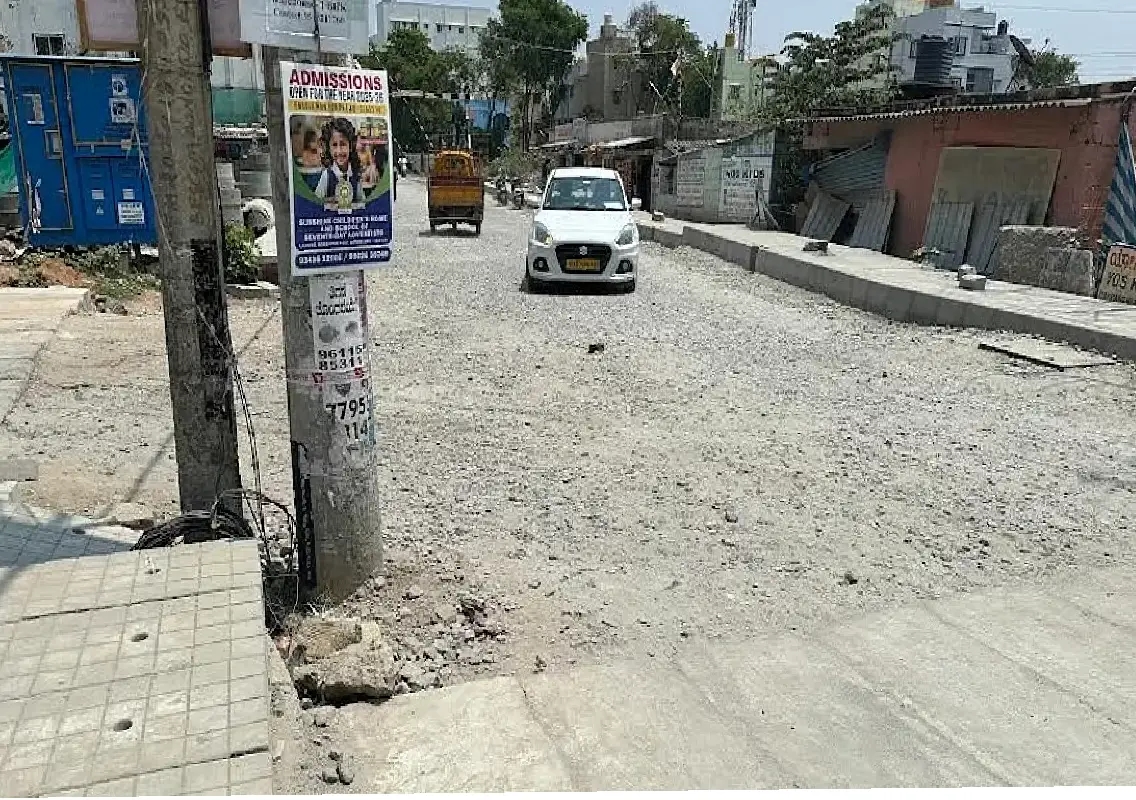


Bengaluru: Commuting after sunset along the service road between Babusapalya and Kasturi Nagar has become a nightmare. The stretch, which links the city to Kempegowda International Airport, is riddled with potholes and has had non-functioning streetlights for months. Officials are aware, but no solution has been implemented, highlighting once again the gap between budgetary allocations and on-ground delivery.
Civic complaints piling up
Grievances about roads, drains, streetlights and garbage are mounting across Bengaluru. The Sahaaya 2.0 app receives nearly 300 complaints daily, while many more surface on social media. Still, countless issues go unreported, as citizens often assume that authorities will act — though this rarely happens.
This is despite massive allocations in the 2025–26 budget of the now-dissolved Bruhat Bengaluru Mahanagara Palike (BBMP). Funds included Rs 39.50 crore for flyover, underpass and subway maintenance — three times more than the previous year; Rs 64.52 crore for rajakaluves (stormwater drains); Rs 50 crore for arterial roads; and Rs 78 crore for streetlights.
However, little has changed on the ground. With weak oversight and lack of punitive action, engineers are allegedly more confident than ever in inflating project books. Citizens complain that neighbourhood-level fund utilisation remains opaque, making it difficult even for active groups to push for accountability.
Garbage problem worsens
Solid waste management is another sore point. Bengaluru was ranked among the worst metropolitan cities in the latest Swachh Survekshan survey, despite the BBMP earmarking Rs 850 crore for garbage collection and transportation. An exclusive entity was even created to take waste management out of BBMP’s ambit, but efficiency has not improved.
Shift to five municipal corporations
With the dissolution of the BBMP, hopes are pinned on the newly created five municipal corporations. Some citizen activists believe decentralisation will make grievance redressal easier.
“Unlike earlier, grievances can now be escalated within each corporation. This could make public access easier. So far, the special commissioners of the BBMP rarely responded to calls or messages,” said K S Kangheyan, a social worker from Mahadevapura.
Citizen groups also see merit in localised decision-making. R Rajagopalan, convener of the Bengaluru Coalition, pointed out that commissioners of the new corporations wield greater powers than the former zonal commissioners. “Decisions could now be quicker, with files no longer required to travel to Hudson Circle. The transition, however, will be painful, especially for people waiting on khata-related services and plan approvals,” he noted.
New initiatives from local commissioners
Some commissioners are already taking action. P Rajendra Cholan, commissioner of Bengaluru City Central Corporation, has introduced a Rs 25 lakh revolving fund for quick road repairs. “This way, engineers can act without getting stuck in procedures. What matters is that funds are used responsibly, with clear accountability,” he said.
Meanwhile, D S Ramesh, commissioner of Bengaluru East Corporation, inspected the Panathur–Balagere stretch along with engineers a day after a school bus nearly toppled due to a pothole — a rare gesture of direct intervention compared to earlier systems.
The funding crunch
Despite positive signs, questions remain about money. The five corporations face uncertainty over how much of their budgets will be available for maintenance after covering administrative costs like salaries and pensions. Most state and central grants are expected to be routed through the Greater Bengaluru Authority (GBA), leaving local corporations strapped for resources.
“It is too early to judge the new governance structure. We may see real differences only after April 2026, when individual corporations present their own budgets. For now, the GBA has allocated funds based on the old BBMP budget. There are plenty of inspections, but little actual work on the ground because of the funding crunch,” said Clement Jayakumar of the Mahadevapura Taskforce.
Citizens still waiting for change
For residents, the reality remains frustrating. While budgets promise improvements, potholes, dark stretches and garbage heaps still dominate their daily lives. Unless funds are deployed transparently and timely, Bengaluru’s civic woes are unlikely to see meaningful relief.