







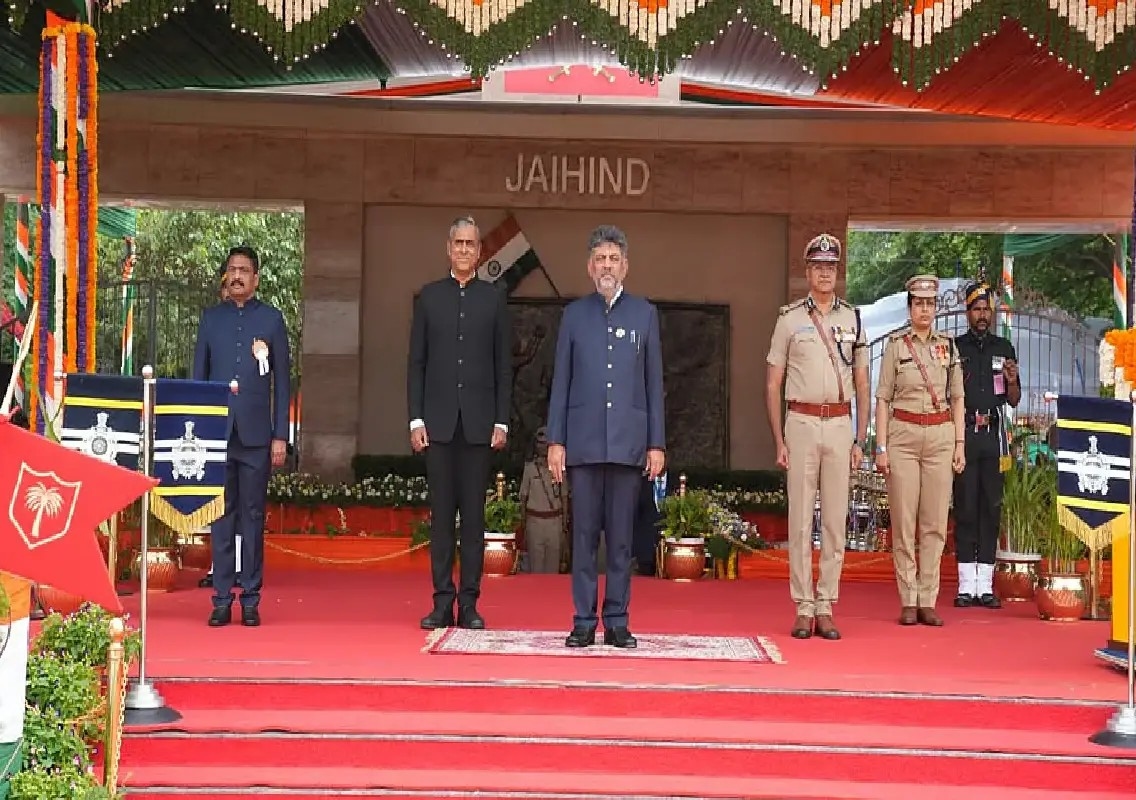


Bengaluru: Karnataka Chief Minister D.K. Shivakumar on Saturday announced a series of major employment, education, technology, agriculture and infrastructure initiatives while outlining the state government’s vision of contributing to a $3 trillion economy by 2047.
Hoisting the national flag at the Field Marshal Manekshaw Parade Ground in Bengaluru on the occasion of the 80th Independence Day, Shivakumar unveiled the government’s strategic vision under the theme “Yuva Karnataka, Nava Bharat”.
Among the key announcements was the proposed recruitment of 72,000 people to vacant government posts within the next six months. The Chief Minister also announced plans for India’s first public AI university in Bengaluru, new technology centres outside Bengaluru, agricultural technology initiatives and major infrastructure projects.
72,000 government vacancies to be filled
Under the newly launched Chief Minister’s Jobs Mission, recruitment notifications for 72,000 vacant posts across various government departments will be issued within the next six months, Shivakumar said.
The announcement is aimed at providing employment opportunities to educated youth while addressing staff shortages across government departments.
The government is also planning measures to connect young job seekers with private-sector employers. The Yuva Udyoga Setu platform will serve as a link between job seekers and companies looking to recruit employees.
Another employment-focused initiative, Udyoga Nidhi, will provide businesses with an incentive of ₹2,500 per month for each job created for a period of two years. The scheme will focus on Karnataka’s 10 most backward districts and is intended to encourage private-sector employment generation in regions that require greater economic investment.
AI and coding education from Class VI
Shivakumar placed considerable emphasis on technology and artificial intelligence in his Independence Day address.
Under the AI Akshara Abhiyana and Coding Gurukul initiatives, the state plans to introduce AI and coding education into the school curriculum from Class VI onwards.
The move is aimed at giving students early exposure to emerging technologies and preparing them for an increasingly digital economy.
The Chief Minister also announced that Bengaluru will host India’s first public AI University. Certificate courses at the institution are expected to commence by January 2027.
The proposed university is expected to strengthen Karnataka’s position as a technology and innovation hub while creating opportunities for students, researchers and professionals to acquire specialised skills in artificial intelligence.
More opportunities for rural students
The government also announced Vidyarthi Sahayahasta, a measure aimed at improving representation of rural students in professional higher education.
Under the initiative, 7.5 per cent of seats within the existing 15 per cent rural quota will be reserved for students from rural government schools seeking admission to professional courses such as engineering and medicine.
The move is intended to improve access to higher education for students from rural backgrounds and government schools.
By increasing opportunities for rural students in professional courses, the government hopes to reduce the educational gap between urban and rural areas.
Five technology centres beyond Bengaluru
Shivakumar also announced plans to decentralise Karnataka’s technology-driven economic growth.
Five Global Technology Centres (GTCs) will be established under the LEAP programme in Kalaburagi, Belagavi, Hubballi-Dharwad, Mangaluru and Mysuru.
The initiative is aimed at expanding Karnataka’s technology ecosystem beyond Bengaluru and creating new employment and investment opportunities in other major cities.
The government also announced an Advanced Manufacturing Cluster at Doddaballapura, with an investment commitment of ₹20,000 crore.
The cluster is expected to strengthen Karnataka’s manufacturing ecosystem and encourage the establishment and expansion of industries outside Bengaluru.
Technology-based support for farmers
The Chief Minister announced new measures to integrate technology into agriculture.
The CM Raitha Chaitanya Yojane will use drones and satellite-based technology for crop monitoring. Such technology can help farmers and authorities assess crop conditions and identify potential problems more efficiently.
The government also introduced Raitha Mitra, which will provide a 50 per cent rental subsidy on agricultural equipment for small farmers owning up to three acres of land.
The initiative is aimed at making modern agricultural machinery more accessible to smallholders, who may otherwise find it difficult to purchase expensive equipment.
Bengaluru Business Corridor announced
Shivakumar also highlighted major infrastructure initiatives for Bengaluru.
The government has launched plans for the 117-km Bengaluru Business Corridor (BBC), aimed at improving connectivity and supporting the city’s future economic growth.
The Namma Metro network will also be expanded to 220 km under Phase 3.
With Bengaluru continuing to experience rapid population growth and increasing traffic pressure, the expansion of mass transit infrastructure is expected to play an important role in improving urban mobility.
The government also plans to establish five Lalbagh-style Tree Parks as part of efforts to increase green spaces and address pollution in the city.
Police commissionerate to be reorganised
On the law-and-order front, Shivakumar announced plans to reorganise the Bengaluru Police Commissionerate into five separate commissionerates.
The restructuring is aimed at improving police administration and public safety in the expanding metropolitan region.
The government will also establish a new Anti-Rowdy Squad to strengthen action against anti-social elements and improve public security.
The proposed changes are part of the government’s wider effort to strengthen governance and policing as Bengaluru continues to grow.
Vision for a $3 trillion Karnataka economy
Shivakumar said the initiatives announced on Independence Day form part of a broader strategy to accelerate Karnataka’s economic development and contribute to India’s growth.
The government’s long-term objective is to help Karnataka move towards a $3 trillion economy by 2047, when India will mark 100 years of Independence.
Emphasising the importance of states in national development, Shivakumar said, “If India is a temple, the States are its pillars.”
He called upon citizens to participate collectively in the state’s development and contribute to building a stronger Karnataka.
The announcements span employment, education, artificial intelligence, agriculture, manufacturing, urban infrastructure and policing, reflecting the government’s attempt to combine economic expansion with welfare and public services.
With the focus on creating jobs, expanding opportunities beyond Bengaluru and preparing young people for emerging technologies, the Chief Minister’s Independence Day address placed youth and innovation at the centre of Karnataka’s long-term development strategy.