







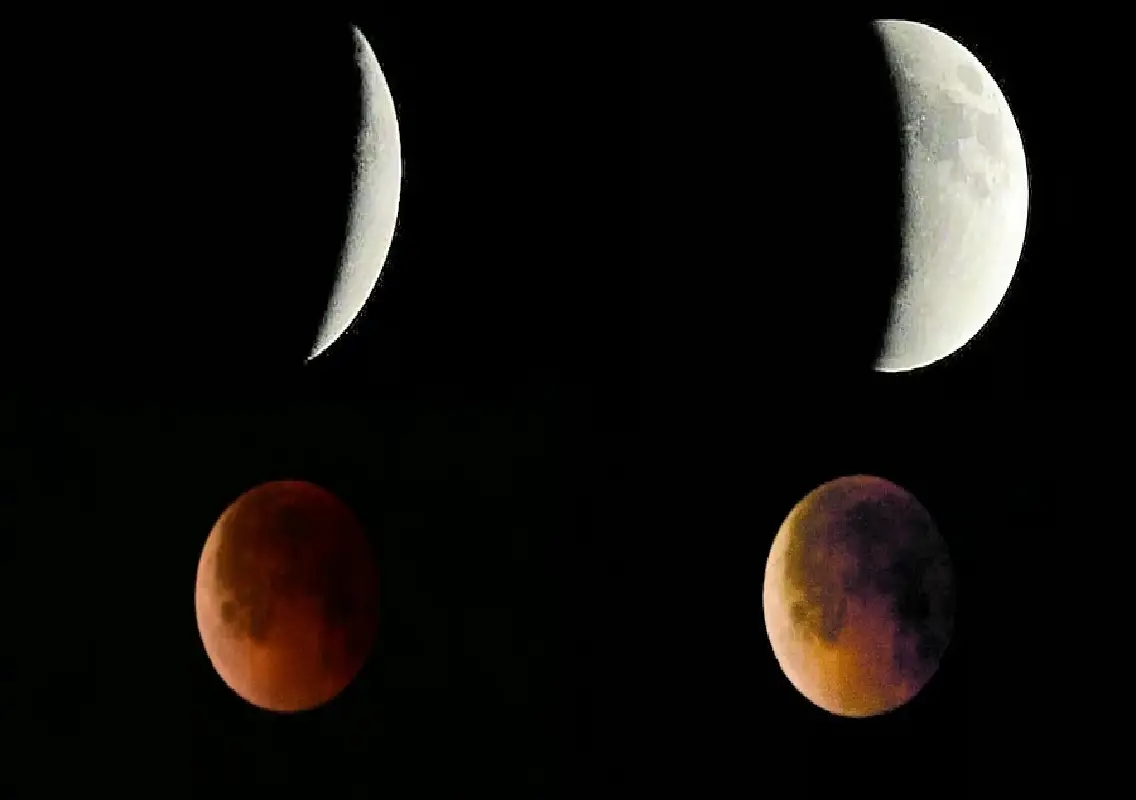


Bengaluru: Skywatchers across the globe are gearing up to witness a total lunar eclipse on Tuesday, March 3, marking what is being described as the last opportunity to see a “blood moon” until 2029.
According to astronomical schedules, the lunar eclipse will begin as a penumbral eclipse at 2.14 pm (IST) and continue until 7.53 pm (IST). During this period, the Earth will gradually move between the Sun and the Moon, casting its shadow on the lunar surface.
Visibility across India
In India, the total phase of the lunar eclipse will be visible only in the North-Eastern regions. The rest of the country, including Karnataka, will witness it as a partial lunar eclipse.
In Bengaluru, observers are expected to see the eclipse only during its concluding stages. Astronomers say the partial phase will be visible for approximately 15 minutes before moonrise or as it appears low on the horizon, depending on local conditions.
Unlike a solar eclipse, a lunar eclipse can be viewed safely with the naked eye. No special protective eyewear is required, making it a popular celestial event among families, students and astronomy enthusiasts.
What causes a lunar eclipse?
A lunar eclipse occurs when the Earth passes directly between the Sun and the Moon. As a result, the Earth blocks sunlight from directly reaching the Moon and casts a shadow over it.
During a total lunar eclipse, the Moon does not go completely dark. Instead, it often turns a reddish-orange hue. This striking colour is caused by sunlight passing through the Earth’s atmosphere, which scatters shorter wavelengths of light and allows red wavelengths to bend and reach the Moon. This phenomenon gives rise to the popular term “blood moon”.
Astronomy experts explain that the intensity of the red colour can vary depending on atmospheric conditions, including dust and cloud particles present in the Earth’s atmosphere at the time of the eclipse.
Temple closures and public interest
The celestial event has also prompted certain religious institutions to take precautionary measures. As reported earlier, the famed Tirumala Venkateswara Temple is scheduled to remain closed for several hours on March 3 in view of the eclipse, in accordance with traditional customs observed during such events.
Across cities, amateur astronomy groups and science organisations are encouraging people to observe the eclipse and learn more about basic astronomical phenomena. Educational institutions are also using the opportunity to create awareness among students about how eclipses occur and dispel myths associated with them.
Last blood moon until 2029
Astronomers note that this is expected to be the last total lunar eclipse visible from many parts of the world until 2029. While partial lunar eclipses will continue to occur, skywatchers eager to witness a full “blood moon” may have to wait nearly three years for the next similar spectacle.
The rarity of the event has heightened public excitement, with many planning to step outdoors in the evening hours to catch a glimpse of the partially eclipsed Moon.
Conclusion
With clear skies forecast in several regions, Tuesday’s lunar eclipse promises to be a captivating sight for millions. Whether viewed casually from balconies or observed through telescopes by astronomy enthusiasts, the event offers a reminder of the fascinating celestial mechanics that govern our solar system.