







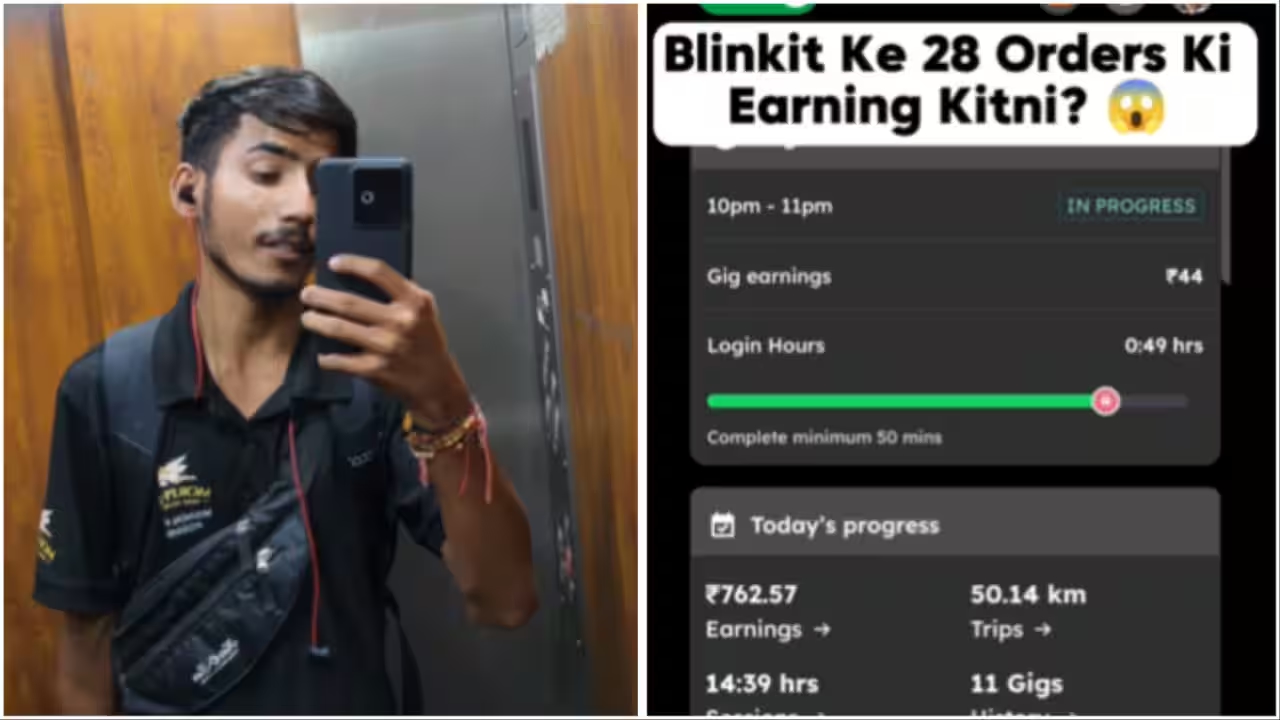


Uttarakhand delivery executive shares daily income
A Blinkit delivery executive from Uttarakhand has sparked a nationwide conversation on gig worker earnings after sharing his daily income details on Instagram, drawing attention to the economic uncertainty faced by last-mile delivery workers.
In one widely shared video, the delivery agent, identified as Thapliyal Ji, revealed that he earned ₹763 after completing 28 deliveries over nearly 15 hours. He supported his claims with screenshots from the Blinkit app, including one showing that his final delivery of the day earned him just ₹15.83. Based on this, his average income worked out to roughly ₹52 per hour, prompting strong reactions online.
Income varies sharply day to day
Following the video’s virality, Thapliyal posted additional reels showing the unpredictable nature of his earnings. In another video recorded in October, he showed a relatively better day, earning ₹1,202 for 32 deliveries in about 11 hours.
Explaining the fluctuations, he said income depends heavily on order availability. “When orders are plenty, it’s possible to earn ₹1,600 to ₹2,000. But on slow days, it’s difficult to even cross ₹1,000,” he noted. His experience highlights how gig workers’ earnings are tied not to fixed wages but to demand, distance and incentives.
Social media reactions and worker concerns
The videos triggered a wave of reactions from viewers. Some suggested alternative livelihoods, while others expressed empathy and urged platforms to treat delivery workers more fairly. Several users spoke about tipping delivery agents more generously, especially during bad weather.
One comment tagged Blinkit directly, questioning who would “take care of employees who deliver goods in a blink of an eye,” echoing wider concerns about worker welfare in quick commerce.
Policy debate around quick commerce pressure
The discussion comes amid growing scrutiny of 10-minute delivery models. Recently, AAP leader Raghav Chadha called for a ban on ultra-fast delivery services run by platforms such as Blinkit, Zepto and Instamart, arguing that they create unsafe working conditions and push gig workers to take risks on the road.
Blinkit has not yet responded publicly to Thapliyal’s claims. Industry observers say such firsthand accounts are increasingly shaping public perception of gig work, raising questions about fair pay, incentives and long-term sustainability in India’s rapidly expanding quick commerce sector.