







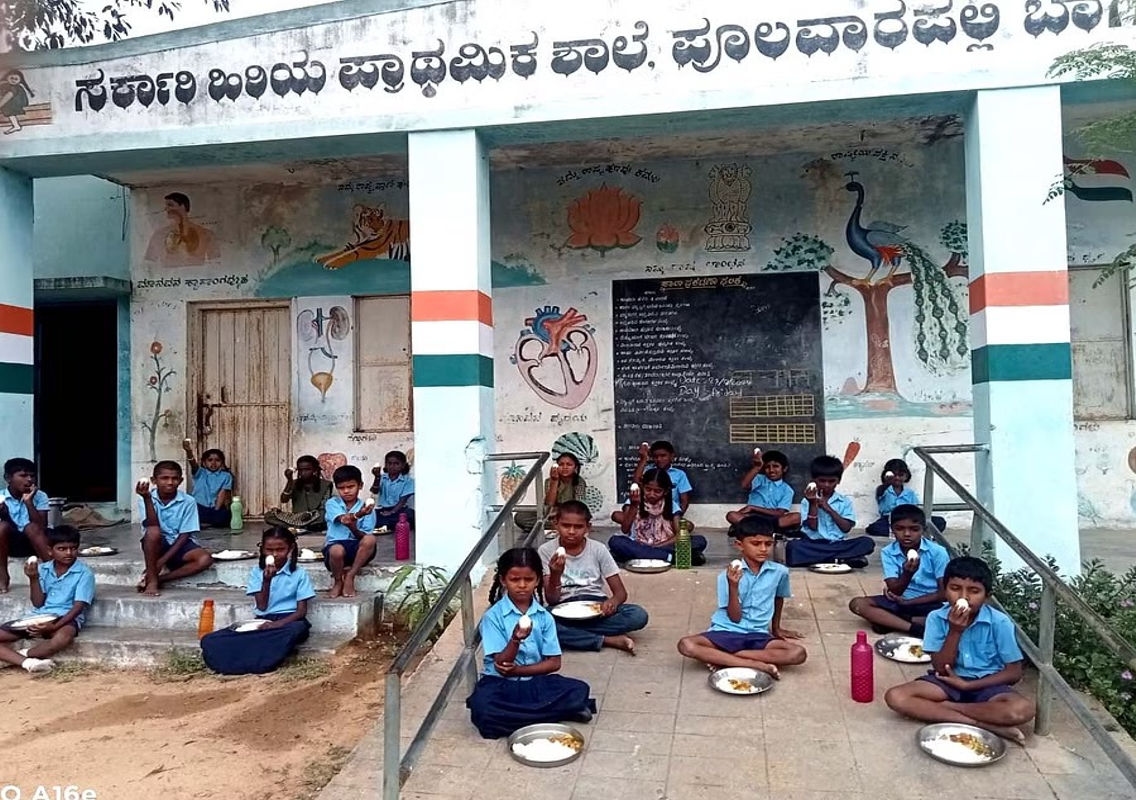


Bagepalli: At the government higher primary school in Poolavari Palli village, the poor condition of classrooms has forced students to study amid constant fear for their safety. With crumbling cement ceilings, leaking roofs, rusting beams, and cracks throughout the building, students endure discomfort and anxiety every day.
The school, located 2 kilometres from the village at Poolavari Palli Cross, caters to around 23 students from grades 1 to 7, many of whom come from farming, labouring, and economically disadvantaged families. For these children, the school is their only option for education, but it is far from being a safe or comfortable learning environment.
Classrooms have suffered from years of neglect, with leaking roofs and peeling walls making it difficult for students to focus on their lessons. During the rainy season, the situation worsens, with water accumulating on the floors, making them damp and uncomfortable. Rusting beams and exposed electrical wires on the walls add to the growing concerns over student safety.
The school’s bathrooms are also in disrepair, with female students left to find alternative places for sanitation. Access to clean drinking water is limited, exacerbating the already challenging environment.
“Most of the children in government schools are from farming, labouring, and economically disadvantaged backgrounds. Their parents trust these schools to provide basic education. But here, there aren’t even minimal facilities, and students study with constant anxiety over the risk of collapsing walls,” said village leader Narasimhappa, highlighting the lack of infrastructure in the school.
The situation at the Poolavari Palli school is not an isolated case. Somasekhara, a member of the Students’ Federation of India (SFI), pointed out that the lack of basic facilities is widespread in government schools, especially in rural areas. “There is a shortage of teachers, and infrastructure is lacking. This school is not alone—many government schools are deteriorating. Immediate steps are needed to demolish unsafe buildings and build new structures to ensure students’ safety and well-being,” he stressed.
The school principal, B.V. Shivayya, explained that efforts have been made to address some of the issues, including maintaining cleanliness around the premises. However, the crumbling infrastructure continues to pose a significant risk. “We have ensured cleanliness around the school. However, the leaking ceilings and crumbling cement need urgent attention,” he said.
Shivayya also mentioned that letters had been sent to field education officers requesting repairs and renovations. Yet, no significant improvements have been made so far.
Acknowledging the safety concerns, Taluk Field Education Officer N. Venkateshappa assured that the issue had been escalated to higher authorities. “For the safety of the children, we have instructed school heads to maintain cleanliness around the premises. It is not safe to conduct classes in unstable buildings, and we have escalated the matter to higher authorities for repairs,” he confirmed.
However, despite these assurances, the situation at the school continues to worsen, leaving parents and local leaders frustrated and anxious about the children’s well-being.
The deteriorating condition of the school in Poolavari Palli highlights a deeper issue affecting rural education facilities across the region. With the school serving as the only educational institution for many children in the area, the need for immediate intervention has never been more critical. Parents, students, and local leaders are calling for urgent action to renovate the school, rebuild its infrastructure, and provide a safe learning environment for the next generation of children.
Until these issues are addressed, children will continue to study under unsafe and uncomfortable conditions, with the looming threat of collapsing walls and leaking roofs hanging over them. The government must act swiftly to ensure that education is not compromised by neglect and mismanagement, and that schools like the one in Poolavari Palli can provide the kind of safe, supportive environment that every child deserves.