




Bengaluru: Karnataka has emerged as India’s leading state for private equity-backed healthcare deals, with hospital chains Manipal Health Enterprises and Health Care Global (HCG) Enterprises among the major contributors to the state’s position. A research study mapping private equity investments in India’s healthcare sector identified 70 acquisitions backed by private equity between January 2007 and May 2025.
Manipal Health accounted for six deals, while HCG Enterprises recorded four, according to the study. Both companies are headquartered in Karnataka and have used investments to support expansion, particularly within the state.
The findings highlight the growing role of private equity in India’s healthcare sector, while also raising questions about affordability, access to treatment and the increasing commercialisation of hospital services.
Karnataka records 13 private equity-backed acquisitions
The study, published in BMC Health Services Research on October 4, 2026, found that Karnataka recorded 13 private equity-backed healthcare acquisitions between January 2007 and May 2025. This was the highest among Indian states covered by the research.
Maharashtra and Telangana followed with 10 acquisitions each. Gujarat recorded six deals, while Kerala and Haryana had five each. The findings show that private equity investment has largely concentrated in urbanised southern and western parts of the country, with northern and eastern states attracting comparatively little investment.
The researchers identified four major hospital groups that together accounted for nearly one-third of the acquisitions. These included Manipal Health Enterprises and HCG Enterprises from Karnataka, along with CARE Hospitals and ASG Eye Hospitals.
Manipal Health recorded six acquisitions, while HCG accounted for four. The concentration of investment in these hospital groups highlights the importance of established healthcare networks in attracting private equity capital.
Hospital chains attract the largest share of investments
Hospitals were the primary focus of private equity investors, accounting for 45 of the 70 acquisitions, or around 64.3 per cent. Multispeciality hospitals attracted most of this investment, reflecting investor interest in healthcare businesses that operate across several medical departments and treatment categories.
The remaining transactions covered clinics and outpatient services, laboratory services, and elder and disability care. Among outpatient healthcare providers, ophthalmology and fertility or reproductive healthcare attracted notable interest.
The study identified seven acquisitions in ophthalmology and five in fertility and reproductive care among outpatient service providers. Other specialised medical areas, including oncology, urology and orthopaedics, also formed part of the wider healthcare investment landscape, although they did not attract the same level of attention as multispeciality hospital networks.
The concentration of investments in large hospital chains indicates that private equity firms have largely favoured established healthcare platforms with opportunities for expansion and consolidation. However, the geographical distribution of these investments also raises questions about whether the benefits of private capital are reaching smaller towns and underserved communities.
Private equity activity increased after 2020
The research found that private equity-backed healthcare acquisitions remained relatively limited during the earlier years of the study period but increased substantially after 2020. The year 2023 recorded the highest number of transactions, with 18 acquisitions.
Researchers Megha Reddy, Cyrus Engineer and Yashaswini Singh linked this growth partly to the financial conditions that emerged during the Covid-19 pandemic and its aftermath.
The study observed that low interest rates and large amounts of available investment capital made financing less expensive during the pandemic. Healthcare businesses also appeared attractive to investors because their revenues were considered relatively stable compared with several other sectors.
The researchers explained: “During the pandemic, low interest rates and large amounts of available capital made financing inexpensive and widely available, while health care’s relatively stable revenues made it more attractive than other economic sectors.”
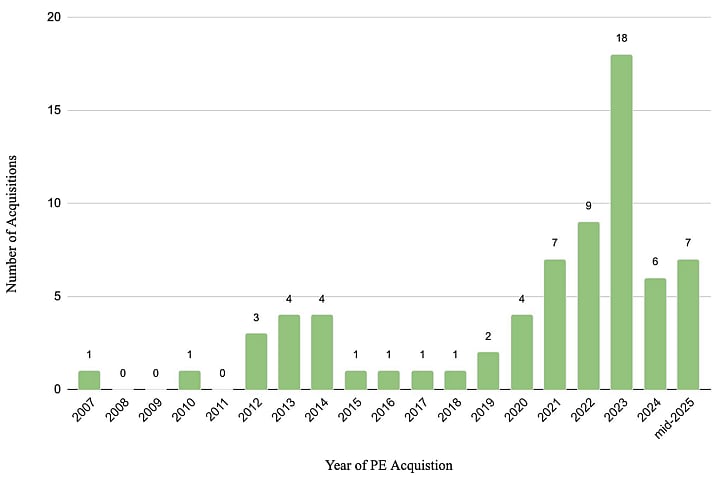
The trend reflects how the pandemic changed investment priorities, with healthcare infrastructure and service providers receiving increased attention from financial investors.
Foreign investors account for most acquisitions
Another significant finding was the prominent role of overseas private equity firms in India’s healthcare sector. Of the 70 acquisitions identified, 47, or 67.1 per cent, were financed exclusively by foreign private equity investors.
These investors included firms based in the United States, Singapore and Mauritius. Eighteen acquisitions were backed exclusively by Indian investors, while the remaining transactions involved other combinations of investment participation.
The findings underline India’s growing importance as a destination for international healthcare investment. The country’s expanding demand for medical services, established private hospital networks and opportunities for consolidation have attracted investors looking to finance the growth of healthcare businesses.
The study also examined ownership changes after acquisitions. It identified 25 exits from private equity investments, with sales to other private equity firms accounting for 64 per cent of those exits. The average holding period for investments that had exited was 5.1 years.
The researchers also found that 45 of the 70 healthcare platforms remained under their original private equity ownership at the time covered by the study.
Uneven investment raises concerns over healthcare access
Although private equity investments can provide hospitals with capital for infrastructure development, expansion and operational improvements, the geographical concentration of funding remains a concern.
The study found that investment was heavily clustered in urban areas of southern and western India. Rural and underserved regions received limited or no private equity investment, despite the need for better healthcare infrastructure in these areas.
This distribution raises questions about whether private capital is helping address gaps in healthcare access across the country or primarily strengthening hospital networks in markets that already have established medical infrastructure.
The researchers noted that the long-term effects of private equity ownership on healthcare delivery, pricing and quality in India are not yet fully understood. While investments can help healthcare providers expand their services, the implications for patients and medical workers require further examination.
The study pointed to the need for stronger regulatory safeguards, greater transparency in hospital ownership and closer monitoring of outcomes following private equity acquisitions. It also highlighted the importance of tracking changes in treatment costs, patient care and workforce conditions.
Concerns have also been raised more broadly about the participation of private hospitals in government-funded health insurance programmes and the financial burden faced by patients. However, the research does not establish that private equity ownership directly causes hospitals to deny government insurance coverage or restrict treatment.
Researchers call for closer monitoring of private equity ownership
The study, conducted by researchers affiliated with Brown University School of Public Health and Johns Hopkins Bloomberg School of Public Health, offers a broad mapping of private equity-backed acquisitions in India’s healthcare delivery sector.
The authors described their findings as a baseline for future research into how private capital influences healthcare services. They stressed that policymakers need to examine both the potential benefits of investment and its possible consequences for affordability, access and quality.
For Karnataka, the findings highlight the state’s position as the country’s leading destination for private equity-backed healthcare acquisitions. The presence of major hospital groups such as Manipal Health and HCG has contributed to this concentration.
However, the larger question is whether the expansion of private hospital networks will also improve access to affordable treatment beyond major urban centres. As private equity continues to play a role in healthcare ownership and expansion, transparency, regulation and patient protection are likely to remain important policy considerations.