







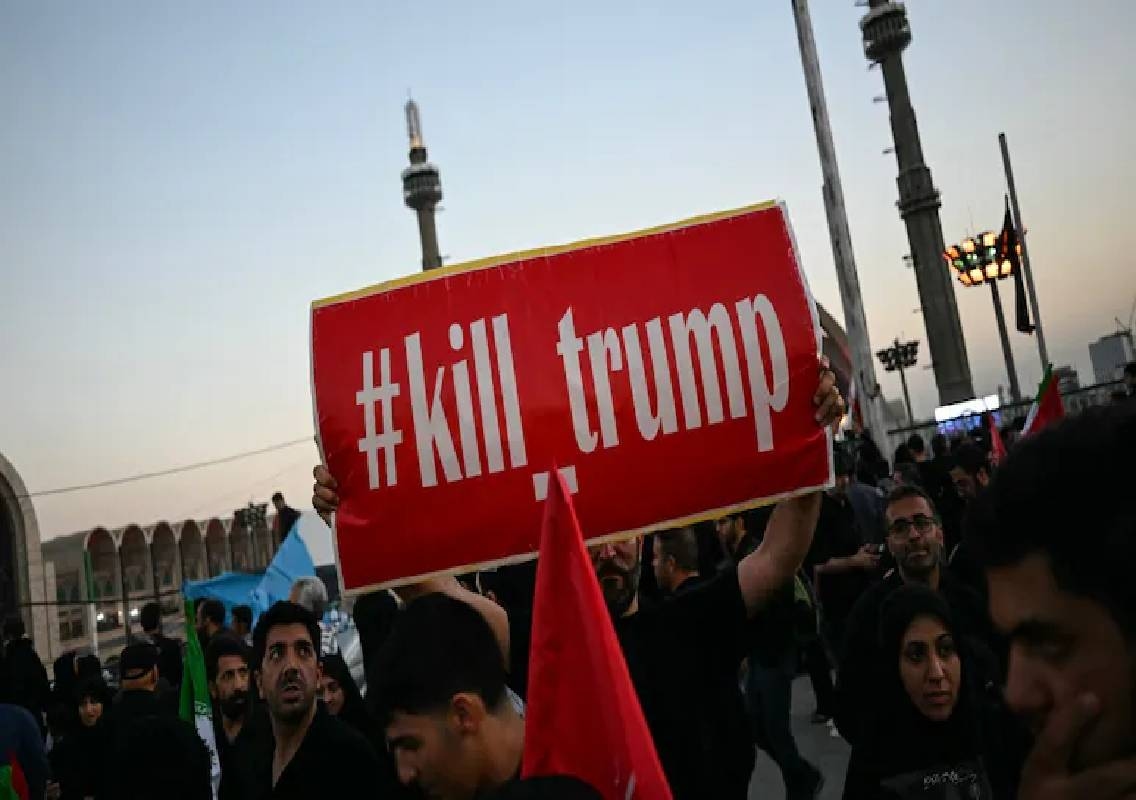


Tehran: Chants calling for the killing of US President Donald Trump and Israeli Prime Minister Benjamin Netanyahu dominated funeral ceremonies for former Iranian Supreme Leader Ayatollah Ali Khamenei in Tehran as senior political and military leaders emerged in public for the first time since the conflict with Israel. The funeral, attended by hundreds of thousands of mourners at the Grand Mosalla prayer complex, became both a tribute to Khamenei and a powerful display of defiance amid continuing regional tensions.
Funeral turns into a show of defiance
Iran has organised a week-long series of funeral processions for Ayatollah Ali Khamenei and four members of his family who were killed during the opening phase of the conflict involving Israel and the United States on February 28.
Crowds gathered overnight at Tehran’s Grand Mosalla, with many arriving before dawn to participate in funeral prayers. Mourners waved Iranian national flags and red flags symbolising revenge while chanting slogans against the United States and Israel.
The ceremony reflected the Iranian leadership’s effort to project unity and public support during a period of heightened geopolitical uncertainty. The funeral is expected to continue through several Iranian cities before concluding with Khamenei’s burial at the Imam Reza shrine in Mashhad later this week.
Calls for revenge dominate the gathering
One of the most striking aspects of the funeral was the repeated calls for revenge against the United States and Israel.
Posters, graffiti and slogans inside and around the Grand Mosalla reportedly called for the assassination of Donald Trump and Benjamin Netanyahu. During the ceremony, poet Mohammad Rasouli addressed mourners and declared that avenging Khamenei’s death had become a responsibility, drawing loud applause from sections of the crowd.
Several mourners also openly demanded retaliation.
One attendee, identified as 29-year-old grocery store worker Gholamreza Sabooni, said those responsible for Khamenei’s death should face consequences and called for revenge against the US President.
Iran’s Ambassador to Armenia, Khalil Shirgholami, also posted a message on X, stating that while individuals can be killed, their ideals cannot, and described Khamenei’s legacy as something that would continue to inspire supporters.
Mohammed Bagher Zolghadr, Secretary of Iran’s National Security Council, said mourners were united behind two messages — resistance against enemies and revenge for the late leader’s death.
Senior Iranian leaders return to public view
The funeral also marked the first major public appearance of several senior Iranian officials and military commanders since the conflict.
Among those attending were President Masoud Pezeshkian, Parliament Speaker Mohammad Bagher Qalibaf and Quds Force commander Esmail Qaani. Revolutionary Guard chief General Ahmad Vahidi also appeared publicly after remaining out of sight during the conflict.
Khamenei’s sons Masoud, Meysam and Mostafa stood alongside the coffins during funeral prayers.
However, Mojtaba Khamenei, widely regarded as the country’s new Supreme Leader, did not attend the ceremony. Reports suggest he remains under heavy security after reportedly suffering injuries during the attack that killed his father. Iranian authorities have previously indicated that concerns over potential assassination attempts have limited his public appearances.
The gathering was widely viewed as an attempt by Iran’s leadership to demonstrate stability and continuity despite recent military setbacks and ongoing security threats.
Religious ceremony draws massive crowds
Funeral prayers were led by 97-year-old Shiite cleric Ayatollah Jafar Sobhani at the Grand Mosalla.
Alongside Khamenei’s coffin were those of several family members, including his daughter-in-law Zahra Haddad Adel and his 14-month-old granddaughter Zahra Mohammadi Golpaygani. Images of the small coffin of the infant drew emotional reactions from mourners attending the ceremony.
Authorities have announced that Khamenei’s remains will travel through several cities in Iran before also being taken to important Shiite religious sites in neighbouring Iraq. His final burial is scheduled to take place at the Imam Reza shrine in Mashhad.
Security remains exceptionally tight throughout the mourning period. Streets have been closed, airspace restrictions remain in place and large sections of Tehran have witnessed extensive security deployments to manage the crowds.
Regional tensions remain high
The funeral comes against the backdrop of continuing diplomatic and military tensions between Iran, the United States and Israel.
Iran continues to oppose US demands regarding its nuclear programme and regional influence, while disputes over the Strait of Hormuz remain unresolved. The strategic waterway is vital for global energy supplies and remains under close international monitoring.
According to maritime authorities overseen by the US Navy, around 70 commercial transits passed through the Strait of Hormuz over the previous 72 hours. While shipping activity has remained steady, officials continue to describe the security threat in the region as substantial, with mine clearance and surveillance operations ongoing.
The funeral has therefore served not only as a national mourning event but also as a political statement highlighting Iran’s continued resistance amid international pressure.
Conclusion
The funeral of Ayatollah Ali Khamenei has become one of the largest public gatherings in Iran in recent years, combining mourning with strong political messaging. While senior Iranian leaders used the occasion to project unity, the repeated calls for revenge against the United States and Israel underscored the deep tensions that continue to shape the region. As funeral ceremonies continue across Iran, attention is likely to remain focused on the country’s leadership, regional security and the future of diplomatic efforts.