







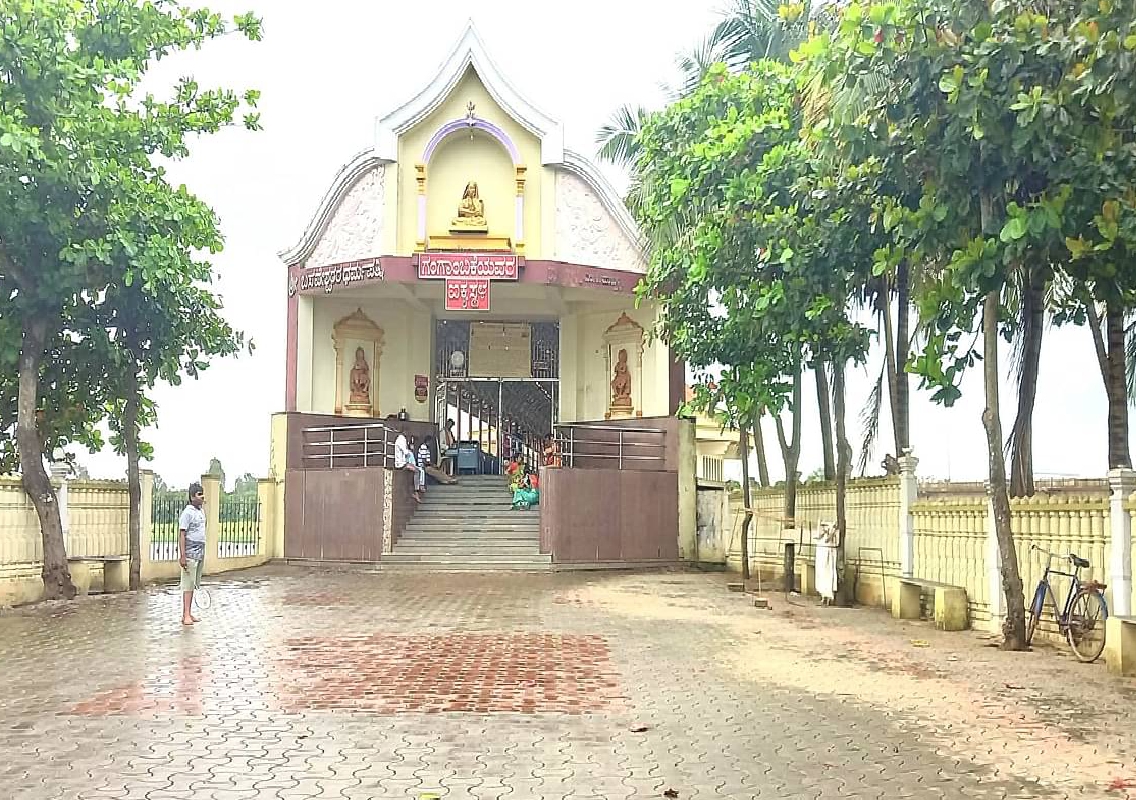


Located 25 kilometres from Belagavi, Mugut Khan Hubli, commonly known as M K Hubli, is a serene village that beautifully blends cultural, historical, and spiritual heritage. Nestled along the Malaprabha river, this charming hamlet is home to sacred sites and monuments that reflect the village’s storied past. Among the village’s most notable landmarks are the Ashwath Lakshmi Narasimha Temple and the tomb of Mugut Khan, a revered 19th-century Sufi saint, both of which attract visitors from near and far.
A Village of Spiritual Significance
M K Hubli is well known for its ancient Ashwath Lakshmi Narasimha Temple, dedicated to Lord Vishnu in his ferocious Narasimha avatar. This temple stands as a testament to the village’s spiritual heritage, attracting devotees and pilgrims who seek the blessings of the deity. The temple is a symbol of religious unity, as the village also honours the Sufi saint Mugut Khan, whose tomb continues to serve as a place of worship for devotees from various faiths.
In addition to its religious landmarks, M K Hubli boasts expansive sugarcane fields, a common sight across the village. The presence of a nearby sugar factory highlights the region’s agricultural prominence and showcases its importance in contributing to the local economy.
The Gangambike Memorial: A Tribute to a Martyr
Among the village’s treasures, the most significant historical monument is the Gangambike Memorial, a towering structure that honours the wife of the 12th-century social reformer, Basavanna. Gangambike, remembered for her immense bravery and dedication to Basavanna’s cause, sacrificed her life while defending the Sharana community and Basavanna’s ideals.
Visitors can access this memorial through a welcoming hall, which leads to a bridge spanning the gushing Malaprabha river. The bridge guides them to a 105-foot dome under which the memorial stands. A serene painting of Gangambike, created by renowned artist S S Hiremath, graces the entry hall leading into the dome. The entire complex is designed in a way that allows access to the memorial even during monsoon, when the Malaprabha swells, submerging the original temple below its bed.
The temple, thought to be approximately 800 years old, lies several feet below ground level and is only visible during the driest months of summer. To preserve the sanctity of the site and allow year-round access, the Kudalasangama Development Board constructed the Gangambike Memorial in 2009. Today, it stands as a proud symbol of the village’s historical importance.
The Life and Legacy of Gangambike
Gangambike was the only daughter of Baladev, the prime minister in the court of Bijjala, the 12th-century ruler of the Kalachuri dynasty. After the early death of her mother, Baladev raised Gangambike with care, ensuring she received an education in Kannada, Sanskrit, music, and the arts of sword-fighting and archery. Gangambike was known not only for her intelligence and beauty but also for her unwavering bravery.
As Gangambike matured, her father began seeking a suitable groom for her. He had heard of Basavanna’s fame and virtues and decided that he would be an ideal match for his daughter. Basavanna, who was Baladev’s nephew, was already a well-known figure by this time, revered for his revolutionary ideas and social reforms.
After their marriage, Gangambike became an active supporter of Basavanna’s reforms. At their home, called Mahamane, she managed the ‘anna dasoha’, a programme that provided free meals to thousands of people daily. Her efforts were crucial in supporting Basavanna’s initiatives, especially the Anubhava Mantapa, a spiritual academy where intellectuals gathered to discuss social and religious issues. Gangambike’s sharp intellect and understanding of Basavanna’s vision made her a vital figure in his reform movement.
The Courageous End of Gangambike
In the wake of Bijjala’s murder, his successor Rayumurari Sovideva’s army unleashed violence on Basavanna’s followers, the Sharanas. During this period, Gangambike was involved in the dasoha and later accompanied Channa Basavanna, Basavanna’s nephew, to Ulavi. Many of the Sharanas scattered in an attempt to protect the precious literature of Basavanna, even risking their lives in the process.
Gangambike’s bravery eventually led to her martyrdom at Kadrolli, near M K Hubli, where she was killed by Sovideva’s forces. Her body was buried by Basavanna’s followers, and for years, her grave remained hidden beneath the waters of the Malaprabha river. Today, the Akkagangambike Trust, set up in M K Hubli, works to honour her memory and share her story of valour and sacrifice.
A Rich Cultural Heritage
M K Hubli’s significance goes beyond its spiritual and historical landmarks. The village’s rich cultural heritage is reflected in its traditional practices, festivals, and its contribution to Karnataka’s agricultural prosperity. As a quiet yet important part of Belagavi’s landscape, the village draws visitors seeking to learn more about the lives of those like Gangambike, who played crucial roles in shaping the state’s spiritual and social history.
For those interested in Karnataka’s vibrant history, M K Hubli is a must-visit destination that promises a blend of spirituality, history, and natural beauty.