







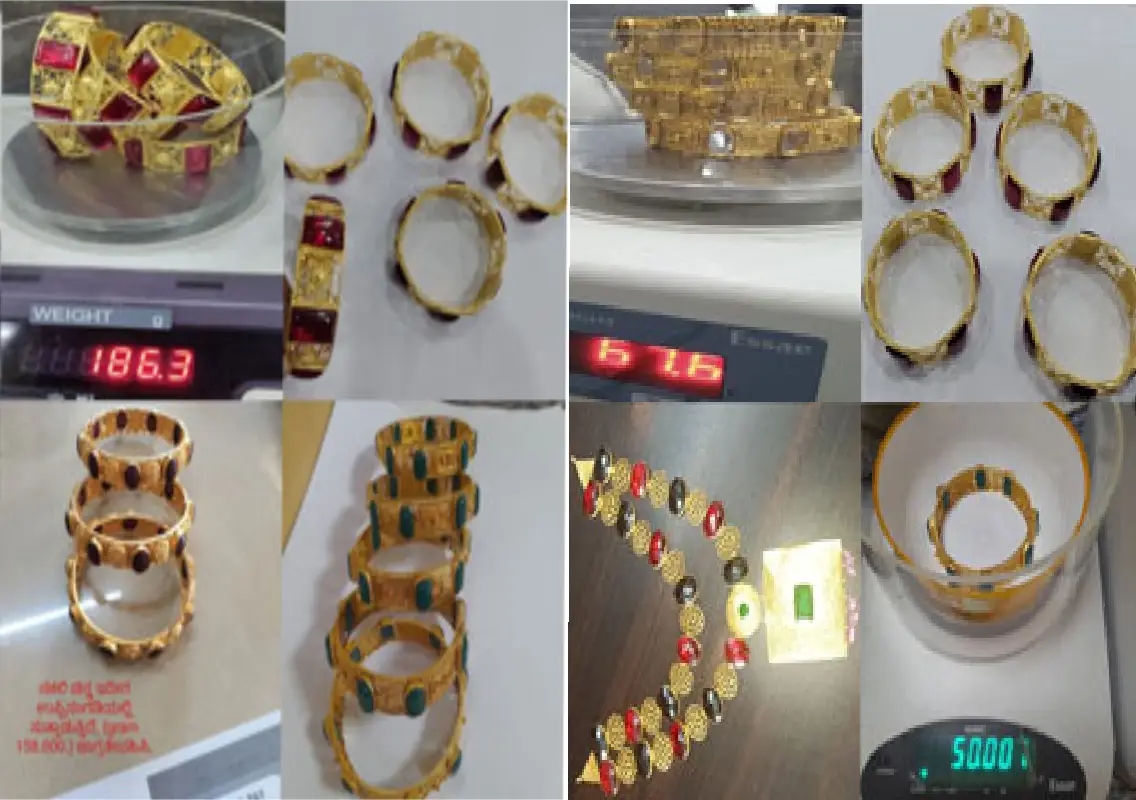


Mangaluru: A sophisticated gold loan fraud has reportedly surfaced in and around Mangaluru, raising serious concerns among cooperative societies and banks, particularly at a time when gold prices are touching record highs. An organised group is alleged to be cheating financial institutions by pledging gold jewellery embedded with artificially heavy fake stones to secure inflated loan amounts running into several lakhs of rupees.
The scam has reportedly come to light in several areas on the outskirts of Mangaluru, including Thokkottu, Ullal and Mudipu. Preliminary information suggests that the accused are exploiting a major loophole in the gold loan appraisal process followed by many cooperative societies and smaller banks, where the stones fixed in jewellery are neither separated nor accurately weighed before sanctioning loans.
Loophole in gold appraisal process exploited
In most cooperative societies, gold ornaments are assessed based on their gross weight, and the value is calculated accordingly. However, these institutions often lack specialised equipment or trained personnel to identify and segregate stones embedded in jewellery. Fraudsters are allegedly taking advantage of this gap by manufacturing ornaments with chemically processed fake stones that are significantly heavier than genuine stones.
By embedding these artificially weighted stones into bangles and other ornaments, the overall weight of the jewellery increases substantially. As a result, when such items are pledged, the gross weight appears much higher, enabling the borrower to secure a loan amount far exceeding the actual value of the gold content.
Banking sources said this method is particularly effective during periods of high gold prices, as even a small increase in weight can translate into loans worth several lakhs of rupees.
Shocking case highlights scale of fraud
A recently detected case has highlighted the alarming scale of the fraud. According to sources, a gold bangle containing only 50 grams of actual gold was presented as weighing a total of 186.3 grams. Upon closer examination, it was found that a single fake stone embedded in the bangle weighed as much as 4.1 grams.
This manipulation allowed the accused to obtain a loan amount that was disproportionately higher than the true gold value. Cooperative society officials said that multiple such instances may have gone unnoticed in the past, leading to significant financial exposure.
“There is a genuine fear that several societies may already be sitting on bad loans without realising it,” said a senior official from a cooperative institution, speaking on condition of anonymity.
Suspected organised network operating across districts
Investigators and banking circles believe that the scam is not the work of isolated individuals but an organised network with access to skilled jewellery makers and chemical processing methods. There is growing suspicion that the fraud is not limited to Dakshina Kannada district alone and may have spread to neighbouring districts as well.
The modus operandi reportedly involves moving from one cooperative society or bank to another, pledging such jewellery and avoiding repeat visits to the same institution to reduce the risk of detection. Due to the lack of a centralised alert system or shared database among cooperative societies, tracking such fraudulent borrowers becomes extremely difficult.
Officials said that many bank and society staff are now anxious, as they fear retrospective scrutiny and potential losses once the pledged ornaments are re-evaluated.
Cooperative sector under pressure
The cooperative banking sector, which largely caters to small traders, farmers and middle-class families, is particularly vulnerable to such frauds. Unlike commercial banks, many cooperative societies operate with limited resources and rely heavily on trust-based systems.
Experts warn that if the issue is not addressed urgently, it could undermine confidence in gold loan schemes, which are a critical source of liquidity for many households and small businesses.
Calls for police action and awareness drives
In view of the seriousness of the matter, there is increasing public demand for immediate intervention by the police department, supervisory authorities and specialised awareness squads. Citizens and banking experts have urged the authorities to conduct a comprehensive investigation to expose and dismantle the organised network behind the scam.
There are also calls for training bank and cooperative society staff to identify fake stones, invest in proper gold-testing equipment, and adopt stricter verification protocols. Some have suggested mandatory random checks of pledged ornaments and periodic audits to detect irregularities early.
Conclusion
The emergence of the fake stone gold loan scam has exposed a critical vulnerability in the gold appraisal systems of cooperative societies in and around Mangaluru. As gold prices continue to rise, the risk of such frauds is likely to increase unless immediate corrective measures are implemented. A coordinated response involving law enforcement, banking regulators and public awareness is essential to prevent further financial damage and restore trust in the system.