







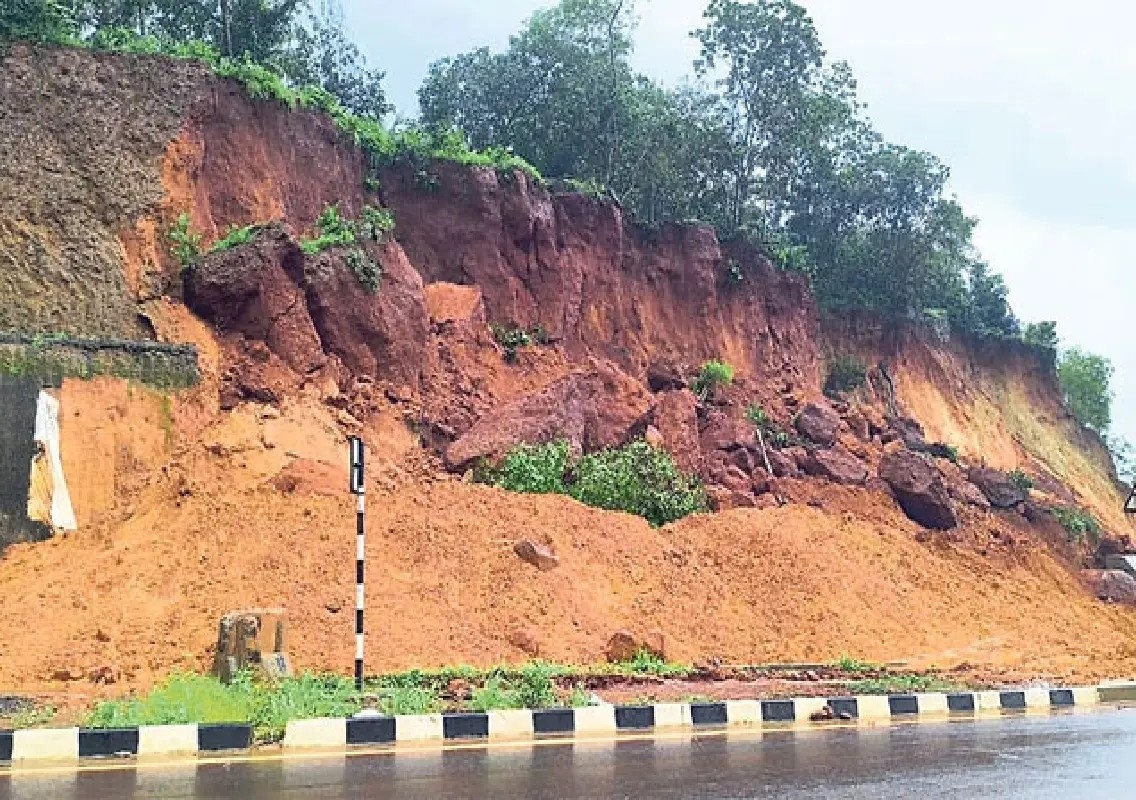


Mangaluru: Work on a gabion wall at the landslide-prone Kethikal stretch of National Highway 169 between Mangaluru and Moodbidri has resumed, with authorities aiming to complete the protective structure by January. The project is expected to provide a long-term solution to recurring monsoon landslides and the traffic disruptions caused by them.
The work is being carried out by Dilip Buildcon under the supervision of the National Highways Authority of India (NHAI). The protective measures are being implemented based on recommendations made by the National Institute of Rock Mechanics (NIRM), Bengaluru, following studies of the unstable slope.
Officials said the gabion wall work was not part of the original highway project. It has now been taken up as a disaster management measure with the approval of the deputy commissioner, following repeated landslides at the location.
100-metre retaining wall planned
An additional retaining wall of around 100 metres is being constructed near the Vamanjoor Government School building. Of the planned stretch, around 15 metres of work has already been completed.
The construction remains challenging due to the continuing risk of soil collapse. However, workers are carrying out the project wherever weather and ground conditions permit.
Officials have set January as the target for completing the entire rehabilitation work. Construction activity is expected to gain further momentum once the rainfall stops completely and the slope becomes more stable.
Kethikal has two stretches that have been identified as particularly vulnerable to landslides. One of these locations had witnessed a landslide earlier, while another was affected during the current monsoon season.
The gabion wall is currently being constructed at one of the vulnerable locations. Work at the second stretch will be taken up after the ongoing construction is completed, officials said.
Private land access needed for protection work
Authorities said the land acquired by the highway authority for the gabion wall has been exhausted, making access to adjoining private property necessary for completing the slope protection measures.
Nailing work is required on a portion of private land adjoining the highway. A local family has agreed to allow the authorities to carry out the work on its property.
The family has also provided written consent and informed the authorities that space would be left for an arrangement to drain rainwater from the area.
As part of the slope protection plan, a five-metre-high wall will be provided on the private property, along with nailing work at the top of the slope.
A concrete slope protection structure using cement, plastic and steel rods is also planned. These measures are intended to strengthen the unstable soil and reduce the possibility of further collapse during heavy rain.
Drainage and slope protection measures included
Proper drainage is a key part of the rehabilitation work at Kethikal. A culvert and catch pit have already been installed to channel water flowing down from the hill and prevent uncontrolled water accumulation along the slope.
Officials are also placing geo-composite material between different sections of the protective wall. The material is expected to support the growth of green grass and improve slope stability.
The combination of drainage, nailing and retaining structures is aimed at addressing the factors that contribute to soil movement and landslides at the site.
The work is being carried out carefully because of the unstable terrain and the importance of keeping the highway safe for regular traffic.
NIRM recommendations guide construction
The rehabilitation work is being carried out according to recommendations made by the National Institute of Rock Mechanics, Bengaluru.
NIRM had studied the site after a major landslide occurred during highway construction around three years ago. A five-member team of scientists visited Kethikal, examined the conditions and submitted a report recommending measures to stabilise the slope.
Based on these recommendations, rocks are being secured using iron rods in a large cage-like structure to stabilise the soil before the gabion wall is built.
The entry and exit stretches of the highway are also being constructed at different elevations, as advised by NIRM. Officials said this has been done while taking precautions to prevent excessive load from affecting the road structure.
The technical recommendations are expected to help create a more durable solution for the landslide-prone stretch.
Work resumes after monsoon disruption
Construction activity had earlier been halted due to the monsoon and unstable conditions at the site. With work now resuming, authorities are focusing on completing the first phase of the protective measures before taking up the second vulnerable stretch.
Officials said the pace of work would increase once rainfall subsides completely. The January deadline has been set with the aim of completing the permanent protective measures before the next monsoon season.
Repeated landslides at Kethikal have posed challenges to the construction and maintenance of the Mangaluru-Moodbidri highway. The latest work is therefore being treated as an important disaster management intervention rather than a routine component of the original highway project.
Officials expressed confidence that the gabion wall and associated slope stabilisation measures, implemented according to NIRM’s recommendations, would help reduce the risk of future landslides.
The completion of the project by January is expected to provide safer travel on this important highway stretch and minimise the possibility of prolonged traffic disruptions during future monsoons.