







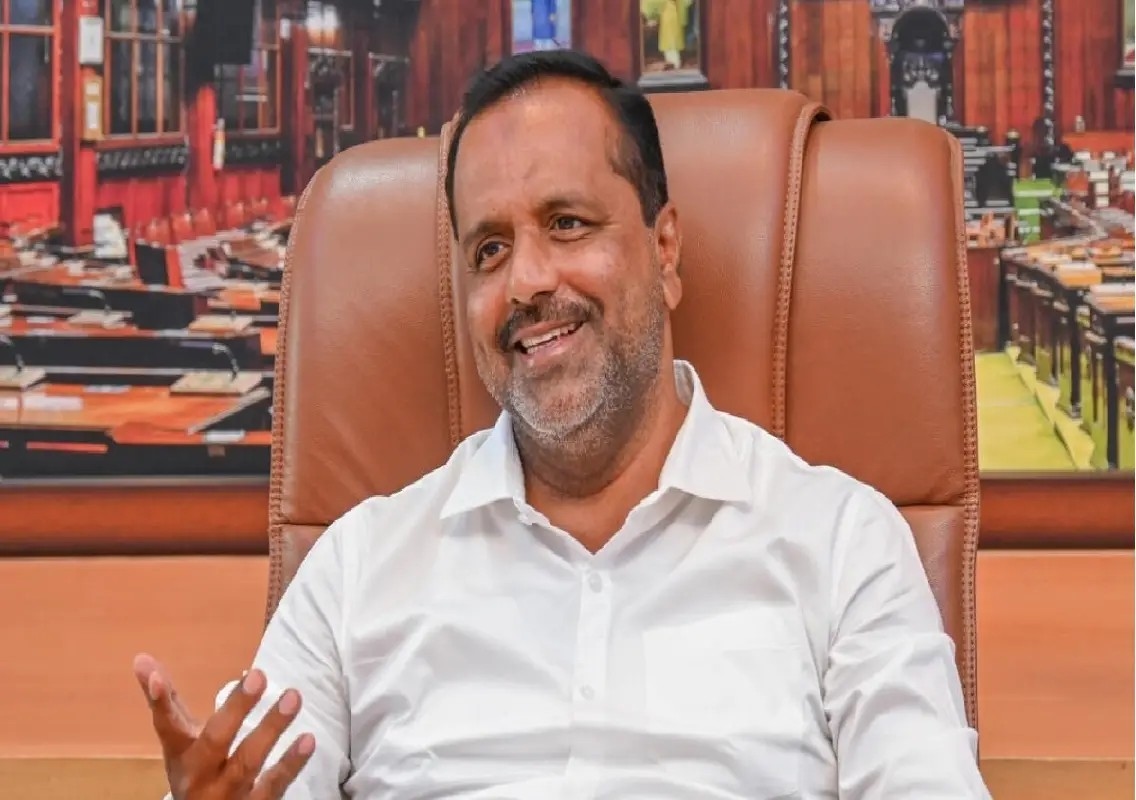


Mangaluru: State Health and Family Welfare Minister U T Khader on Monday called for swift follow-up action on the decisions taken at the recent Cabinet meeting in Mangaluru, stressing that administrative approvals and concrete action plans should not be delayed.
Addressing a press conference at the Circuit House in Mangaluru, Khader said a preliminary meeting with officials had already been convened to identify projects sanctioned for Dakshina Kannada and prepare detailed action plans and estimates.
He said the officials concerned were working to finalise the proposals so that they could be submitted to the government at the earliest.
Action plans for Cabinet projects
Khader said the Cabinet decisions would have to move beyond announcements and be translated into concrete projects through proper administrative procedures.
The preliminary discussions with officials are aimed at identifying the projects approved for Dakshina Kannada, assessing their requirements and preparing estimates. Once the proposals are finalised, they will be submitted to the government for further action and approvals.
He said the process was being taken up to ensure that the decisions announced during the Cabinet meeting lead to visible development works in the district.
The Cabinet meeting held in Mangaluru had resulted in several decisions concerning Dakshina Kannada and other coastal areas.
Local bodies get powers for small layouts
Khader also announced the delegation of powers to approve single-plot layout plans measuring up to 1,000 square metres, equivalent to around 25 cents.
The move is aimed at reducing difficulties faced by members of the public in obtaining 9/11 approvals for such properties.
Under the new arrangement, the authority to process and approve eligible applications will depend on the jurisdiction. At the gram panchayat level, the powers will be exercised by Panchayat Development Officers (PDOs), while chief officers will handle the process at the town level.
In municipal areas, the respective commissioners will exercise the delegated powers.
Khader said detailed rules governing the exercise of these powers would be framed by the concerned departments shortly.
The delegation is expected to reduce the need for people with smaller single-plot properties to approach higher authorities for approvals, thereby simplifying the administrative process.
Guidelines planned for Tulu official language status
Speaking about the Cabinet’s recent decision to grant official language status to Tulu, Khader said guidelines would be prepared to clarify how the decision would be implemented in government administration.
He said mechanisms would be put in place to facilitate applications submitted in Tulu through translation arrangements.
The proposed guidelines would also clarify the use of Tulu and Kannada scripts in official communication and administrative procedures.
The announcement follows the Cabinet’s decision to recognise Tulu as Karnataka’s second official language, a move that has generated considerable discussion across the coastal region.
Khader said the implementation would require clear administrative guidelines so that government departments could follow a uniform procedure.
Public views sought on Mangaluru renaming
On the proposed renaming of Dakshina Kannada district as Mangaluru district, Khader said the Cabinet had granted in-principle approval and provided one month for the public to submit their views.
He said the final decision would take into consideration the opinions and sentiments expressed by the people during the consultation period.
Members of the public can submit their suggestions and objections to the Deputy Commissioner, he said.
The consultation process will therefore precede the government’s final decision on the proposed name change.
Khader defends PPP model
Responding to questions about funding for projects announced by the government, Khader said Cabinet-approved projects would be taken forward.
He said the Finance Department’s role was to examine the financial implications of projects and ensure that funds were allocated appropriately.
Khader also defended the proposed Public-Private Partnership (PPP) model for projects such as Mangaluru Haat.
He said the government would continue to retain policy control, while private participation could bring professional expertise in areas such as operation and maintenance.
According to Khader, the PPP model would allow the government to retain its role in policy and oversight while using private-sector participation for the professional management of facilities.
Wenlock to get 200-bed expansion
On healthcare infrastructure, Khader said the government had approved an initial 200-bed expansion at Wenlock Hospital in Mangaluru.
He said further expansion could be considered subsequently depending on requirements.
Khader also stressed the importance of strengthening taluk-level hospitals so that patients would not have to be referred unnecessarily to district hospitals.
He said the government was planning Tele-ICU facilities as part of efforts to improve access to critical care and strengthen healthcare delivery.
A system to monitor bed availability is also being planned, which would help hospitals and authorities track available capacity and manage patient referrals more effectively.
Focus on preventive healthcare
Khader also highlighted the need for greater emphasis on preventive healthcare, particularly in relation to excessive salt consumption.
He said the government was considering measures to create awareness about excessive sodium intake and encourage healthier food practices.
The minister said concerns over high medicine prices would also be raised with the Union government.
He further announced plans to hold a national-level conference of food and drug safety officials in Bengaluru. The conference is expected to provide a platform to discuss issues relating to food safety, drug regulation and public health.
Khader raises concerns over SIR
Khader also spoke about voter rights in the context of the Special Intensive Revision (SIR) of electoral rolls.
He said the responsibility of the Election Commission was not limited to identifying and removing ineligible names from voter lists, but also included ensuring that all eligible citizens were included.
He stressed that genuine voters should not lose their voting rights during the revision exercise.
Khader called for proper verification before names are deleted from electoral rolls, emphasising the importance of protecting the voting rights of eligible citizens while carrying out the revision.
The minister’s comments come as the electoral roll revision process continues, with scrutiny of voter records and verification of eligible electors forming a key part of the exercise.
The issues raised by Khader covered the implementation of Cabinet decisions, local governance, language policy, healthcare infrastructure, preventive health measures and electoral rights, with an emphasis on administrative follow-up and implementation.