









Mangaluru: Krishna Janmashtami, commemorating the birth of Lord Krishna, is being celebrated from midnight on Friday, September 4, into the early hours of Saturday, September 5. This year, the festival holds particular significance for devotees as the Ashtami Tithi and Rohini Nakshatra coincide during the celebrations.
The Ashtami Tithi began at 2:25 am on September 4 and concludes at 12:13 am on September 5. The Rohini Nakshatra began at 12:29 am on September 4 and continues until 11:04 pm on the same day.
Lord Krishna is worshipped across India and in several countries through diverse religious and cultural traditions. Devotees observe fasts, offer special prayers, sing bhajans and participate in temple rituals and cultural programmes. Many temples also organise Krishna Lila performances depicting important episodes from the life of Lord Krishna.
Karnataka observes Janmashtami with devotion
In Karnataka, Krishna Janmashtami is marked by special prayers, bhajans, devotional programmes and temple rituals.
Children are traditionally dressed as Lord Krishna and Radha, while homes and temples are decorated to commemorate the birth of the deity. Families and communities participate in devotional activities, with celebrations often combining religious observances with cultural programmes.
The festival takes on a particularly vibrant character in coastal Karnataka, where traditional community celebrations form an important part of Janmashtami festivities.
Mangaluru’s vibrant Mosaru Kudike tradition
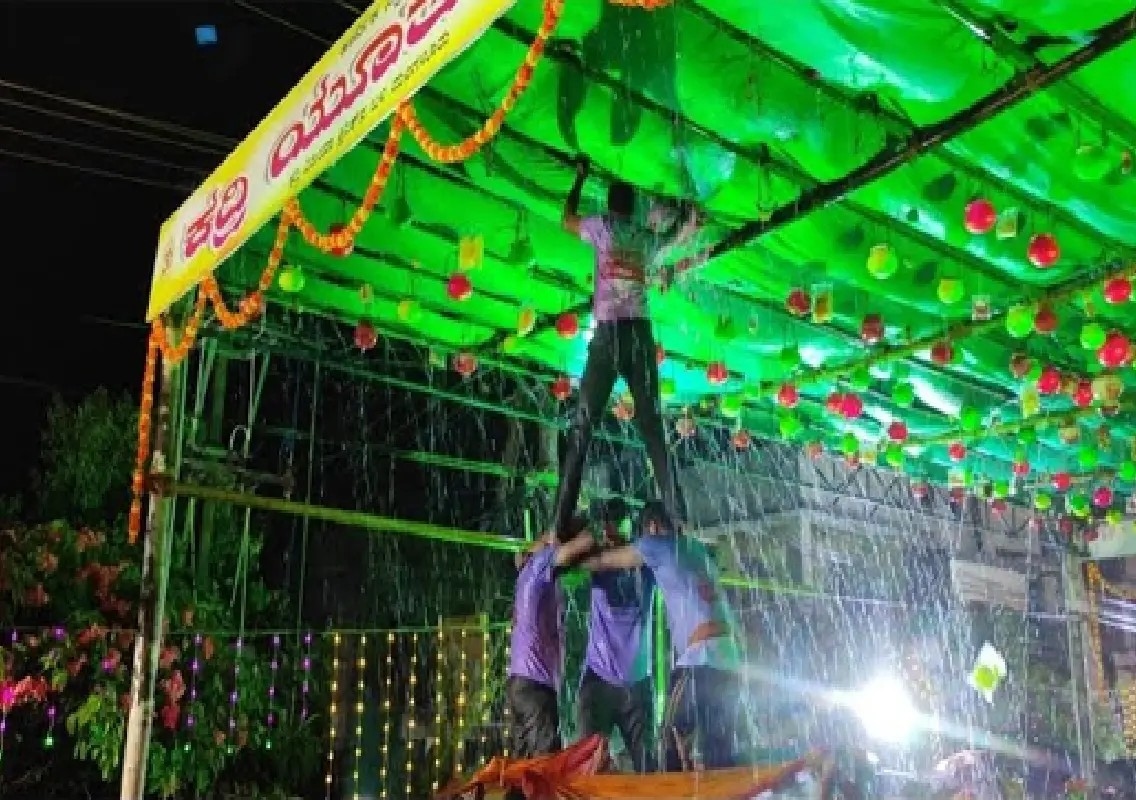
In Mangaluru and other parts of coastal Karnataka, Janmashtami celebrations culminate in the colourful Mosaru Kudike tradition.
The celebrations feature processions, music, dance, cultural performances and the ceremonial breaking of curd-filled pots. Devotees and youth groups participate enthusiastically, while decorated vehicles and tableaux add colour to the festivities.
Mosaru Kudike is closely associated with the playful childhood stories of Lord Krishna, particularly his fondness for butter and curd.
Celebration of Krishna’s playful childhood
The tradition symbolises Krishna’s childhood stories of stealing butter and curd. The ceremonial breaking of the pot recreates the playful spirit associated with these stories.
Beyond its religious significance, Mosaru Kudike has become a major community celebration in Mangaluru, bringing together people from different sections of society.
Youth groups, devotees and cultural organisations participate in the festivities, while music and traditional performances contribute to the atmosphere.
Processions draw crowds in Mangaluru
Several parts of Mangaluru witness large Mosaru Kudike processions during Janmashtami.
Colourfully decorated vehicles, tableaux, drums, music and dance performances accompany the processions. Large numbers of devotees and spectators gather along the routes to witness the celebrations.
The scale of the events also requires traffic-management arrangements. Police personnel are deployed along procession routes to regulate vehicle movement and facilitate the smooth conduct of the festivities.
The combination of temple rituals and public celebrations gives Janmashtami a distinctive character in coastal Karnataka.
North India celebrates Krishna’s birthplace
In North India, devotees observe Janmashtami through fasting, devotional singing and religious programmes. Mathura, traditionally regarded as the birthplace of Lord Krishna, and Vrindavan, associated with his childhood, are among the most prominent centres of celebration.
Rasa Lila performances are an important part of festivities in several areas. These dramatic and devotional presentations depict Krishna’s interactions with the gopis and his childhood and youthful stories.
Temples and public spaces are decorated, while devotees participate in midnight prayers marking the traditional time of Krishna’s birth.
Maharashtra’s Dahi Handi tradition
In Maharashtra, Janmashtami is strongly associated with Dahi Handi.
Teams form human pyramids to reach and break a pot filled with curd, recreating the childhood tradition associated with Krishna’s playful attempts to obtain butter.
The celebrations often attract large crowds and feature music, cultural programmes and competitions. Dahi Handi has become one of the most recognisable public expressions of Janmashtami celebrations in Maharashtra.
Gujarat worships Dwarkadhish
In Gujarat, Lord Krishna is widely worshipped as Dwarkadhish, the king of Dwarka.
Temples and communities organise bhajans, prayers, devotional programmes and traditional dances. Dwarka holds particular religious significance for Krishna devotees and becomes a major centre of pilgrimage during the festival.
The celebrations combine temple worship with cultural traditions that reflect Krishna’s association with the region.
Southern and eastern traditions
In Tamil Nadu, Krishna is celebrated as the divine child and protector. Temples often feature elaborate decorations, sculptures and paintings depicting episodes from his life.
In Odisha, Krishna is closely associated with the Jagannath tradition. He is worshipped alongside Balarama and Subhadra as part of the broader religious traditions surrounding Lord Jagannath.
In West Bengal, the relationship between Krishna and Radha receives particular emphasis. Devotional singing, prayers and cultural programmes form an important part of the celebrations.
Janmashtami gains global following
Krishna Janmashtami is also observed by Hindu communities and Krishna devotees outside India.
In the United States, the International Society for Krishna Consciousness, commonly known as ISKCON, organises large Janmashtami gatherings featuring kirtans, spiritual discourses, cultural performances and vegetarian feasts. Dramatic presentations based on Krishna’s life are also held at several temples.
In the United Kingdom, major celebrations are organised by the Krishna consciousness community, including at ISKCON’s Bhaktivedanta Manor. The programmes feature prayers, music, dance and devotional gatherings.
Celebrations in Trinidad and Tobago and Bali
Hindu communities in Trinidad and Tobago also observe Krishna Janmashtami through fasting, prayers, devotional singing and discussions on the teachings of the Bhagavad Gita.
In Bali, Krishna is revered within the island’s distinctive Hindu religious traditions. His worship is incorporated into local customs and broader religious festivals, reflecting the way Krishna traditions have adapted to different cultural settings.
Krishna’s universal appeal
While the customs associated with Janmashtami differ from region to region and country to country, the celebrations are united by devotion to Lord Krishna.
Krishna is widely regarded as an embodiment of divine love, compassion and playfulness, as well as a spiritual teacher. His teachings in the Bhagavad Gita emphasise duty, righteousness, devotion and spiritual wisdom.
From midnight prayers and temple rituals to Mangaluru’s energetic Mosaru Kudike and Maharashtra’s Dahi Handi, the festival reflects the diversity of traditions through which Krishna’s birth is celebrated.
The varied celebrations across India and abroad demonstrate how Janmashtami has retained its religious significance while also becoming an important expression of local culture, community participation and devotional traditions.