







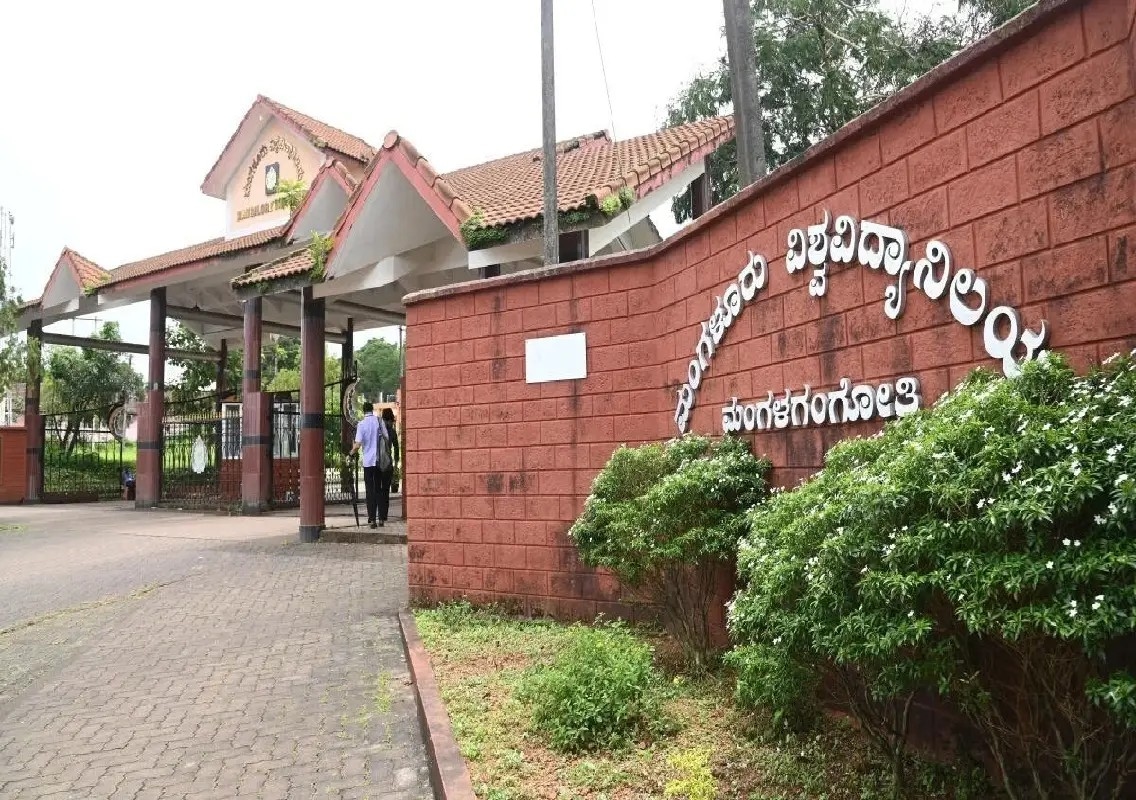


Mangaluru: Mangalore University has temporarily discontinued 16 postgraduate programmes for the 2026-27 academic year after they failed to attract the minimum number of students required to conduct the courses.
Vice-Chancellor Prof. P.L. Dharma said the decision was taken in accordance with government guidelines, which require a minimum of 15 students for a postgraduate programme to be conducted.
The programmes affected include Analytical Chemistry, Electronics, Cyber Security, MEd, Sociology, MCom (HRD), Bioscience, MCJ, Tulu, Konkani, Hindi, Sanskrit, Statistics, Environmental Science, Material Science and Geoinformatics. These programmes are offered at the university campus as well as affiliated colleges.
Several programmes record poor admissions
Prof. Dharma said some of the affected programmes had been struggling to attract students for several years.
“Analytical Chemistry has not received any admissions for the past two years,” he said, adding that MSc Statistics had not received admissions for the past three years.
The university currently has second-year students pursuing MA Sociology, while the MCJ programme has students only for the open elective.
MSc Environmental Science has also failed to attract the required number of students despite growing public concern over environmental issues and the availability of a well-equipped laboratory at the university.
MSc Material Science, meanwhile, has not attracted students for the past three years, according to the Vice-Chancellor.
Prof. Dharma said several postgraduate programmes were also facing a shortage of teaching faculty and had become dependent on guest faculty.
“We cannot run postgraduate programmes with just two or three students, as this is not in accordance with government guidelines,” he said.
Departments may be grouped under schools
Mangalore University is also planning to bring related postgraduate departments under schools of studies as part of an effort to address the shortage of senior teaching faculty and improve the functioning of the departments.
Under the proposed arrangement, Bioscience, Applied Botany and Applied Zoology, Food Science and Microbiology will be brought under one school.
Marine Geology and Geography are proposed to be grouped under another school.
“Setting up a school of studies essentially means bringing postgraduate departments belonging to related streams under one banner,” Prof. Dharma explained.
The proposed restructuring is intended to facilitate better coordination among related departments and address challenges arising from limited faculty resources.
Four colleges did not seek affiliation
Around 150 colleges in Dakshina Kannada and Udupi districts are affiliated with Mangalore University.
The affiliated institutions include 33 government colleges, 23 aided colleges, 70 unaided colleges, 11 education colleges, nine autonomous colleges and four constituent colleges.
Prof. Dharma said four colleges did not apply for affiliation for the 2026-27 academic year. They are Ambika Mahavidyalaya, Puttur; Anjuman First Grade College, Jokatte; Prerana College; and Bharathi College.
The Vice-Chancellor also spoke about admissions to the university’s constituent colleges at Nelyadi and Bannadka. He said no new batch of students had been admitted to these institutions.
“The Cabinet will take a decision on attaching these colleges to the nearest government colleges,” he said.
The Evening College at Hampankatta is currently offering only an MBA in International Business. The university is planning to shift the college to the Mangalore University campus, Prof. Dharma said.
Academic Council approves revised PhD regulations
The Academic Council also approved revised regulations governing the award of PhD degrees.
The regulations incorporate recommendations made by the Standing Committee of the Karnataka State Higher Education Council and have been prepared in accordance with the UGC (Minimum Standards and Procedures for Award of PhD Degree) Regulations, 2022.
Mangalore University had constituted a committee comprising deans and senior professors to prepare regulations governing its PhD programmes.
The draft regulations were approved by the Academic Council on October 9, 2025, and submitted to the government on November 25, 2025.
The draft was subsequently placed before the Standing Committee of the Karnataka State Higher Education Council. The committee directed the university to incorporate its observations and resubmit the regulations.
The revised draft, incorporating the recommendations, was subsequently approved by the Academic Council.
Prof. Dharma said Mangalore University was the only university to have prepared the revised regulations and that the Karnataka State Higher Education Council had circulated them among other state-run universities.
New courses and programmes approved
The Academic Council approved several new and revised academic programmes during the meeting.
The revised curriculum for the add-on course in Retail Management and Digital Marketing was approved, along with the curriculum for the first and second semesters of the BCom (Human Resources Operations) AEDP programme.
The curriculum for the fifth and sixth semesters of the BA Rural Development core course was also approved.
New affiliation was granted to Prestige School of Management and Innovation to offer BBA in Logistics, BCA in Artificial Intelligence and Machine Learning, and BCA in Data Analytics.
The Council also approved Tulu and French as optional subjects in undergraduate programmes at Alva’s College.
MBA in Healthcare Management and MCA programmes were also approved, while the BSc Data Science programme at Vivekananda College of Arts, Science and Commerce received approval.
Event and hospitality courses approved
The Academic Council approved certificate and diploma programmes in Event and Hospitality Management following an MoU between Mangalore University and Wedmin Academy Pvt. Ltd.
Prof. Dharma said the programmes would provide students with practical exposure while creating an opportunity for the university to utilise student skills during major events.
“If commerce students on the university campus undergo the certificate and diploma programmes in event and hospitality management, we can utilise their services while hosting convocations and other major programmes at the university,” he said.
According to the Vice-Chancellor, such practical exposure could benefit students while also helping the university reduce expenditure on organising major events.
The Academic Council meeting was chaired by Prof. P.L. Dharma. Mangalore University Registrar Santhosh Jagalasar, Registrar (Evaluation) Dr H. Devendrappa and Finance Officer S. Panchalingaswamy were present.
The decisions taken at the meeting reflect the university’s efforts to rationalise postgraduate programmes with low enrolment, restructure related departments, update academic regulations and introduce courses aligned with emerging academic and industry requirements.