







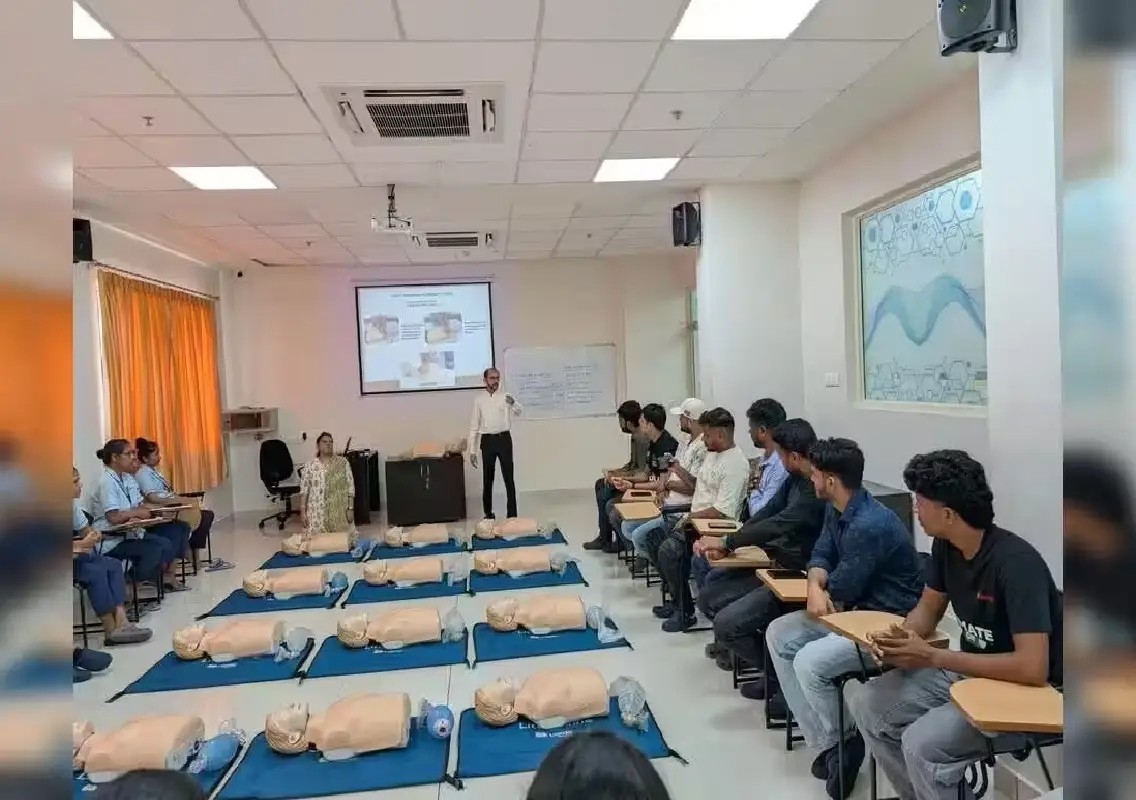


Mangaluru: What began as a routine Saturday for a group of bikers turned into a life-saving learning experience as 30 riders from the Tulunadu chapter of Riding Brotherhood underwent hands-on training in cardiopulmonary resuscitation (CPR) and first aid at Justice KS Hegde Charitable Hospital, Deralakatte.
The one-day programme was organised by the Department of Public Health, Nitte (Deemed to be University), in association with Nitte Medical Simulation Centre (Nu-MEDISiM), KS Hegde Medical Academy, with support from Riding Brotherhood.
The training was designed to equip bikers with practical skills to respond to medical emergencies and road accidents before professional medical assistance arrives.
Riders trained in emergency response
Participants underwent practical training in adult, child and infant CPR, along with the use of an automated external defibrillator (AED).
The session also covered choking management, safe patient handling, bleeding and wound care, treatment of burns, fracture immobilisation, and appropriate responses to shock and fainting.
Given the nature of motorcycle travel, particular attention was given to situations that riders could encounter on roads. Emergency scenario-based exercises covered road accidents, head injuries, fractures, falls, burns, bleeding and choking.
The participants were given opportunities to practise the techniques rather than only learn them theoretically. Trainers assessed each participant individually, corrected techniques where necessary and helped the riders build confidence in responding to emergencies.
Focus on immediate help before medical assistance
The programme emphasised the importance of timely action during emergencies, when professional medical help may not be immediately available.
Riders can potentially be among the first people to reach the scene of a road accident. Basic knowledge of CPR, bleeding control, fracture immobilisation and safe handling of injured persons can help them respond appropriately while waiting for emergency medical services.
The training therefore sought to make emergency response skills accessible to members of the riding community and encourage a safety-oriented approach to group and individual riding.
“Accidents can happen to anyone, anytime. In those critical moments, knowing what to do can make a real difference,” said Nikhil Thingalaya, founder and administrator of Riding Brotherhood.
Initiative by biker and public health team
The initiative was conceived by Jupiter Lobo, a biker and member of Harley Owners Group, and Nikhil Thingalaya.
The programme brought together members of the riding community and medical simulation and public health professionals to provide practical emergency-response training.
The programme was inaugurated in the presence of Prof Sripada G Mehendale, coordinator, Nu-MEDISiM; Dr Shruthi KT, assistant coordinator, Nu-MEDISiM; Prof Mackwin D’Mello, coordinator, Department of Public Health and chairperson of the workshop; Jupiter Lobo, assistant professor and organising secretary; and Dr Ashith PC, public health specialist.
The organisers said the collaboration was aimed at helping participants develop the skills and confidence required to respond to emergencies in the initial minutes following an incident.
Scenario-based exercises strengthen practical skills
The emergency exercises simulated situations that riders could encounter during their journeys, including road crashes, head injuries, fractures and falls.
Participants also practised responses to burns, severe bleeding and choking.
The trainers monitored the riders during the exercises and provided individual feedback. Techniques were corrected where required to ensure that participants understood the appropriate steps for providing first aid and performing CPR.
The use of simulation-based training allowed participants to practise emergency procedures in a controlled environment before potentially having to use them in real-life situations.
The training covered different age groups, with participants learning CPR procedures for adults, children and infants.
Pre-test and post-test conducted
The programme began with a pre-test to assess participants’ existing knowledge of CPR and first aid.
Following the practical sessions and emergency scenario exercises, a post-test was conducted to assess their learning.
The programme was conducted by Prof Mehendale and Dr Shruthi KT, with support from Sr Judy, Sr Jacintha and Br Santhosh.
The organisers combined classroom instruction, demonstrations and hands-on practice to give participants a comprehensive introduction to emergency response.
Participants receive certificates and badges
At the conclusion of the programme, participants received certificates recognising their completion of the training.
They were also presented with specially designed first-aid and CPR badges.
A safety helmet light sponsored by Phantom Code was presented to Denin Tom Abraham for securing the highest score in the assessment.
The organisers said the programme provided riders with an opportunity to develop skills that can be useful not only during road accidents but also in a range of medical emergencies.
For the participating bikers, the session offered practical knowledge that could potentially help them provide immediate assistance at an accident or medical emergency scene until professional help arrives.
The initiative also highlighted the potential role of community groups such as riding clubs in promoting road safety and basic emergency preparedness among their members.