







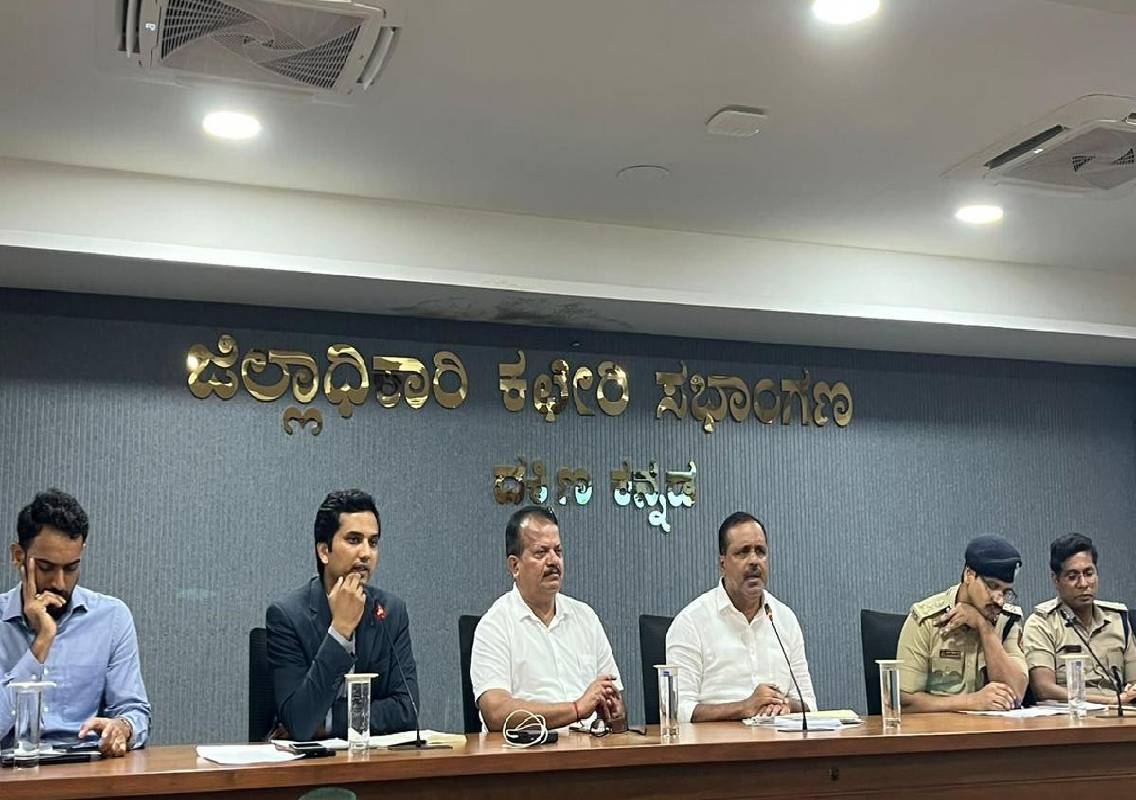


Mangaluru: The Karnataka Cabinet’s first meeting in Mangaluru has brought the coastal region into sharper political and administrative focus, with the government announcing a series of decisions on Tulu language recognition, tourism, fisheries, infrastructure and healthcare. Held on September 18, the meeting was accompanied by a public road show and strong political messaging from both the ruling Congress and the BJP.
The Cabinet approved projects and proposals worth around ₹32,611 crore, with Chief Minister D.K. Shivakumar saying a substantial portion would go towards rural development, infrastructure and projects in Mangaluru, Udupi and other coastal areas. The government also announced that Tulu would become Karnataka’s second additional administrative language in Dakshina Kannada and Udupi districts.
The scale of the announcements has led to a political debate over whether the Mangaluru meeting could strengthen the Congress’s position in coastal Karnataka. Congress leaders have described the meeting as a significant administrative exercise, while BJP leaders have questioned whether it would translate into political gains for the ruling party. The Udayavani report also frames the meeting against this wider political backdrop.
Why the Mangaluru Cabinet meeting matters
The September 18 meeting was the first Cabinet meeting of the D.K. Shivakumar-led government to be held outside Bengaluru. The decision to take the Cabinet to Mangaluru was presented by the government as part of an effort to understand regional requirements and take development decisions closer to the people.
Before the meeting, Shivakumar had said the government wanted to focus on the needs of coastal Karnataka, including ports, infrastructure, fisheries and industries. He also used a Tulu greeting while announcing the meeting, adding a cultural dimension to the government’s outreach.
After the meeting, Shivakumar said the government planned to hold Cabinet meetings at around 10 to 12 locations across Karnataka over the next 15 months, depending on regional requirements as well as financial and legal considerations.
The move therefore goes beyond Mangaluru itself, with the government positioning decentralised Cabinet meetings as part of a wider administrative approach.
Tulu gets additional administrative language status
One of the most prominent decisions was the recognition of Tulu as Karnataka’s second additional administrative language in Dakshina Kannada and Udupi districts.
The demand for official recognition of Tulu has been pending for several years and has had support from cultural organisations and political representatives across the coastal region. The decision allows the language to have an administrative role within the two districts, rather than making it an additional language across the entire state.
The government has said the decision responds to a longstanding regional demand. Congress leaders have subsequently highlighted the announcement as evidence that the Cabinet meeting addressed cultural as well as developmental concerns.
The recognition has also generated discussion about the next steps required to implement the decision and the broader demand for Tulu’s inclusion in the Eighth Schedule of the Constitution. KPCC president B.K. Hariprasad, for instance, welcomed the decision and called for further legislative steps concerning the language.
₹32,611 crore development proposals announced
The financial scale of the Cabinet decisions has become another major talking point.
According to reports, projects and proposals worth approximately ₹32,611 crore were approved. Shivakumar said about ₹16,000 crore would be directed towards rural roads, rural development and infrastructure, while another roughly ₹16,000 crore would cover Mangaluru, Udupi and other coastal areas.
The government has also emphasised that several proposals came from elected representatives, fishermen, industrialists, trade bodies and other organisations representing the region.
The announcements include projects connected with tourism, fisheries, healthcare and infrastructure, reflecting the government’s stated intention to develop the coast around multiple economic sectors rather than relying on a single industry.
Tourism policy targets coastal and Malnad regions
The Cabinet approved the Coastal-Malnad Karnataka Tourism Policy 2026, aimed at encouraging investment in tourism across the coastal and Malnad regions.
Under the proposed framework, tourism projects would be treated as infrastructure projects, allowing investors to access incentives and greater flexibility in loan repayment. The government has argued that coastal and Malnad tourism faces particular challenges because of prolonged monsoon conditions and therefore requires additional support for greenfield investments.
The policy is expected to cover tourism linked to the region’s beaches, religious centres, heritage sites, culture and natural attractions.
The government has also discussed tourism as part of a broader strategy for generating employment and strengthening the coastal economy.
Focus on fisheries and blue economy
Fisheries and the emerging blue economy also featured prominently in the Cabinet decisions.
The government approved plans to upgrade the existing fisheries college into a Fisheries and Blue Economy University, with student intake proposed to rise from 60 to 200. A 150-acre fisheries park has also been included among the approved projects.
The government has additionally announced plans connected with marine biotechnology and blue-economy education. A blueprint for a Karnataka Institute of Marine Biotechnology and Blue Economy in Udupi has been proposed, according to reports.
These measures are significant for a region where fishing, ports and maritime activities form an important part of the local economy.
The focus on fisheries also came immediately before Shivakumar’s surprise visit to the Mangaluru fishing harbour on September 19, where he interacted with fishermen and traders and reviewed their concerns.
Puttur medical college also approved
Healthcare infrastructure was another component of the Cabinet’s coastal development package.
The government approved a medical college in Puttur at an estimated cost of around ₹549 crore, according to reports. The government has also referred to regional demands for institutions such as Kidwai Memorial Institute of Oncology and Jayadeva Hospital.
The decisions indicate that the Cabinet’s Mangaluru agenda was not restricted to cultural or political issues, but also included long-term public infrastructure and healthcare proposals.
Political debate over Congress’s prospects
The Cabinet meeting has inevitably acquired a political dimension because coastal Karnataka has traditionally been a closely watched region in Karnataka politics.
Before the meeting, political leaders from both Congress and BJP had differing views on whether the event could alter the political landscape.
Congress leaders have highlighted the development announcements and the Tulu decision. Dakshina Kannada District Congress Committee president-elect Padmaraj R. Poojary described the meeting as a historic success and said the government’s emphasis on development could provide a different political narrative in the region. He called the meeting a potential “benchmark” for future administration.
BJP leaders, however, have questioned whether the Cabinet meeting itself would produce a political shift. Ahead of the meeting, BJP Dakshina Kannada president Sathish Kumpala said the event would not affect the BJP’s position and pointed to the party’s organisational presence in the region.
These are political assessments by the respective parties and cannot, by themselves, establish the eventual electoral impact of the Cabinet meeting.
Development announcements now face implementation test
The immediate political attention around the Mangaluru meeting is likely to shift towards implementation.
The Cabinet has announced multiple policies and projects, but their longer-term impact will depend on funding, administrative approvals, land acquisition where required, project execution and delivery to residents.
The recognition of Tulu will similarly require administrative implementation within Dakshina Kannada and Udupi. The tourism policy, fisheries university, fisheries park and healthcare projects will require further institutional and financial steps.
For residents, the significance of the Cabinet meeting will therefore ultimately depend on whether the announced decisions translate into visible improvements in infrastructure, employment opportunities, healthcare, tourism facilities and fisheries-related livelihoods.
District renaming proposal also enters public consultation
Another politically sensitive decision concerns the proposal to rename Dakshina Kannada district as Mangaluru district.
Shivakumar said the government would issue a draft notification and invite public views for one month before taking a final decision. He said public sentiment and the historical significance of the existing name would be considered before any final decision.
The proposed renaming means the government has chosen a consultation process rather than announcing an immediate change.
Mangaluru meeting puts coastal issues at centre stage
The Cabinet meeting has placed coastal Karnataka at the centre of the state’s administrative conversation, at least for the present. Tulu recognition, tourism, fisheries, healthcare and infrastructure featured prominently in the decisions announced after the meeting.
For Congress, the event provides an opportunity to highlight these policy decisions and its engagement with regional demands. Opposition parties, meanwhile, will assess the announcements in terms of their implementation and political significance.
Whether the Mangaluru Cabinet meeting changes the political dynamics of coastal Karnataka will depend on developments beyond the event itself. For now, the measurable outcome is a package of policy announcements and project approvals whose impact will become clearer as implementation progresses.