







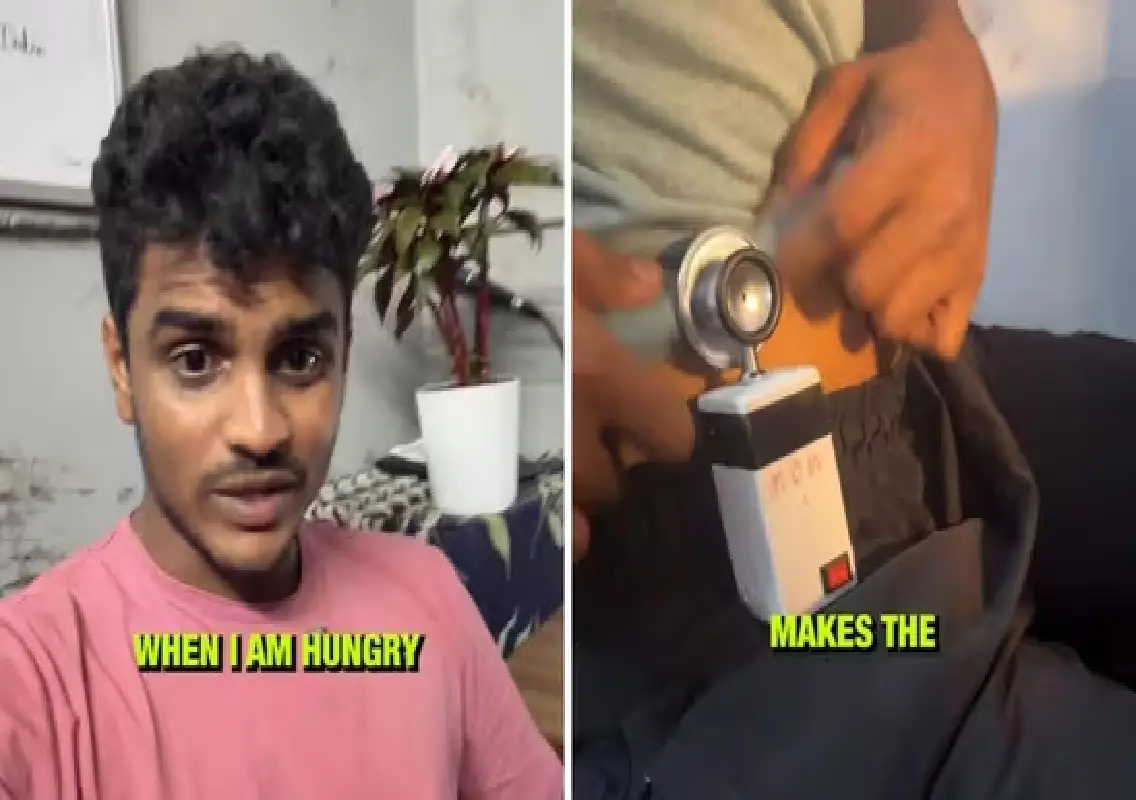


Mangaluru: A Mangaluru-based startup founder and content creator, Sohan M Rai, has once again captured social media attention after unveiling a quirky but inventive project—a device that uses artificial intelligence to detect stomach growls and automatically order food. The innovation, which Rai has named the Meal Ordering Module (MOM), was showcased in a video on Instagram, where he explained the hardware, functionality and the humorous thought process behind the creation.
Device powered by hunger-detection concept
In the video shared on his page “zikiguy,” Rai is seen wearing the belt-mounted device while explaining its purpose. “I invented this device which understands when I’m hungry and automatically orders food on Zomato,” he says, before proceeding to demonstrate how the module is assembled. According to him, the idea began as an experiment to use sound detection paired with AI to interpret hunger levels.
Rai explains that MOM operates by identifying the low-frequency, rumbling sound produced by a growling stomach. For this, he creatively incorporated a stethoscope—borrowed from his sister—into the hardware setup. He paired the sound-capturing equipment with sensors and a simple processing unit that sends the input to Claude AI, which then determines whether the sound corresponds to hunger.
Once the AI interprets the audio as a hunger signal, the device is programmed to automatically place an order on Zomato from the user’s saved preferences. While the concept borders on humorous exaggeration, the underlying functionality demonstrates Rai’s enthusiasm for bridging everyday problems with playful tech-based solutions.
Public reactions and online commentary
As with many of Rai’s projects, MOM drew a mix of amusement, curiosity and scepticism from viewers. One user asked, “How did you test this?” To which Rai humorously replied, “Had to sit a whole day without eating.” Another netizen remarked, “Growl does not mean hungry. Nice work though.” Rai responded that the signals were accurate enough for his personal use.
Another commenter quipped that the invention “should be featured in unnecessary inventions,” while someone else expressed interest in the device being adapted for pets: “I wish this device were smaller and lightweight so I could attach it to my cat and know when he’s hungry. It would make monitoring him so much easier.”
The playful debate around the necessity and practicality of the device only added to its charm, helping the video gain traction across Instagram.
An innovator known for quirky tech experiments
Rai, who completed his bachelor’s degree at Sahyadri College of Engineering & Management, has built a niche following online for his engaging, often unconventional tech experiments. His Instagram account features a variety of builds, software demonstrations and humorous takes on trending technologies.
Beyond social media, he has interned at multiple tech companies before launching his own startup. His projects often merge engineering with creativity, making them accessible and entertaining for younger audiences.
This is not the first time Rai has gone viral. In 2023, he gained nationwide attention after he joined Zomato temporarily as a delivery partner—not to deliver food traditionally, but to deliver a pizza using a self-made autonomous drone. In his caption then, he explained, “I wanted to put my skills into use and build an autonomous drone which could deliver a pizza directly to a home, without having a pilot. I built the drone with a lot of Jugaad, and it would be a lot better when it is commercial. This is an experiment and was conducted with safety and precautions.”
The video sparked conversations about the future of autonomous deliveries in India and positioned Rai as a creator willing to experiment outside conventional boundaries.
Growing trend of AI-driven personal gadgets
Rai’s latest innovation comes at a time when AI-integrated personal devices are becoming increasingly common. From smart watches that monitor heart activity to gadgets that track sleep cycles and calorie consumption, consumer interest in health-focused technology is rising.
While MOM is unlikely to become a consumer product, its humorous premise draws attention to how AI can be integrated into daily life, even in unexpected ways. It also highlights a culture of experimental engineering among young Indian technologists who enjoy pushing the limits of creativity.
Industry observers note that such projects, though often created for fun, contribute to a vibrant maker community where engineering skills, AI tools and rapid prototyping merge to inspire future innovation.
Conclusion
With the Meal Ordering Module, Sohan M Rai has once again demonstrated how playful ideas can harness modern technology to create engaging and thought-provoking content. Whether MOM becomes a prototype for more serious applications or remains a fun, one-off experiment, it has already succeeded in sparking conversations, entertaining viewers and showcasing the spirit of innovation that continues to grow among India’s young tech creators.