







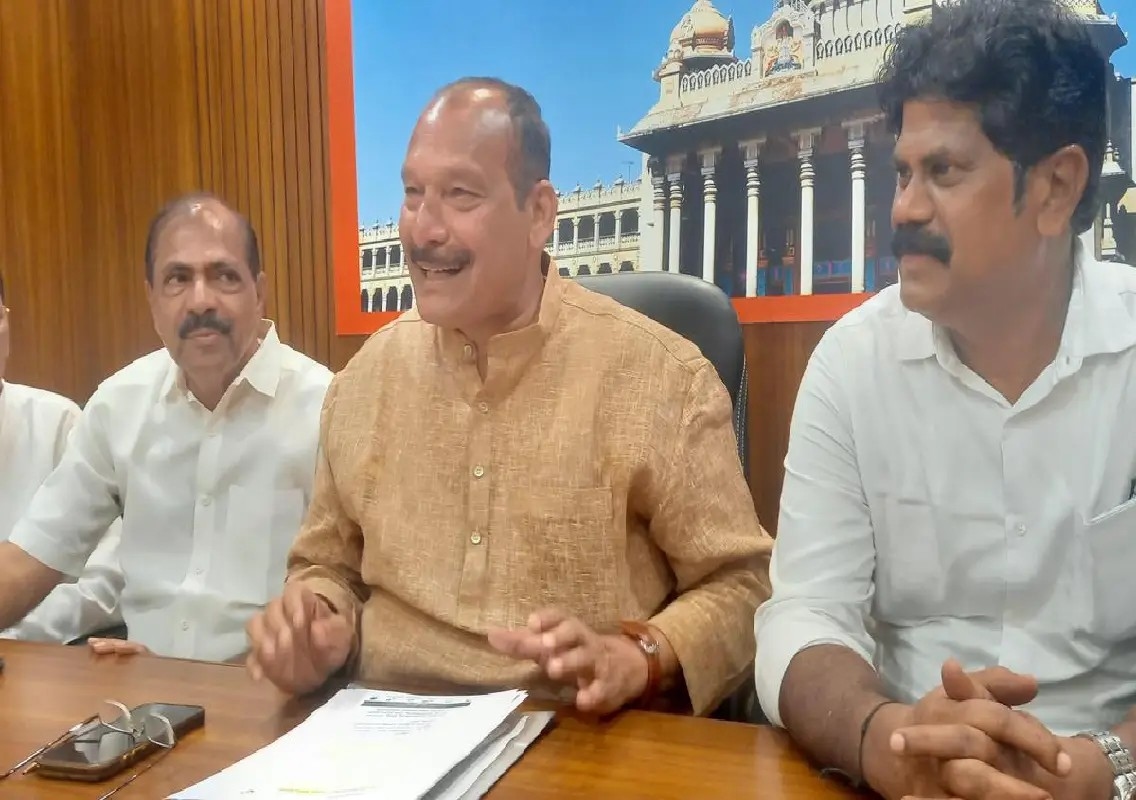


Mangaluru: A committee constituted by Karnataka High Court Chief Justice Vibhu Bakhru to examine the demand for establishing a High Court bench in Mangaluru is expected to visit the city in the first week of October, MLC Ivan D’Souza said on Sunday.
D’Souza, who has been pursuing the demand for a High Court bench in Mangaluru, said the visit would be an important step in examining the proposal and the requirements for establishing a judicial facility in the coastal region.
The demand has been raised for a bench that would serve Dakshina Kannada, Udupi, Chikkamagaluru and Kodagu districts.
Committee expected to visit Mangaluru
Speaking to reporters, D’Souza said former Chief Minister Siddaramaiah had written to the Chief Justice of the Karnataka High Court highlighting the need for a bench in Mangaluru.
According to D’Souza, elected representatives from the four districts have expressed support for the proposal. He said the region would generate sufficient cases for a High Court bench to function effectively.
D’Souza also said Chief Minister D.K. Shivakumar had reiterated his support for the demand and indicated that land or a suitable building would be made available if the bench is established.
He said the immediate proposal could be for a circuit bench, before considering a permanent arrangement.
“We are confident about the Karnataka Chief Justice favouring setting up a circuit bench (to start with),” D’Souza said.
The visit by the committee is expected to provide an opportunity to assess the practical requirements and views surrounding the proposal.
Four districts proposed under bench
The proposed bench is being sought to cater to litigants from Dakshina Kannada, Udupi, Chikkamagaluru and Kodagu.
Supporters of the demand have argued that a High Court facility in Mangaluru would provide greater access to justice for people from the coastal and Malnad districts, who otherwise have to travel to Bengaluru for matters before the principal seat of the High Court.
D’Souza said the elected representatives had jointly supported the proposal and maintained that the volume of cases from the region would justify the establishment of a circuit bench.
The committee’s proposed visit is expected to be part of the process of examining the demand before any further decision is taken.
D’Souza welcomes Tulu language decision
D’Souza also welcomed the Karnataka Cabinet’s recent decision to grant Tulu additional official language status in Dakshina Kannada and Udupi districts.
The decision was taken at the State Cabinet’s first-ever meeting in Mangaluru on September 18. The Cabinet approved Tulu as an additional official language in the two coastal districts.
D’Souza said a notification regarding the decision would be issued shortly. He also said the government would begin the process of recruiting translators to facilitate the translation of official communications into Tulu.
The MLC said he did not believe Legislative Assembly approval was required before the government issued the notification.
The precise administrative implementation of the Cabinet decision will depend on the notification and subsequent government procedures.
Call for Tulu’s inclusion in Eighth Schedule
D’Souza also appealed to Dakshina Kannada MP Capt. Brijesh Chowta and other BJP MPs from Karnataka to pursue with the Union government the demand for including Tulu in the Eighth Schedule of the Constitution.
The Eighth Schedule currently recognises 22 languages. Inclusion in the Schedule is a separate matter from the Karnataka government’s decision to recognise Tulu for official administrative use in Dakshina Kannada and Udupi.
The latest state-level decision has therefore renewed discussion about the language’s recognition at the national level.
Opinion sought on Dakshina Kannada renaming
D’Souza further said the district administration would soon begin the process of seeking public opinion on the proposal to rename Dakshina Kannada district as Mangaluru district.
The issue has been raised previously by representatives and organisations seeking a change in the district’s name to reflect Mangaluru as the region’s principal urban centre.
The process of inviting public opinion would provide an opportunity for residents and other stakeholders to place their views before the administration.
Coastal development projects highlighted
D’Souza also referred to the development decisions announced at the September 18 Cabinet meeting in Mangaluru.
The Cabinet approved projects and proposals with a combined value of Rs 32,611 crore covering various sectors. The package includes road infrastructure, healthcare, tourism, water supply, fisheries and other development initiatives in the state and coastal region.
Among the projects highlighted by D’Souza were Rs 400 crore for road repairs and infrastructure in Mangaluru and Rs 160 crore for ongoing water-related works under the Jalasiri scheme.
The Cabinet also approved an increase of 200 beds at Government Wenlock Hospital and gave in-principle approval for satellite centres of the Sri Jayadeva Institute of Cardiovascular Sciences and Research and the Kidwai Memorial Institute of Oncology in Mangaluru. The Cabinet decisions on the two healthcare institutions were also reported following the Mangaluru meeting.
Rs 100 crore approved for Surathkal drainage
D’Souza said the government had approved Rs 100 crore for underground drainage works in the Surathkal area against a demand of Rs 350 crore.
He also said additional funds would be provided to complete pending works at the new Mangaluru District Prison near Balepuni.
The new prison project is intended to facilitate the shifting of inmates from the existing facility once the necessary works are completed.
The range of projects discussed by D’Souza comes against the backdrop of the State Cabinet’s decision to approve a large development package during its first meeting outside Bengaluru in Mangaluru. The Cabinet’s announced projects include initiatives spanning infrastructure, healthcare, tourism, water supply and other sectors.
The proposed High Court bench committee visit, meanwhile, is expected to bring the long-standing judicial infrastructure demand into the next stage of consideration.