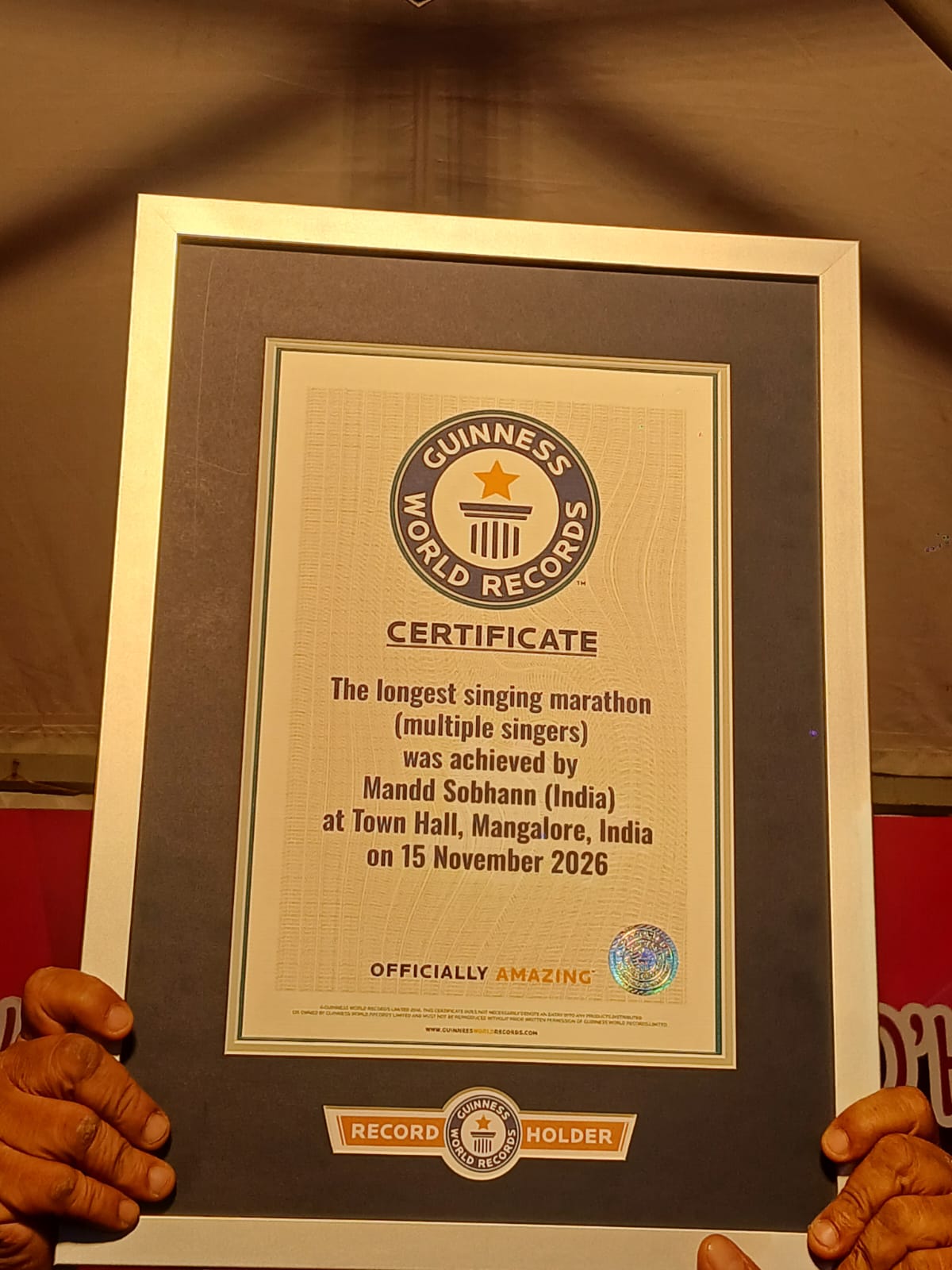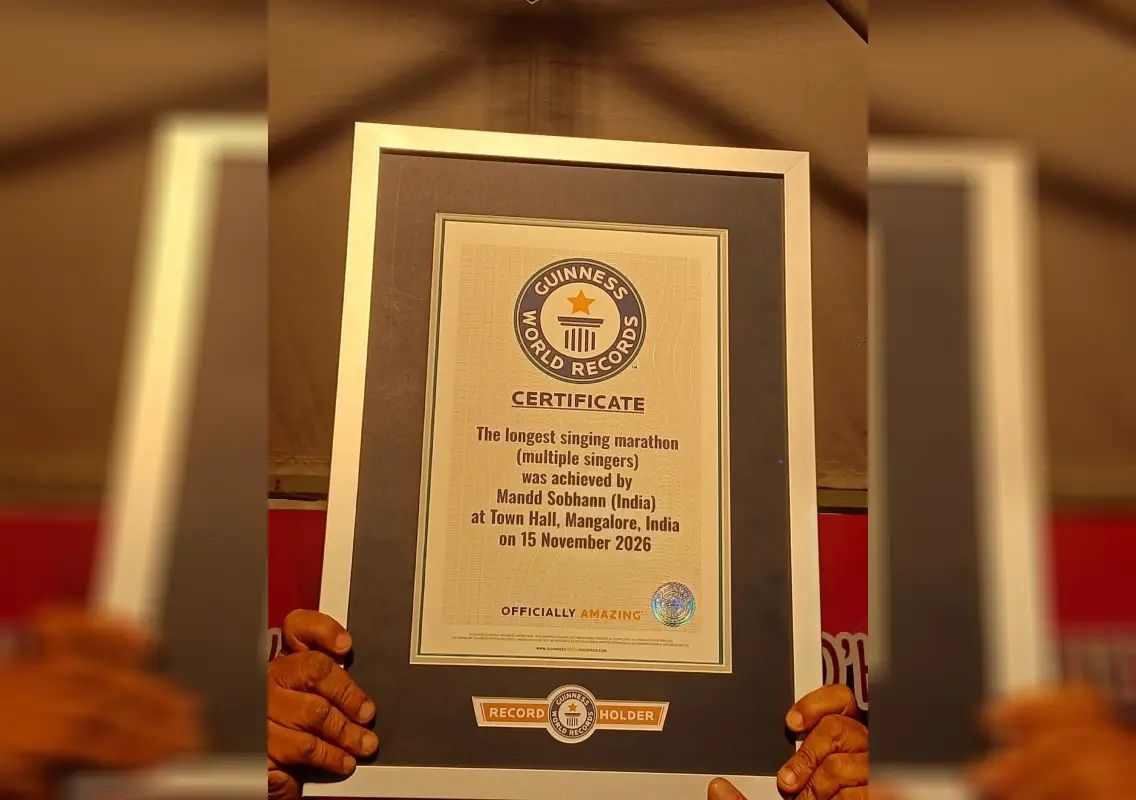


Mangaluru: The first World Konkani Music Mega Convention has concluded at Town Hall, Mangaluru, with a remarkable non-stop singing marathon lasting 12 days, 12 hours and 12 minutes, earning a place in the Guinness World Records.
The historic musical event brought together more than 6,789 singers, organised into nearly 300 performing groups, who rendered over 4,500 unique Konkani songs without repetition. Artistes from across India and Konkani-speaking communities in Australia, Oman, Qatar and Kuwait participated in the marathon, turning the city into a global meeting point for Konkani music and culture.
The grand valedictory ceremony began immediately after the finale performance by Sumel, led by renowned singer and backing vocal trainer Raina Sequiera. Legendary Konkani singer Joyce Ozario, popularly known as Konkani Abolem, brought the marathon to an emotional and triumphant conclusion.
The achievement marked a significant moment for the Konkani-speaking community, celebrating its musical heritage, linguistic identity and cultural connections across generations and geographical boundaries.
Twelve days of uninterrupted Konkani music
The singing marathon continued for 12 days, 12 hours and 12 minutes, making it an extraordinary showcase of musical endurance and collective participation.
Town Hall witnessed performances by thousands of singers, with nearly 300 groups taking turns on stage. More than 4,500 distinct Konkani songs were presented during the event, with organisers ensuring that no song was repeated.
The scale of participation reflected the depth and diversity of Konkani music. Singers representing different generations, communities and regions came together to contribute to the marathon, creating an extensive musical celebration of the language.
The participation of more than 6,789 singers also demonstrated the strong connection that Konkani-speaking communities continue to maintain with their mother tongue and its artistic traditions.
The event culminated with the performance by Sumel, led by Raina Sequiera. Joyce Ozario then brought the marathon to a close, marking the end of the record-setting musical journey.
Konkani heritage celebrated on a global stage
The convention attracted participation from different parts of India as well as international Konkani delegations from Australia, Oman, Qatar and Kuwait.
The presence of overseas participants highlighted the global reach of Konkani-speaking communities and the continuing importance of music in preserving cultural identity among people living away from their ancestral regions.
The event was held in recognition of Konkani’s inclusion in the Eighth Schedule of the Indian Constitution. It sought to celebrate the language’s rich literary and musical traditions while encouraging younger generations to remain connected with their linguistic heritage.
The marathon provided a platform for traditional Konkani songs and diverse musical expressions, bringing together artistes who share a common language despite differences in regional backgrounds and dialects.
The organisers described the convention as an effort to ensure that Konkani’s musical legacy continues to resonate with future generations across the world.
Hindu, Christian and Muslim artistes share one stage
Beyond the world-record achievement, the convention stood out for its message of religious harmony and social inclusiveness.
Artistes and community members belonging to Hindu, Christian and Muslim faiths participated in the event, sharing the same stage through their common language and love for music.
The participating communities represented the diversity of the Konkani-speaking population. These included Goud Saraswat Brahmins (GSB), Rajapur Saraswat Brahmins (RSB), Kudal Deshasta, Syrian Orthodox Christians, Kharvis, Kudmis, Siddis, Nawayat Muslims and Daldi Muslims.
The different communities also brought their respective dialects and musical traditions to the convention, reflecting the cultural richness of Konkani.
The event demonstrated how a shared mother tongue can bring people together across religious and social divisions. By providing a common platform to artistes from diverse backgrounds, the marathon became a celebration of brotherhood and cultural solidarity.
The organisers viewed the gathering as much more than a record-setting exercise, emphasising its role in strengthening relationships among Konkani-speaking communities.
Mandd Sobhann’s leadership behind the achievement
The convention was organised through the efforts of Mandd Sobhann and its organising committee, whose members coordinated the extensive programme and the participation of thousands of singers.
The initiative was spearheaded by Luvi J Pinto, president of Mandd Sobhann; Roy Castelino, chairman of the Finance Committee of F.W.K.M.M.C.; Joel Pereira, chief music director of F.W.K.M.M.C.; Joachim Stany Alvares, coordinator of Mandd Sobhann; and Ronald Crasta, secretary of Mandd Sobhann.
The organisers were supported by the wider Mandd Sobhann team and its associates, who contributed to bringing together the performers, coordinating the groups and sustaining the marathon over nearly two weeks.
The participation of singers from different regions and countries required extensive coordination, particularly to ensure continuity throughout the long-duration programme.
The successful conclusion of the event reflected the collective effort of the organisers, artistes, volunteers and community members who contributed to the initiative.
Mangaluru strengthens its place in Konkani cultural history
The Guinness World Records recognition has given international visibility to the musical traditions of the Konkani-speaking community and highlighted Mangaluru’s longstanding association with Konkani culture.
The city has a significant place in the history of Konkani language, music and community activities. The convention added another milestone by bringing together thousands of singers for an uninterrupted musical celebration.
The event also underlined the role of cultural organisations in preserving languages through collective participation and public platforms. By involving singers from different generations and communities, the organisers sought to create a legacy that extends beyond the record itself.
With 12 days, 12 hours and 12 minutes of non-stop singing, more than 6,789 participants and over 4,500 unique songs, the first World Konkani Music Mega Convention has become a landmark celebration of Konkani heritage.
The successful conclusion at Town Hall has reaffirmed Mangaluru’s importance as a cultural centre for the global Konkani community, while celebrating the power of music to unite people across borders, faiths and generations.