







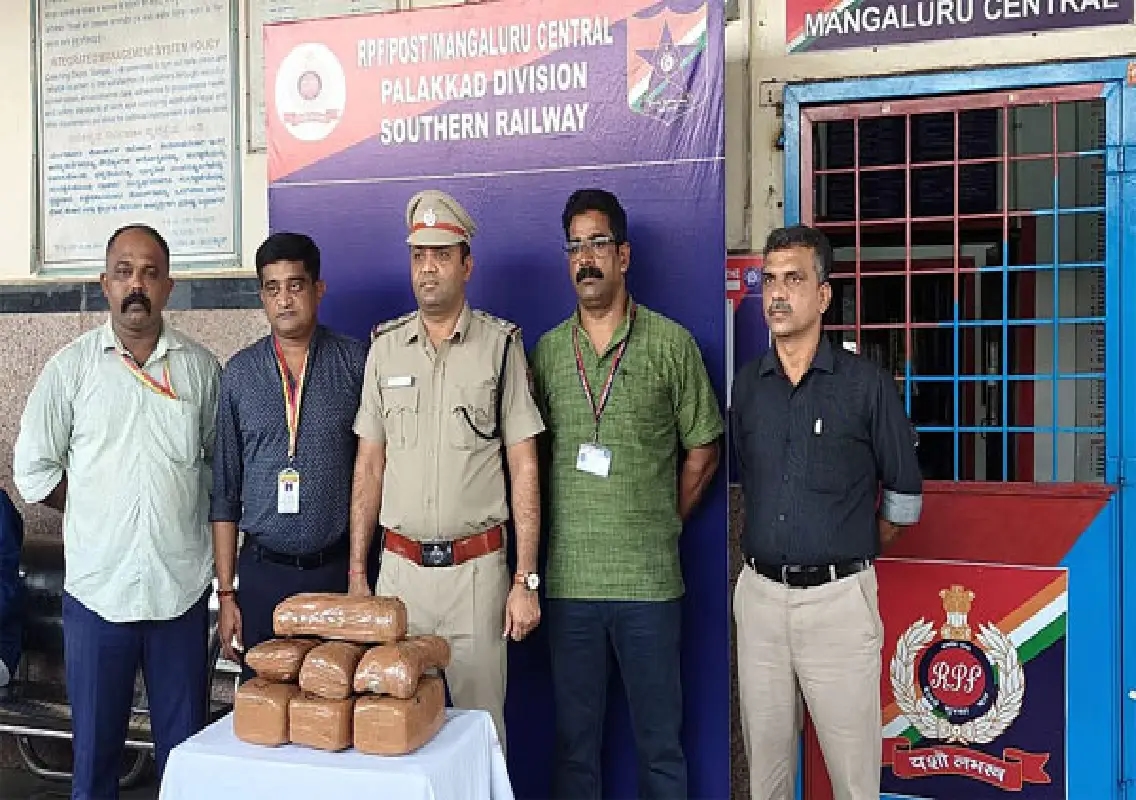


Mangaluru: In a continued crackdown on drug trafficking, the Railway Protection Force (RPF) seized over 10 kilograms of dry ganja from a train at Mangaluru Central Railway Station on March 23. The contraband was recovered during a routine inspection carried out upon the train’s arrival, highlighting ongoing vigilance by railway security personnel.
According to RPF officials, the operation was led by Inspector Manoj Kumar Yadav and his team, who acted promptly after identifying suspicious baggage in one of the train coaches. The seizure adds to a growing list of narcotics interceptions in transit routes across the region.
Ganja found in unclaimed baggage
The seized contraband, weighing 10.129 kilograms, was discovered in an unclaimed bag inside a general coach of Train No. 12601 MGR Chennai Central–Mangaluru Central Express. The train had just arrived at Platform No. 1 of Mangaluru Central Railway Station when the inspection was conducted.
Officials stated that the unattended nature of the baggage raised suspicion, prompting a thorough search. Upon examination, the bag was found to contain dry ganja, a prohibited substance under the Narcotic Drugs and Psychotropic Substances (NDPS) Act.
The estimated market value of the seized ganja is ₹5,06,450, indicating a potentially significant supply intended for illegal distribution.
Swift action by RPF team
The RPF team, under the leadership of Inspector Manoj Kumar Yadav, secured the contraband immediately after discovery. Standard procedures were followed to ensure proper documentation and handling of the seized material.
Officials noted that such timely interventions are crucial in preventing the movement of illegal substances through railway networks, which are often exploited by traffickers due to high passenger volumes and multiple transit points.
Handed over to Excise Department
Following the seizure, the ganja was formally handed over to the Excise Department in Mangaluru for further investigation and legal proceedings. Authorities from the Excise Department are expected to probe the origin and intended destination of the consignment.
Efforts are underway to identify those responsible for transporting the narcotics. Investigators will examine CCTV footage from the station, passenger records, and other intelligence inputs to trace the source of the unclaimed baggage.
Increasing vigilance on railway routes
Railway authorities have been intensifying surveillance across key routes, particularly those connecting major cities. Trains operating between metropolitan hubs and coastal regions are often monitored closely due to the risk of drug trafficking.
The use of unclaimed baggage is a known tactic employed by traffickers to avoid direct detection. By abandoning the consignment in transit, they attempt to minimise personal risk while relying on intermediaries or later retrieval.
Conclusion
The seizure at Mangaluru Central Railway Station underscores the importance of constant vigilance and coordinated efforts among enforcement agencies. With investigations ongoing, authorities aim to dismantle networks involved in transporting narcotics via rail routes.
Such actions serve as a strong deterrent and reinforce the commitment of law enforcement agencies to curb the illegal drug trade in the region.