


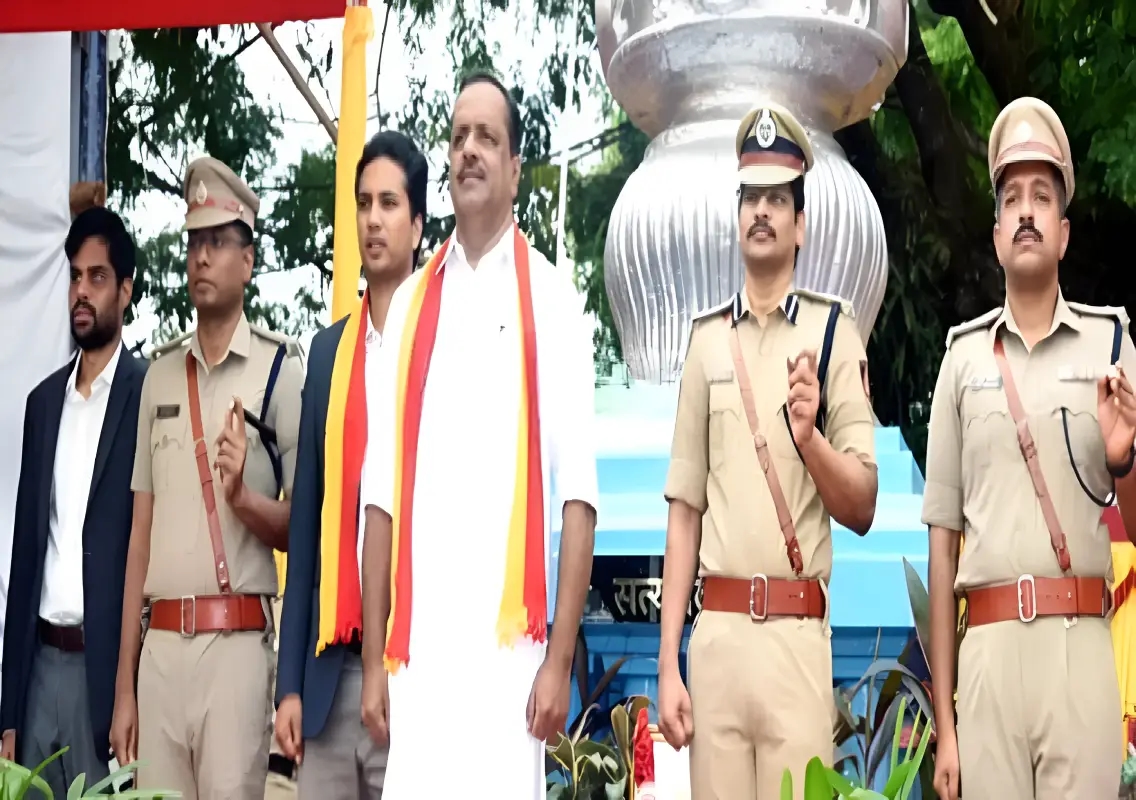


Mangaluru: Kannada pride should bring people together through affection and mutual respect rather than create divisions among speakers of different languages, said Dakshina Kannada district in-charge minister U T Khader.
Presiding over the 71st Kannada Rajyotsava celebrations at Nehru Maidan in Mangaluru on Sunday, Khader said Kannada was not merely a language but the identity and soul of the land. He called for a celebration of the language that embraced its rich heritage while remaining open to other cultures and languages.
He described Kannada as reflecting the continuous flow of the Cauvery, the grandeur of the Sahyadri mountains and the rhythm of the coastal waves. The language, he said, represented both the pride of the past and the responsibility of shaping the future.
Kannada’s literary heritage is a source of pride
Highlighting the state’s literary legacy, Khader referred to the contributions of several prominent Kannada writers and thinkers.
He said the visionary writings of Pampa, the egalitarian philosophy expressed in the Vachanas of Basavanna, the self-awareness reflected in the works of Akkamahadevi and the universal humanism of Kuvempu continued to guide society.
Their writings, he noted, encouraged people to move beyond narrow divisions based on caste, religion and gender.
Khader also highlighted Kannada’s status as a classical language, its history spanning around 2,000 years and the recognition it had received through eight Jnanpith Awards.
He urged Kannadigas to remain connected to their language and cultural roots irrespective of where they lived. He said the responsibility of preserving Kannada rested not only with people residing in Karnataka but also with Kannadigas living elsewhere.
Calls for Kannada integration with artificial intelligence
Turning to the challenges and opportunities of the digital age, Khader stressed the need to integrate Kannada with artificial intelligence, digital education and emerging technologies.
He said Kannada should not remain merely a language through which people consume technology. Instead, it should become an active contributor to technological innovation and development.
According to him, the practical usefulness of a language was essential for its survival and growth.
He said a farmer who approached the government in Kannada should be able to communicate grievances and receive timely public services in the same language. Similarly, students educated in Kannada should have access to quality education and strong career opportunities.
Khader emphasised that young people should be able to find suitable employment and entrepreneurship opportunities within Karnataka.
He said the use of Kannada in administration, education and technology would help ensure that the language remained relevant to younger generations.
Government reiterates commitment to Karnataka state flag
Speaking about the state government’s efforts to promote Kannada identity, Khader said the administration was working through an action plan rather than relying on slogans.
He reiterated the government’s commitment to securing official recognition for the Karnataka state flag, popularly known as the Nada Dhwaja.
He said the process would involve a Cabinet resolution, consensus among political parties and constructive discussions with the Union government.
Khader also praised Deputy Chief Minister D K Shivakumar for his leadership and focus on both Karnataka’s overall development and the preservation of Kannada culture.
Emphasising the need to balance linguistic pride with respect for other languages, he said love for Kannada should never become a reason to look down upon people speaking different languages.
“We must have immense pride in our language, but it should not become a wall of narrow-mindedness. True love for a language lies in respecting other languages and absorbing their good qualities to further enrich our own. Rajyotsava should be celebrated as a festival in every household, not just as a government programme,” he said.
120 individuals and 53 organisations receive awards
A major highlight of the district-level celebrations was the presentation of the Dakshina Kannada Rajyotsava Awards.
A total of 120 individuals and 53 organisations were honoured for their contributions across various fields. The awards recognised their work and service in their respective areas.
The celebrations also featured a march-past by police personnel, National Cadet Corps (NCC) cadets and students from various educational institutions. The parade added to the ceremonial atmosphere at Nehru Maidan.
The participation of students and uniformed personnel formed part of the district’s observance of Karnataka’s formation day.
Dignitaries attend celebrations
The programme was attended by MP Capt Brijesh Chowta, MLA Vedavyas Kamath, Karnataka Cashew Development Corporation chairperson Mamata Gatti, Karnataka State Minimum Wages Advisory Board chairman T M Shahid and Mangalore Urban Development Authority chairman Santhosh Kumar Shetty.
Ganiga Development Corporation chairman Vishwas Kumar Das, Karnataka State Konkani Sahitya Academy president Joachim Stanley Alvares, Dakshina Kannada Deputy Commissioner Darshan H V and Mangaluru Police Commissioner Sudheer Kumar Reddy were also present.
The 71st Kannada Rajyotsava celebrations brought together public representatives, officials, award recipients, students and members of the public to mark Karnataka’s formation day.
Khader’s address focused on the need to preserve Kannada’s historical and literary legacy while making it a language of opportunity in education, administration and technology. He also underlined that linguistic pride should strengthen social harmony and respect for all languages.