







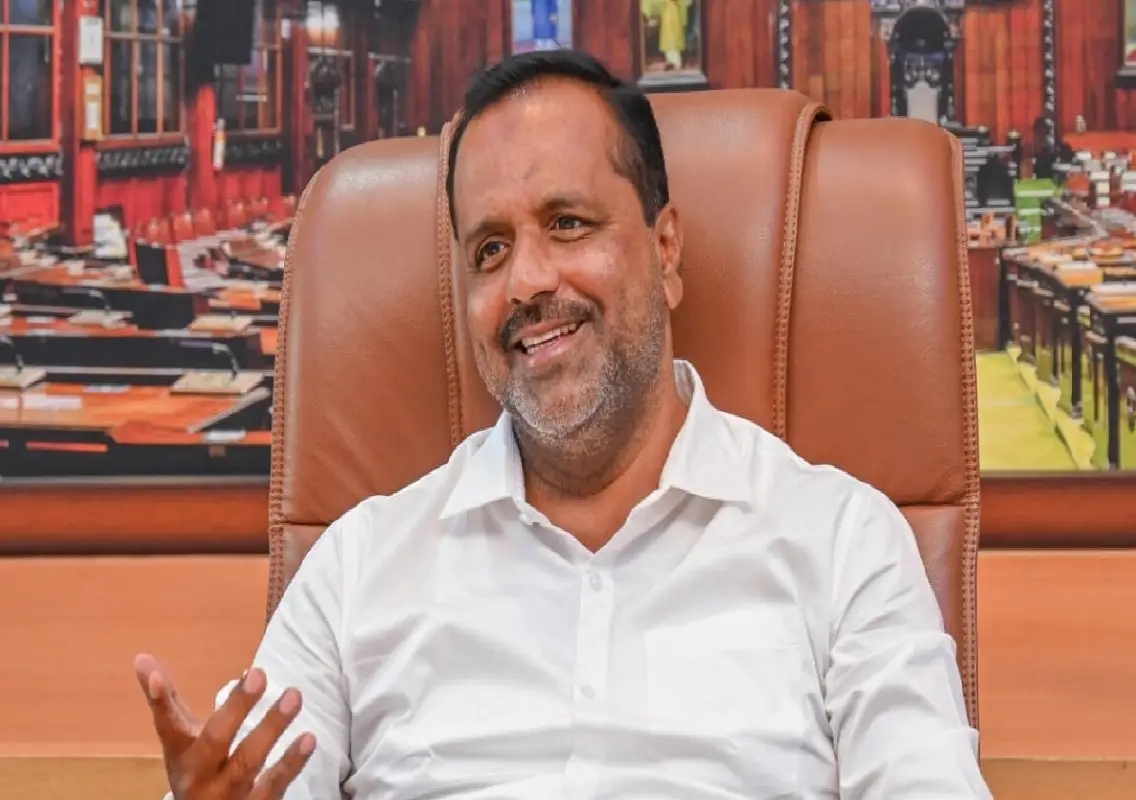


Mangaluru: Karnataka Legislative Assembly Speaker U T Khader on Wednesday said it is the responsibility of the government and its officials to create an environment in which people can live peacefully and happily. Speaking to reporters, Khader underlined the need for balanced governance that respects public sentiment while adhering to constitutional and legal frameworks.
Responding to queries on the police ban on traditional cockfighting in Dakshina Kannada district, Khader said the matter should be discussed at the government level before arriving at any decision. He clarified that, as the Speaker of the Legislative Assembly, it would not be appropriate for him to express personal opinions on such issues.
“Even if one has personal views, it is not right to express them while holding a constitutional post,” he said, adding that decisions on sensitive cultural or traditional practices must be taken collectively by the government after due deliberation.
On cockfighting ban and public sentiment
Khader’s remarks come amid debate and criticism over restrictions imposed on traditional cockfighting events in parts of coastal Karnataka. While some sections view cockfighting as a long-standing local tradition linked to festivals, others have raised concerns over animal cruelty and law and order issues.
Khader maintained that such matters require careful consideration of all viewpoints. He stressed that the role of the government is to strike a balance between tradition, legality, and public welfare. “The government should discuss the issue in detail and take an appropriate decision,” he said, without elaborating further.
Remarks on ‘Harikatha’ controversy
Replying to questions regarding objections raised over certain remarks related to ‘Harikatha’ during the ongoing Assembly session, Khader said the coastal region of Karnataka enjoys a special reputation for harmony and mutual respect. He noted that legislators from the region have historically been known for their courtesy, simplicity, and respectful conduct.
“This reputation should be preserved,” Khader said, urging elected representatives to be mindful of the words they use and the sentiments they reflect. He added that maintaining decorum and mutual respect is essential for the healthy functioning of the legislature.
The Speaker’s comments were seen as a call for restraint and dignity in public discourse, particularly on issues linked to religion, culture, and tradition.
Mahakalipadu railway underpass delay
Khader also responded to questions about the delay in opening the Mahakalipadu railway underpass, which is expected to provide direct connectivity between Ullal and Mangaluru city. Despite the completion of construction work, the underpass has not yet been opened for public use, causing inconvenience to commuters.
He said he would take up the issue with the concerned officials and the district in-charge minister. “I will discuss the matter and ensure that the reasons for the delay are addressed,” Khader said.
Residents and commuters have repeatedly raised concerns over traffic congestion and longer travel times due to the delay in operationalising the underpass.
Proposal for advanced healthcare institutions
On the healthcare front, Khader said discussions have already been held regarding the establishment of units of Jayadeva Institute of Cardiovascular Sciences and Research and Kidwai Memorial Institute of Oncology in Mangaluru. He noted that similar specialised centres have already been set up in Kalaburagi and Mysuru.
Khader pointed out that patients from four to five districts currently travel to Mangaluru for heart and cancer treatment. The proposed institutions would not only benefit patients by providing advanced care closer to home but also help maintain balance in treatment costs for critical illnesses such as cardiac ailments and cancer.
“Establishing these centres will strengthen the healthcare infrastructure of the region and reduce the burden on patients who otherwise have to travel long distances,” he said.
Legislative business during Assembly session
Khader also highlighted the legislative work completed during the current Assembly session. He said a total of 23 Bills were passed, including key legislations such as the Appropriation Bill and the Karnataka Land Revenue (Second Amendment) Bill, 2025.
He described the passage of these Bills as significant for the administration and development of the state, noting that smooth conduct of legislative business is essential for effective governance.
Conclusion
The Speaker’s remarks reflected a broader emphasis on responsible governance, institutional dignity, and balanced decision-making. By refraining from personal commentary on contentious issues, Khader reiterated the importance of constitutional propriety while urging the government to remain sensitive to public concerns. His comments on infrastructure, healthcare expansion, and legislative progress underscored the need for coordinated efforts to improve quality of life and governance across the region.