







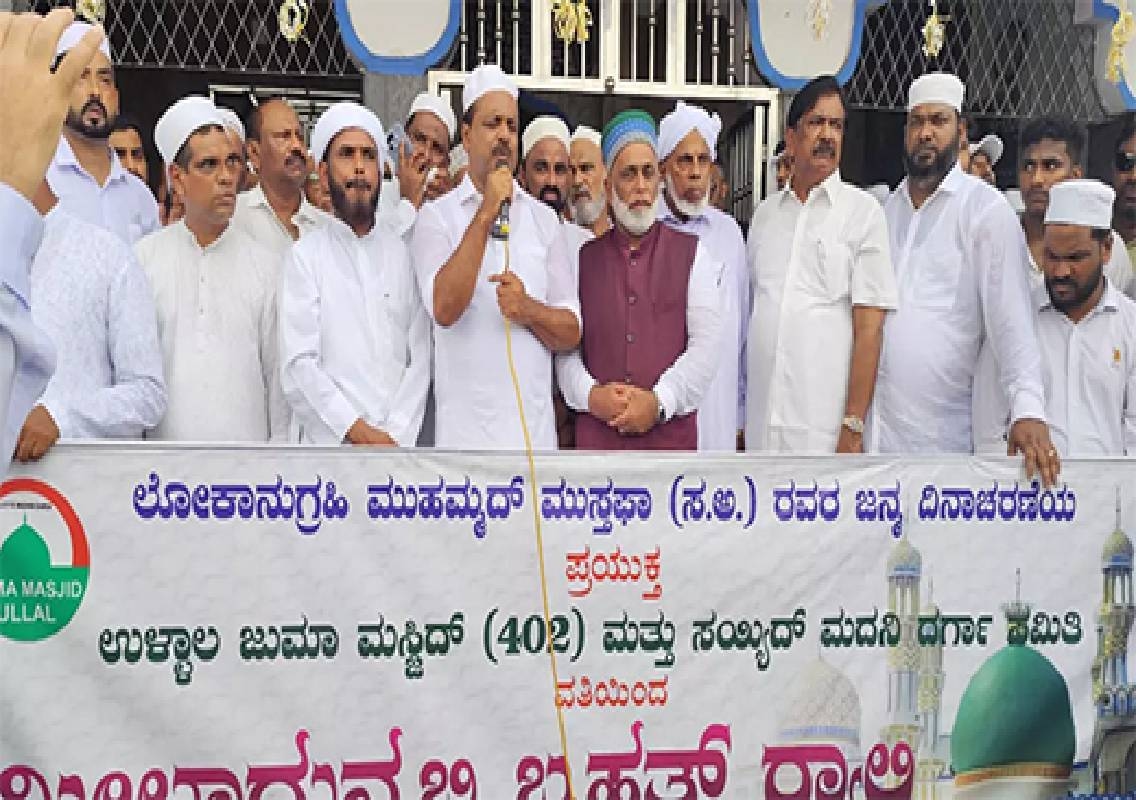


Ullal: Eid Milad-un-Nabi was celebrated peacefully across Dakshina Kannada on August 25, with religious programmes and processions held in Mangaluru, Ullal, Puttur, Bantwal and other parts of the district. The celebrations coincided with an announcement by Karnataka Minister for Minority Welfare, Haj and Wakf U T Khader that the state will introduce a special law to regulate private agencies arranging Haj and Umrah pilgrimages.
Khader made the announcement while flagging off a Milad-un-Nabi walking procession at Kotekar, organised under the Ullal Dargah. The procession involved students from 34 madrasas representing 27 mahallas and proceeded through Mukacheri, Azad Nagar and Melangadi before concluding at the Ullal Syed Madani Dargah.
The proposed legislation comes amid complaints that some private pilgrimage operators have allegedly abandoned pilgrims midway through their Haj or Umrah journeys. Khader said the government intends to bring greater regulation to the sector and provide pilgrims with better access to information and support.
Special law planned for Haj and Umrah operators
Speaking at the Ullal programme, Khader said a special law would be introduced to regulate private agencies involved in arranging Haj and Umrah pilgrimages. The announcement is significant for pilgrims who depend on private operators for travel, accommodation and other arrangements during their religious journeys.
According to the minister, complaints have emerged against some operators who allegedly left pilgrims without adequate assistance during their pilgrimage. A regulatory framework is therefore being planned to bring such agencies under greater scrutiny and establish clearer responsibilities towards pilgrims.
The proposed law could provide a mechanism to monitor operators and address complaints, although the detailed provisions of the legislation have not yet been announced. Khader’s statement indicates that the government is considering a more structured system to protect pilgrims from problems arising from poorly managed or unreliable private arrangements.
The move comes at a time when thousands of people from Karnataka are seeking opportunities to undertake Haj and Umrah. The scale of demand makes regulation and reliable information particularly important.
Around 11,000 people apply for Haj
Khader said around 11,000 people have applied for Haj this year. The figure highlights the substantial demand for pilgrimage services in Karnataka and the need for proper arrangements for applicants.
The minister also said arrangements for Umrah, along with Haj, would be made through the Haj Committee. Unlike Haj, which is undertaken during a specific period of the Islamic calendar, Umrah can be performed at different times of the year. Bringing information and arrangements for both pilgrimages under a more organised system could help pilgrims navigate the process.
A web portal is also planned to collect and provide information related to pilgrims. The proposed portal is expected to become an important source of information for those preparing for their journeys.
Such a system could help reduce confusion regarding applications, travel arrangements and other pilgrimage-related information. It could also give authorities a more structured way of communicating with pilgrims and addressing issues that arise during the process.
Haj Bhavan planned at Bajpe
Khader also spoke about infrastructure being developed to support pilgrims from Karnataka. A Haj Bhavan has already been constructed in Bengaluru, providing facilities for pilgrims travelling for Haj through the state capital.
The next phase will see the construction of another Haj Bhavan at Bajpe, near Mangaluru. The minister said arrangements would also be made to facilitate direct Haj travel from Mangaluru for pilgrims from the coastal region.
The proposed facility at Bajpe could be particularly useful for pilgrims from Dakshina Kannada and neighbouring coastal districts. At present, pilgrims travelling through Bengaluru may have to undertake additional domestic travel before beginning their international journey.
A direct travel arrangement from Mangaluru would potentially reduce that additional movement and make the journey more convenient for people from the coastal Karnataka region. The timing and detailed operational arrangements for such direct services have not yet been announced.
Ullal procession draws students and religious representatives
The Milad-un-Nabi programme at Kotekar featured participation from students of 34 madrasas spread across 27 mahallas. Religious leaders, representatives of mosques and madrasas, members of the Ullal Dargah Administrative Committee and local political leaders also attended the event.
Ullal Dargah Administrative Committee president Hanif Haji presided over the programme.
The procession began at Kotekar and passed through Mukacheri, Azad Nagar and Melangadi before reaching the Ullal Syed Madani Dargah. The event was organised as part of the district-wide observance of Milad-un-Nabi.
Addressing participants, Khader called upon people to mark the occasion by following the teachings of Prophet Muhammad in their daily lives. He emphasised the values of peace and harmony associated with the occasion.
Milad celebrations held across Dakshina Kannada
Milad-un-Nabi celebrations were held in several parts of Dakshina Kannada on August 25. Religious programmes and organised processions took place in Mangaluru, Puttur and Bantwal, among other locations.
In Mangaluru, large Swalat and Milad processions were organised in areas including Bajal. In Bantwal, processions were held in Panemangalore Guddeangadi and Aladka, with various mosques and madrasas joining the celebrations.
Daf performances, scout contingents and flower displays were among the attractions during the processions. Religious leaders, mosque office-bearers and hundreds of residents participated in the events.
The celebrations largely focused on religious observance and messages of peace and communal harmony.
Puttur procession held peacefully amid bandh
The Milad-un-Nabi procession in Puttur was held peacefully despite a bandh observed in the town on August 25 over a separate incident involving the alleged assault of traders at Darbe. Several shops and commercial establishments remained closed as part of the bandh, while government buses continued to operate.
The Milad procession was held at Bappalige in Puttur, with police personnel deployed along the route. Despite the tense backdrop created by the bandh, the procession passed off peacefully.
Security arrangements had been strengthened in Puttur ahead of the festival. Police had conducted a flag march on August 24 and deployed additional personnel and multiple platoons to maintain law and order.
The police deployment included an additional superintendent of police, a deputy superintendent of police, police sub-inspectors, assistant sub-inspectors and other personnel, along with KSRP, DAR and SF platoons.
Security arrangements strengthened for festival
The heightened security arrangements in Puttur were intended to ensure that religious processions could take place peacefully and that there would be no forced closure of shops or commercial establishments.
Police had appealed to residents to avoid rumours and approach authorities directly for clarification. The measures were particularly relevant given the separate tensions surrounding the bandh in the town.
Despite these circumstances, the Eid Milad procession proceeded without reported disruption. The peaceful conduct of the procession allowed religious observances to continue while authorities maintained a heightened security presence.
The situation also underlined the importance of coordination between organisers, community representatives and law enforcement during large public gatherings.
Focus on peace and communal harmony
Across the district, the message of peace and harmony remained a prominent theme during Milad celebrations. Khader, speaking at Ullal, urged people to incorporate the teachings associated with Prophet Muhammad into their everyday lives.
The processions brought together students, religious leaders, local residents and representatives of mosques and madrasas. Such gatherings are also an important part of the cultural and social life of coastal Karnataka, where major religious occasions are often marked through community programmes and public processions.
The peaceful celebrations in different parts of Dakshina Kannada were particularly notable given the separate law-and-order concerns in Puttur. Police arrangements helped facilitate the processions while maintaining security along the routes.
What the Haj law could mean for pilgrims
The proposed law regulating private Haj and Umrah operators could become an important measure for pilgrims if it establishes clear standards for agencies providing pilgrimage services.
Pilgrims often depend on operators for several aspects of their journey, including travel, accommodation and logistical assistance. Problems with these services can leave travellers particularly vulnerable when they are outside India.
Khader’s announcement indicates that the government wants to address such concerns through a formal regulatory mechanism. However, the effectiveness of the proposed law will depend on its final provisions, implementation and the monitoring system established for private operators.
The proposed web portal could complement the legislation by providing pilgrims with reliable information and potentially making it easier to verify arrangements before undertaking a journey.
Coastal pilgrims may benefit from Bajpe facility
The proposed Haj Bhavan at Bajpe and plans for direct Haj travel from Mangaluru could also have a long-term impact on pilgrims from coastal Karnataka.
A dedicated facility closer to Mangaluru could provide pilgrims with access to services without requiring them to travel to Bengaluru for every stage of the journey. Direct international travel arrangements, once operational, could further reduce the logistical burden for pilgrims from Dakshina Kannada and nearby districts.
The government has not yet announced a detailed timeline for the Bajpe Haj Bhavan or the proposed direct Haj travel from Mangaluru. Further details are expected as the plans progress.
Conclusion
Eid Milad-un-Nabi was celebrated peacefully across Dakshina Kannada on August 25, with processions and religious programmes held in Mangaluru, Ullal, Puttur, Bantwal and other areas. The celebrations carried messages of peace and harmony, while police maintained heightened security in sensitive areas such as Puttur.
At Ullal, Minister U T Khader used the occasion to announce plans for a special law regulating private Haj and Umrah operators following complaints against some agencies. With around 11,000 people applying for Haj this year, the government also plans to bring Umrah arrangements under the Haj Committee and launch a web portal for pilgrim-related information.
The proposed Haj Bhavan at Bajpe and plans to facilitate direct Haj travel from Mangaluru could further improve pilgrimage facilities for people from coastal Karnataka. The proposed regulatory and infrastructure measures will now be watched closely as the government works towards implementing them.