







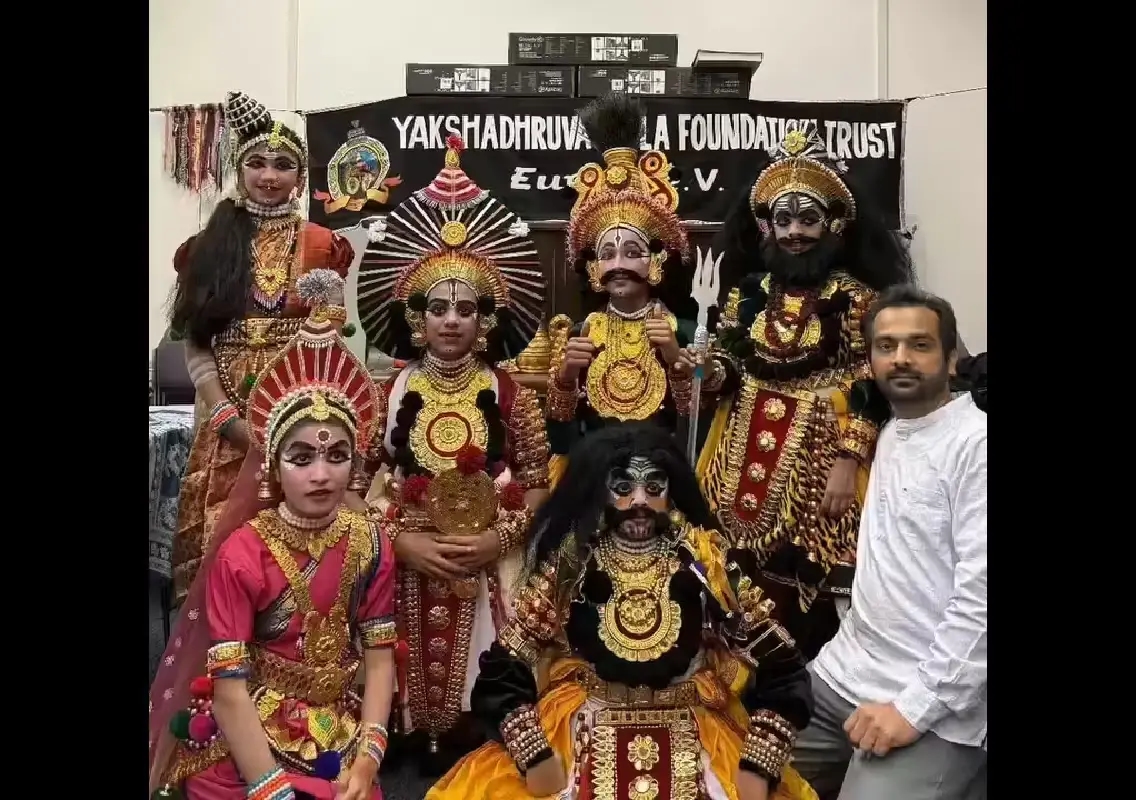


Mangaluru: Yakshagana, the vibrant and centuries-old theatre tradition of coastal Karnataka, will be staged in the German language for the first time, marking a major cultural milestone for the classical folk art form. The special German-language production of the Yakshagana episode Mohini Bhasmasura will be presented in Munich on February 28, according to Yakshagana artiste and Yakshadhruva Patla Foundation Europe unit secretary Ajeeth Prabhu Thallu.
Yakshagana has historically been performed in Kannada and Tulu, with several productions also staged in Konkani and Marathi over the decades. In recent years, a few pioneering troupes — including Aithal’s team and others — experimented with English-language versions to introduce Yakshagana to international audiences. However, this is the first time a full Yakshagana prasanga is being designed and performed in German specifically for a European audience.
Designed for German audiences
According to Ajeeth, the upcoming production is the result of more than a year of detailed planning, scripting, rehearsal and linguistic adaptation. The initiative was driven by the unique composition of the performing troupe — children of Indian origin who were born and brought up in Germany and speak German as their first language.
He said the concept developed naturally as trainers observed both the comfort level of the young performers in German and the growing curiosity among local German viewers about Yakshagana.
The Munich performance is specially structured for German audiences, with attention given to language clarity, pacing, presentation style and cultural accessibility. While retaining the visual richness of Yakshagana through costume, dance, music and facial expression, the spoken dialogue has been fully adapted into German.
Growing European interest in Yakshagana
Organisers noted that German art enthusiasts have been attending Kannada Yakshagana performances in Europe for several years. Despite language barriers, many viewers reportedly sat through shows lasting over 90 minutes, trying to follow the storyline through visual cues and narration.
Feedback from these audiences indicated strong interest in the art form but difficulty in understanding the dialogue-heavy portions. This response encouraged the troupe to explore a German-language adaptation so that local viewers could connect more directly with the narrative and humour.
Yakshadhruva Europe, which has been promoting Yakshagana across the continent through workshops and performances, decided to take up the challenge as a structured cultural experiment.
Complex translation process
Translating Yakshagana dialogue into German proved to be one of the most demanding aspects of the project. Ajeeth explained that Yakshagana language is layered with poetic expression, cultural references, wordplay and region-specific humour, making literal translation ineffective.
To address this, the team adopted a multi-stage translation method. Dialogues were first rendered from Kannada into English, and then from English into German. After this, they were reshaped into a theatre-friendly German script that preserved dramatic intensity and character tone rather than word-for-word equivalence.
German theatre experts and German language specialist Birgit Goulet collaborated closely on the script. Multiple review rounds were conducted to ensure that the dialogues sounded natural to German ears while maintaining Yakshagana’s stylised dramatic flavour.
The himmela (background music ensemble) will continue in Kannada, preserving the musical authenticity of the form. The dance segments required minimal change, as they are largely expressive and symbolic rather than language-dependent.
Why Mohini Bhasmasura was chosen
The prasanga Mohini Bhasmasura was selected because of its universal storyline and strong visual appeal. The episode narrates the tale of a demon who receives a powerful boon and is ultimately tricked into self-destruction by Mohini, the enchanting female form assumed by Vishnu.
Organisers said the story combines humour, dramatic conflict, dance and expressive character interaction, making it easier for audiences unfamiliar with Indian mythology to understand and enjoy. Its clear moral arc and theatrical energy make it particularly suitable for cross-cultural staging.
Training young performers
Though the child performers are fluent in German, delivering lines in Yakshagana style — with its heightened expression, rhythmic delivery and dramatic projection — requires sustained training. Coaches have been working with the children on body language, gesture vocabulary, facial expression and timing.
Adjustments have also been made to match European theatre etiquette. German audiences typically expect tighter show durations, controlled sound levels and attentive silence during performances. The production has therefore been edited and structured to suit these expectations without diluting the core elements of Yakshagana.
Wider European outreach planned
Yakshadhruva Europe is promoting the Munich show through local radio, newspapers and cultural networks. As part of a broader outreach effort, the team is also preparing a nine-minute documentary introducing Yakshagana to European audiences.
The documentary will be released in multiple European languages, including Italian, Polish and French, to widen reach and accessibility. A dedicated digital platform titled “Yakshagana in Europe” has also been launched to support awareness, documentation and future events.
Organisers believe the German-language production could open doors for more multilingual Yakshagana performances globally and help the traditional art form reach new generations and geographies while preserving its classical roots.