


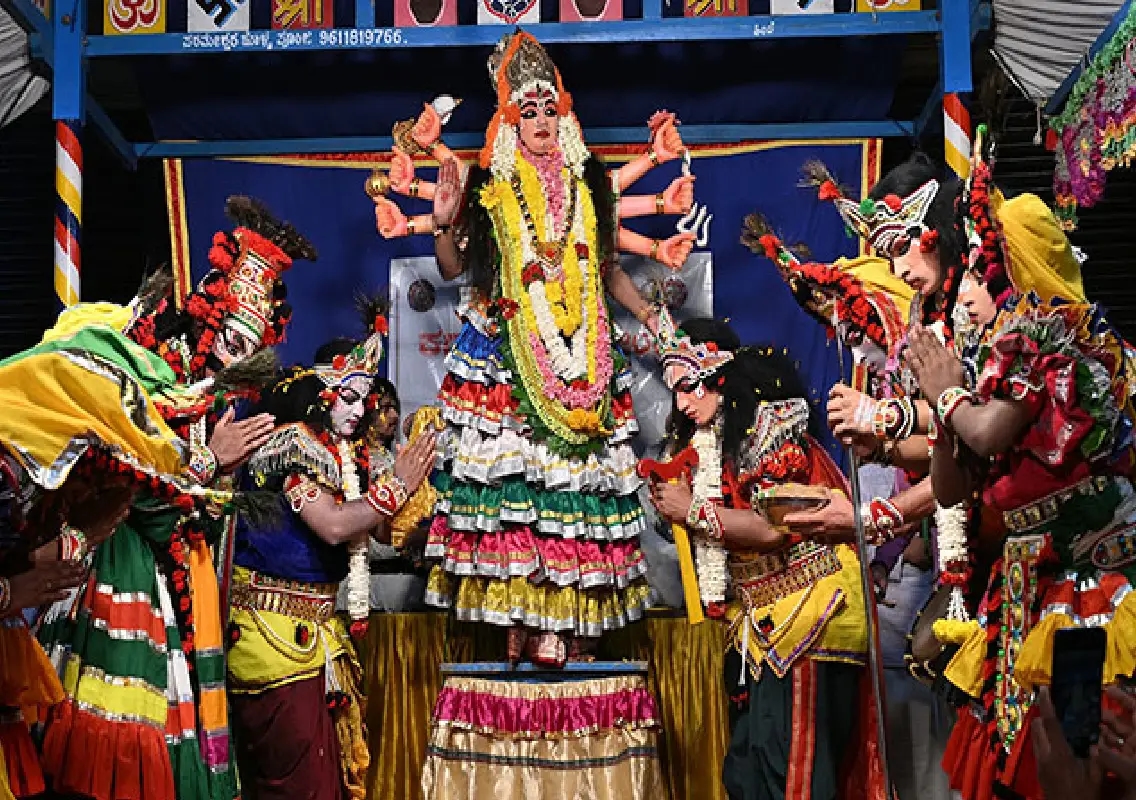


Mangaluru: In a striking celebration of artistic talent and religious harmony, Muslim Yakshagana artist Arshiya Khan portrayed the eight-armed Goddess Sri Devi during a performance at the Kadri Sri Manjunatha Temple in Mangaluru on October 20.
Arshiya, also known by her stage name Tanu Vitla, brought the divine character to life in Sampoorna Sri Devi Mahatme, depicting the goddess holding weapons in her eight hands as she destroys evil and protects devotees. Her performance attracted the attention of audiences and Yakshagana enthusiasts during the concluding programme of the Kadali Dashaha festival.
Her portrayal stood out not only for its artistic execution but also for the cultural significance of a Muslim woman performing a revered Hindu mythological character on a traditional Yakshagana stage.
A childhood passion for Yakshagana
Arshiya hails from Mada near Vitla in Bantwal taluk of Dakshina Kannada district. Her interest in Yakshagana began during childhood, when she watched performances organised in her neighbourhood.
Drawn to the colourful costumes, expressive movements, rhythmic music and dramatic storytelling of the traditional art form, she began learning Yakshagana at the age of nine while studying in Class 4.
Her parents, Abdul Khader, a retired deputy tahsildar, and Mumtaz, encouraged her interest and supported her artistic ambitions. With their backing, what began as a childhood fascination gradually developed into a sustained commitment to the performing arts.
Arshiya has now accumulated 12 years of stage experience, building her skills through training and performances in the traditional dance-drama form that remains an integral part of coastal Karnataka’s cultural identity.
She received training under Yakshagana guru Kadri Ramesh Bhat and is actively associated with Kadali Kala Kendra, which operates on the premises of the Kadri temple.
From demon characters to Goddess Sri Devi
Over the years, Arshiya has performed several roles in the popular Devi Mahatme prasanga, demonstrating her versatility in portraying characters from Hindu mythology.
Her earlier roles include the demon characters Shumbha and Nishumbha, as well as Aadimaye and Sri Devi. Her latest portrayal of the eight-armed goddess represents another important milestone in her artistic journey.
The role of Sri Devi requires the performer to convey both divine power and protective compassion through elaborate costumes, expressive gestures, dance movements and dramatic presentation. The goddess’s eight arms, traditionally depicted holding weapons, symbolise her power to overcome evil and protect her devotees.
Arshiya’s performance formed part of Sampoorna Sri Devi Mahatme, a Yakshagana presentation that narrates the divine struggle between good and evil.
Her ability to move between contrasting characters, from mythological demons to the goddess herself, reflects the range of roles available to trained Yakshagana performers and the importance of disciplined preparation.
Special preparation for the goddess’s role
Portraying a sacred character such as Sri Devi carries religious and cultural significance for many Yakshagana performers and devotees.
According to the account of her performance, Arshiya followed a strict vegetarian diet and observed religious vows before appearing on stage as the goddess.
She regards the opportunity to portray Sri Devi as a blessing from Ullalthi Durgaparameshwari and has expressed gratitude for the affection, encouragement and support she receives from art lovers.
Her approach reflects the personal commitment she brings to her performances, combining artistic preparation with respect for the traditions associated with the character.
Arshiya has also expressed hope that audiences will continue to encourage her artistic journey and extend their blessings and support.
Kadali Dashaha concludes with Sampoorna Sri Devi Mahatme
Arshiya’s performance took place on the concluding day of the 14th edition of Kadali Dashaha, a 10-day Yakshagana festival organised by Kadali Kala Kendra as part of the Dasara celebrations.
The festival was held at the Rajangana of Kadri Sri Manjunatha Temple from October 11 to 20.
The concluding programme on October 20 featured Sampoorna Sri Devi Mahatme, with artists from prominent Tenkuthittu Yakshagana troupes, including Kateel and Pavanje, participating in the presentation.
Arshiya’s appearance as Sri Devi added a distinctive highlight to the final day’s programme, bringing together the traditional art form, devotional storytelling and the talent of a performer who began her journey at a young age.
The festival provided a platform for artists to present traditional Yakshagana prasangas and sustain public interest in the region’s distinctive performance traditions.
Yakshagana’s tradition of cultural inclusiveness
Yakshagana occupies a special place in the cultural life of coastal Karnataka, particularly in Dakshina Kannada and Udupi districts. Its combination of music, dance, dialogue, elaborate costumes and mythological narratives has helped preserve stories and traditions across generations.
Although the art form is closely associated with Hindu mythology and temple festivals, its performance tradition has also brought together artists from different religious and social backgrounds.
The region’s cultural landscape includes the popular Bappanadu Kshetra Mahatme prasanga, associated with Bappanadu Durgaparameshwari Temple, which is widely regarded as a symbol of Hindu-Muslim harmony.
Muslim artists have also contributed to both the Tenkuthittu and Badaguthittu styles of Yakshagana, demonstrating how the traditional art form can cross community boundaries while preserving its distinctive cultural identity.
Against this backdrop, Arshiya’s portrayal of Goddess Sri Devi has attracted particular attention. Her participation illustrates how dedication, training and artistic expression can create shared cultural spaces among people from different backgrounds.
An artistic journey beyond community boundaries
Arshiya Khan’s performance at Kadri Sri Manjunatha Temple was an important moment in her continuing Yakshagana journey. From watching performances in her neighbourhood as a child to appearing as the eight-armed goddess before an audience during a major festival, her path reflects years of learning and commitment.
Her portrayal also highlights the role of cultural institutions, gurus and families in nurturing talent and ensuring that traditional performing arts remain accessible to new generations.
For Yakshagana enthusiasts, her performance offered an opportunity to appreciate the artistic demands of the Sri Devi character. More broadly, it reflected the ability of cultural traditions to bring performers and audiences together across religious and social boundaries.
As coastal Karnataka continues to preserve its rich performing arts heritage, artists such as Arshiya demonstrate how dedication to a shared cultural tradition can foster understanding and mutual appreciation.