







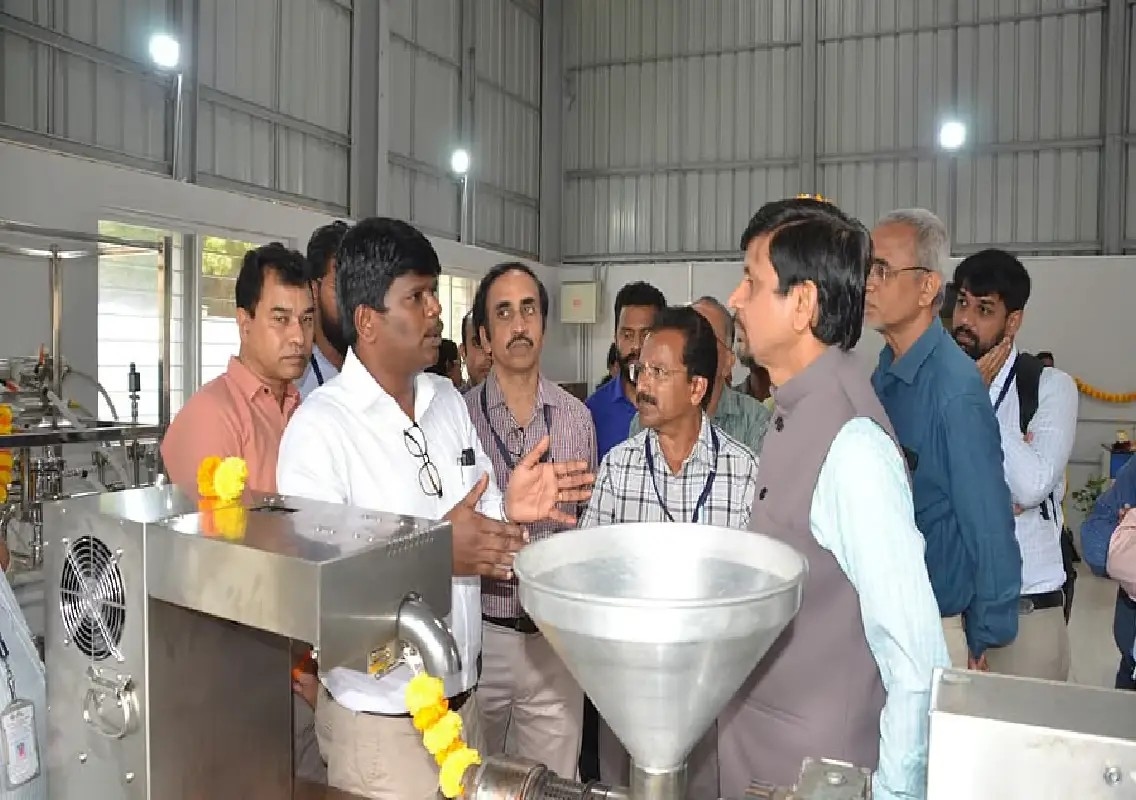


Mysuru: The CSIR-Central Food Technological Research Institute (CSIR-CFTRI), Mysuru, has launched an Integrated Oilseed Processing Unit at its campus as part of its efforts to translate scientific research into practical technologies and strengthen value addition in the oilseed sector.
The facility was inaugurated on Friday by Dr Giridhar Parvatam, Director, CSIR-CFTRI, to mark the birth anniversary of Dr V Subramanian, the founding director of CSIR-CFTRI.
The new facility is designed to provide pilot-scale and pre-commercial processing capabilities, enabling researchers, farmers, entrepreneurs, MSMEs and industry to develop and test technologies and products based on oilseeds.
Focus on taking research beyond laboratories
Inaugating the unit, Dr Giridhar Parvatam said the facility reflects CSIR-CFTRI’s mission of converting scientific knowledge into technologies and products that can support livelihoods and create wider societal impact.
“This unit represents CSIR-CFTRI’s mission to transform scientific knowledge into technologies and products to support livelihoods and create societal impact. It promotes sustainable processing, agricultural value addition, enhancement of farmers’ incomes, and technology-driven entrepreneurship,” he said.
He said the facility was established to ensure that research in oilseeds reaches stakeholders beyond the laboratory.
“This unit is meant to ensure that the value of oilseed research reaches beyond the laboratory to farmers, entrepreneurs, industry and society,” he added.
According to him, the facility also marks an important step towards efficient processing and value addition of oilseeds, while supporting India’s objective of achieving greater self-sufficiency in edible oil production.
Facility equipped for oil extraction and product development
According to CSIR-CFTRI scientists, the Integrated Oilseed Processing Unit has equipment covering several stages of oilseed processing and product development.
The facility includes an oil extraction unit with a capacity of 50 kg per hour and a filtration unit with a capacity of 50 litres per hour.
It also houses a short-path molecular distillation unit capable of processing up to 5 litres per hour. Such facilities can support research and development related to refining and improving the quality and characteristics of oils.
In addition, the unit has equipment for producing oilseed-based pastes and spreads and facilities for energy-bar production.
The facility also has essential instruments for edible oil quality analysis, allowing researchers to assess products developed through different processing methods.
Together, these capabilities provide a platform for testing oilseed processing technologies at a scale beyond laboratory experiments.
Expansion under CSIR-ULIP project
The facility has been developed through a series of government- and industry-sponsored research and development projects, including CSIR Mission projects.
Scientists said the facility is now being further expanded under the CSIR-ULIP project, which will strengthen its capabilities across the oilseed processing chain.
The planned expansion will cover areas ranging from pre-processing to packaging. It will also include capabilities related to adulteration detection, process optimisation and product development.
The expanded facility is expected to support technology demonstration and scale-up, besides enabling pre-commercial assessment of promising technologies.
This will help researchers evaluate technologies under conditions closer to commercial production before they are transferred for wider industrial adoption.
Opportunities for farmers and entrepreneurs
At present, the unit provides a platform for pilot-scale and pre-commercial oilseed processing, with capabilities covering oil extraction, filtration, refining, product development and quality evaluation.
Scientists said one of the important objectives of the facility is to establish stronger links between research institutions and stakeholders involved in oilseed production and processing.
The unit will connect researchers with farmers, industry, MSMEs, start-ups and entrepreneurs. Particular opportunities are expected in the processing and value addition of novel and underutilised oilseeds.
Access to processing and product-development infrastructure can help farmers and entrepreneurs move beyond the sale of raw oilseeds and explore products with greater value addition.
The facility can also help aspiring entrepreneurs test new products and processing technologies before making larger investments in commercial-scale infrastructure.
Scope for rural enterprises and women entrepreneurs
The institute said the facility could create opportunities for new livelihood models, including those involving women entrepreneurs and rural enterprises.
By making processing and product-development infrastructure accessible, the facility can help small businesses explore oilseed-based products and establish enterprises closer to production centres.
Such decentralised value addition could also reduce the need to transport raw agricultural produce over long distances before processing.
Scientists said encouraging local processing can contribute to a more resilient oilseed ecosystem by creating opportunities closer to the source of production and strengthening connections between farmers, researchers and industry.
The approach could also support the development of specialised products from oilseeds that have traditionally received limited attention in mainstream processing.
Technology demonstration and transfer
The expanded facility is expected to play a role in moving promising technologies from research towards commercial application.
Through technology demonstration, scale-up studies and pre-commercial assessment, researchers will be able to evaluate the feasibility of different processing technologies and products.
The facility will also support technology transfer, creating a pathway for suitable innovations developed at CSIR-CFTRI to reach industry and entrepreneurs.
The institute sees this as an important part of its broader effort to ensure that scientific research generates practical benefits for agriculture, food processing and rural livelihoods.
Facility developed with multidisciplinary support
The Integrated Oilseed Processing Unit has been established under the guidance of K Rajagopal, Head, Department of Biochemistry, and coordinated by P Vijayaraj, Scientist E, with support from CSIR-CFTRI scientists and technical staff.
The facility brings together processing, product development and analytical capabilities, allowing researchers to work across multiple stages of the oilseed value chain.
With its existing infrastructure and planned expansion, the unit is expected to provide a common platform for research, demonstration and technology development.
The launch also underlines CSIR-CFTRI’s focus on linking food technology research with agricultural value addition and entrepreneurship. By bringing farmers, researchers, MSMEs, start-ups and industry closer to processing and product-development infrastructure, the facility aims to help oilseed research move from the laboratory towards practical applications and wider commercial use.