







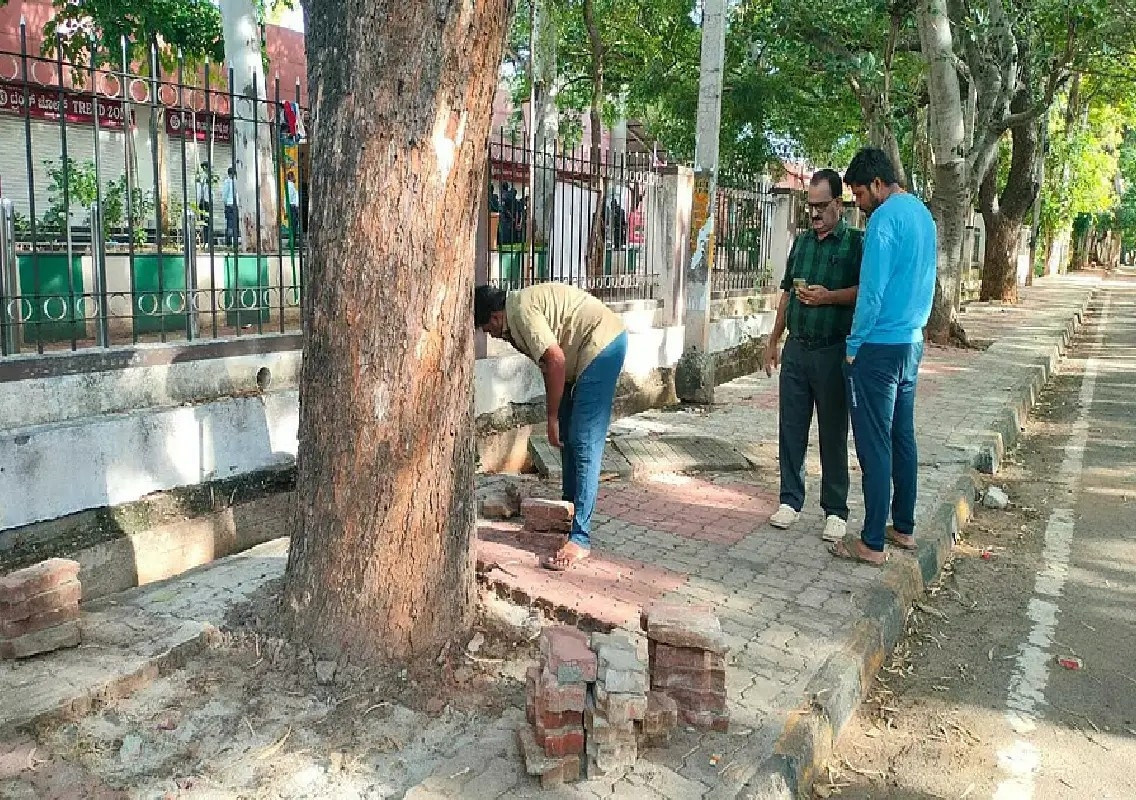


Mysuru: The Mysuru City Corporation (MCC) launched a large-scale drive on World Environment Day to remove concrete, asphalt and interlocking tiles surrounding roadside trees across the city, following concerns raised over violations of environmental regulations and the impact of concretisation on tree health.
The initiative was undertaken after a report highlighted the continued concretisation of tree bases in several parts of Mysuru despite directives issued by the National Green Tribunal (NGT) and a subsequent government order mandating the protection of roadside trees.
The drive began early on Friday morning, with MCC officials and engineers overseeing operations across multiple city zones.
Thirty-four tree bases cleared in first phase
As part of the campaign, MCC workers cleared the bases of 34 roadside trees on the first day of the operation.
Officials said 14 tree bases were cleared in Zone 6, six in Zone 7, ten in Zone 8 and four in Zone 4.
The work was carried out under the guidance of MCC Commissioner Shaikh Tanveer Asif, Superintendent Engineer Manjunath and Executive Engineer A N Manjunath, with zonal engineers leading teams on the ground.
Corporation staff began the de-concretisation work at around 7.30 am and targeted trees whose bases had been covered with asphalt, concrete and interlocking paving blocks.
Areas covered during the initial phase included stretches in Zone 1, Zone 4 and Zone 6, including prominent roads such as JCE College Road and Sayyaji Rao Road.
Action follows environmental concerns
The drive comes in the wake of growing concerns expressed by environmental activists and forest officials regarding the impact of concretisation on urban trees.
A report published earlier this week had highlighted that many roadside trees in Mysuru continued to remain trapped under concrete despite existing environmental regulations.
The report cited observations made by members of the environmental group Parisarakkaagi Naavu, who identified numerous locations where tree bases had been covered, restricting natural growth conditions.
Environmentalists have long argued that covering tree bases with concrete prevents adequate water percolation, restricts air circulation to roots and adversely affects the overall health and stability of trees.
Forest department sought urgent action
The issue gained further attention after Deputy Conservator of Forests (DCF), Mysuru Territorial Division, K Paramesha, wrote to the MCC Commissioner urging immediate compliance with the NGT directives.
In his communication, the DCF referred to the tribunal’s order requiring local authorities to ensure that at least one metre of space around the base of every roadside tree remains free from concrete and is filled with soil.
The objective is to improve water absorption, facilitate nutrient availability and ensure adequate aeration to tree roots, thereby promoting healthier growth and long-term survival.
Forest officials have also pointed out that weakened root systems can increase the risk of trees toppling during heavy rains and strong winds, posing dangers to people and property.
Earlier directives led to limited action
The issue of concretised tree bases has been under discussion for more than a year.
Following a report published in May 2025, former Deputy Conservator of Forests K N Basavaraju had directed the MCC to take corrective measures.
Subsequently, the civic body cleared tree bases on selected roads and passed a resolution proposing the inclusion of specific clauses in tender documents to prevent future violations.
The resolution also proposed penalties against contractors responsible for concreting around tree bases.
Former Forest Minister Eshwar Khandre had also intervened in the matter and directed senior forest department officials to ensure compliance with environmental norms.
Following these directions, the government issued an order upholding the NGT guidelines and making them applicable across Karnataka.
Importance of protecting urban trees
Experts emphasise that preserving open soil around tree bases is essential for maintaining healthy urban green cover.
Tree roots require sufficient access to water, oxygen and nutrients, all of which are significantly restricted when the surrounding area is covered with concrete or asphalt.
Proper de-concretisation not only improves tree health but also enhances groundwater recharge and helps urban areas better manage rainwater runoff during the monsoon season.
Environmental groups have welcomed the MCC’s latest initiative and expressed hope that the campaign will be extended to all affected areas in the city.
Continued monitoring planned
Officials indicated that the drive will continue in the coming weeks as part of efforts to comply fully with environmental regulations and improve the city’s urban ecosystem.
The World Environment Day initiative has been viewed as a significant step towards protecting Mysuru’s roadside trees and promoting sustainable urban development.
Authorities have also appealed to contractors, residents and commercial establishments to avoid practices that obstruct natural tree growth and to support measures aimed at preserving the city’s green heritage.