







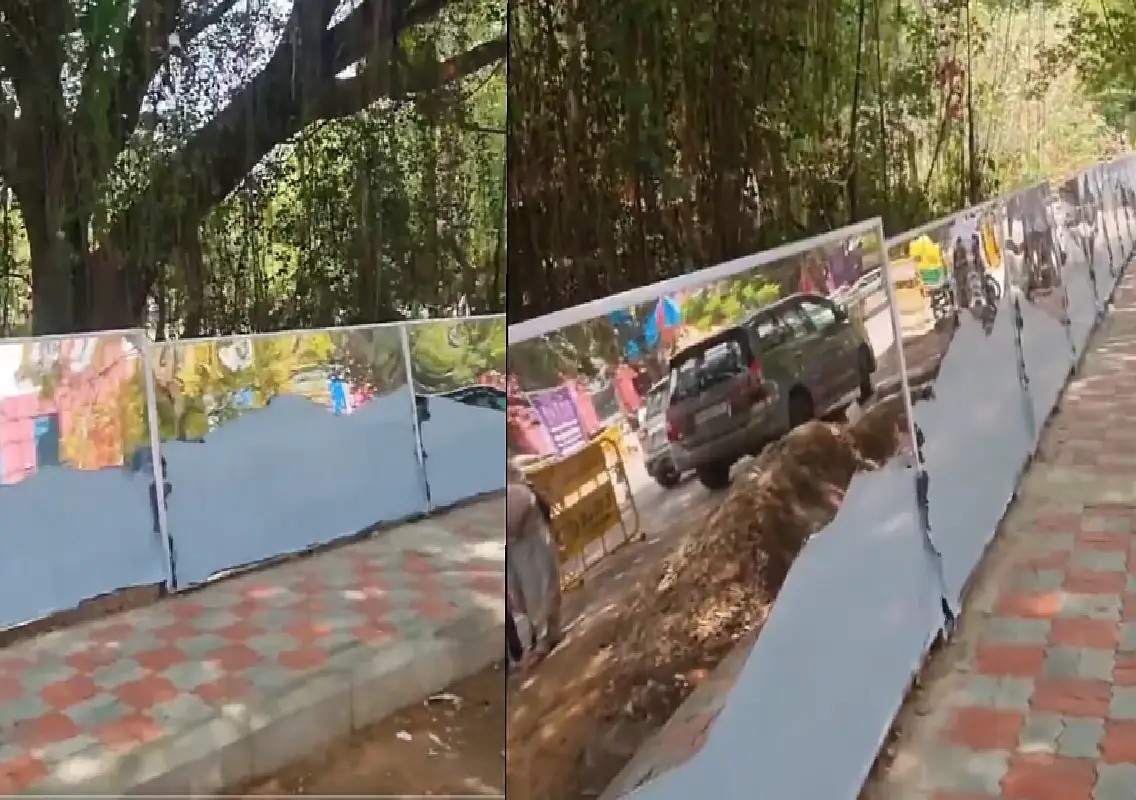


Mysuru: In an unusual attempt to tackle the persistent issue of open urination, authorities in Mysuru have installed reflective mirrors along a roadside wall near the Suburban Bus Stand, aiming to discourage the practice through behavioural intervention.
The initiative targets a location that has long been associated with public urination despite repeated efforts to maintain cleanliness. By placing large, shiny steel mirrors along the wall, officials hope that the presence of one’s own reflection will act as a psychological deterrent.
Idea gains traction on social media
Videos showing the mirrors have gone viral across social media platforms, sparking widespread discussion. A clip shared by user “@Theshashank_p” on X drew significant attention, with many users calling the idea creative and effective.
Several viewers praised the approach as a simple yet innovative solution to a common urban sanitation problem. Comments ranged from calling it “genius” to suggesting similar methods be adopted in other cities facing similar challenges.
Mixed reactions highlight larger concerns
While the initiative has been appreciated for its ingenuity, it has also triggered debate on deeper civic and infrastructural issues. Many users argued that embarrassment alone cannot solve the problem of public urination.
Some pointed out that the lack of accessible and hygienic public toilets remains a key concern in Indian cities. They stressed that authorities must prioritise building and maintaining adequate sanitation facilities alongside behavioural deterrents.
Others suggested stricter enforcement measures, including fines, to ensure compliance with public hygiene norms.
Debate over availability of facilities
Responding to criticism, the individual who shared the viral video claimed that multiple public toilets exist within a 100-metre radius of the location. According to the post, the issue stems less from lack of infrastructure and more from poor civic habits.
This perspective has further fuelled the debate, with some users emphasising the need for behavioural change and awareness, while others maintained that infrastructure gaps still play a significant role.
Humour and scepticism among netizens
The installation has also prompted humorous reactions online. Some users joked about installing cameras or live telecasts to further discourage the act. Others, however, expressed scepticism about the durability of the mirrors.
A few comments suggested that the mirrors might be vandalised or damaged over time, raising questions about the long-term effectiveness of the measure.
Conclusion
The mirror installation in Mysuru highlights a creative approach to addressing civic issues, blending behavioural psychology with urban management. While the initiative has captured public attention and sparked conversation, it also underscores the need for a balanced strategy—combining infrastructure development, enforcement, and public awareness—to achieve lasting improvements in sanitation and civic behaviour.