







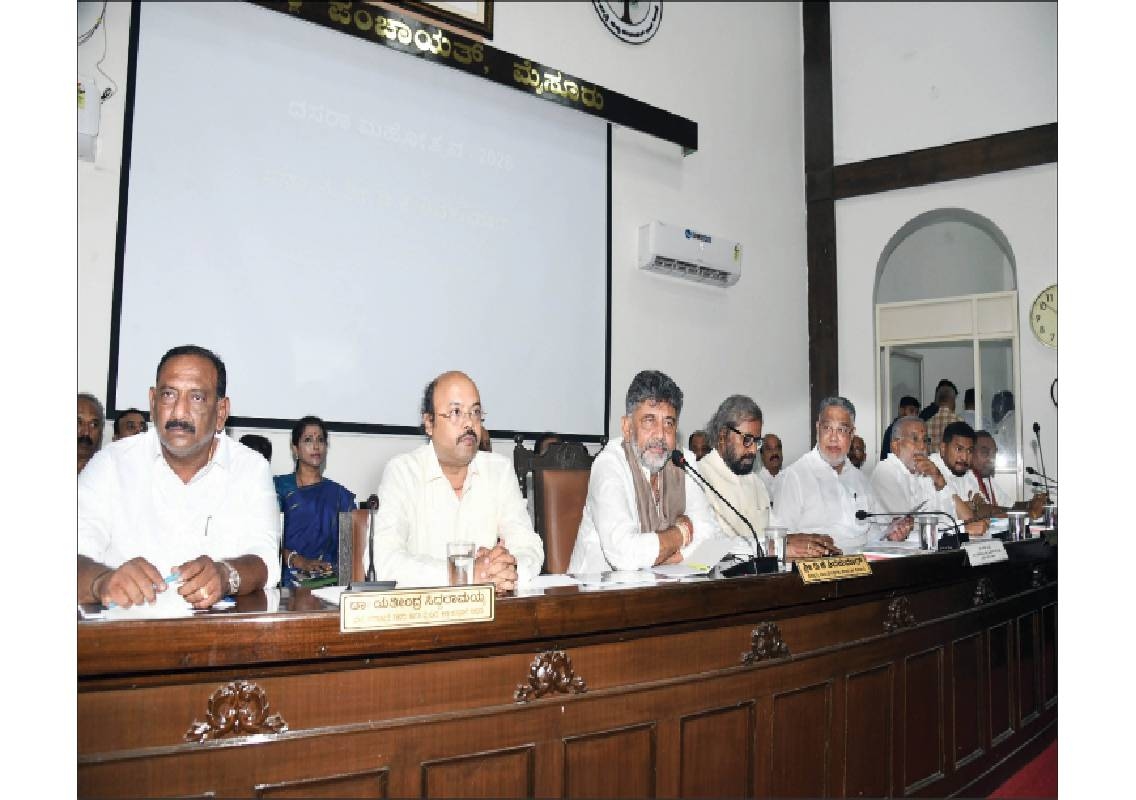


Mysuru: Confusion has emerged over the scope of the proposed flex ban in Mysuru after Chief Minister D.K. Shivakumar announced that the city would be made “flex-free”, while the formal order issued by the Mysuru City Corporation (MCC) restricts unauthorised flexes, banners and posters from October 5 until further orders, with the immediate focus on the Dasara period.
The issue has gained attention as Mysuru prepares for Dasara 2026, when thousands of visitors are expected to arrive in the city. Authorities have said that removing unauthorised publicity material will help preserve the city’s heritage character, improve cleanliness and facilitate smoother traffic movement during the festival.
Chief Minister calls for flex-free Mysuru
Chief Minister D.K. Shivakumar directed the MCC and Mysuru City Police to take action against unauthorised flex boards and publicity material during a review meeting on Dasara preparations.
Following the meeting, Shivakumar said private flex boards would not be allowed in Mysuru and that only Government-related flexes and banners connected with Dasara would be permitted.
He also directed officials not to allow flex boards carrying photographs of political leaders, including his own photograph.
The announcement created an impression that the restriction would apply permanently across Mysuru. However, subsequent clarification and the MCC’s formal notification have created some uncertainty over whether the ban is intended to continue after Dasara.
MCC order focuses on Dasara
MCC Commissioner M.K. Savitha subsequently issued a notification under the initiative ‘Flex-Free Dasara 2026’.
The order prohibits unauthorised flexes, banners and posters within Mysuru city limits from October 5 until further orders. Existing unauthorised publicity material has been directed to be removed voluntarily by October 7.
The civic body has made an exception for authorised publicity and information material connected with Dasara.
The MCC has appealed to elected representatives, political parties, organisations, event organisers and members of the public to cooperate with the campaign and refrain from installing unauthorised publicity material.
If existing material is not removed voluntarily, the MCC has warned that its teams will remove it and initiate legal action under the Karnataka Open Places (Prevention of Disfigurement) Act, 1981. Fines can also be imposed on violators.
Why Mysuru wants to go flex-free
Mysuru is known for its heritage buildings, Palace, tree-lined roads and traditional streetscapes. During Dasara, the city receives visitors from different parts of India and abroad, making the visual appearance of public spaces a particular concern for civic authorities.
The MCC has said that the campaign is intended to protect the city’s traditional beauty and clean image while also facilitating hassle-free movement during the festival.
Unauthorised flexes are frequently installed on roadsides, junctions, medians and in front of buildings. Apart from affecting the appearance of public spaces, large banners can obstruct signboards and visibility for motorists and pedestrians.
The issue has therefore been raised periodically by residents and civic groups seeking stronger enforcement of existing rules.
Residents want permanent ban
The debate has now moved beyond Dasara.
Residents and civic activists have called for Mysuru to remain free of unauthorised flexes even after the festival ends. The Mysore Grahakara Parishat (MGP) has welcomed the MCC’s latest action but has urged the authorities to make the restriction permanent.
MGP Working President S.K. Dinesh said the organisation wants Mysuru to become a permanently flex-free city and appealed to political leaders to stop putting up flex boards.
The demand reflects a broader concern that temporary drives often lose momentum once major festivals or special events are over.
For a permanent ban to work, residents and civic groups argue that enforcement would have to continue throughout the year rather than being concentrated around Dasara.
Political flexes also under scrutiny
The restriction has particular significance because political flexes and banners have frequently appeared in public spaces.
The Chief Minister has specifically directed officials not to allow flex boards carrying photographs of political leaders during the campaign.
The MCC has also asked elected representatives and political parties to cooperate with the initiative.
The involvement of political parties and public representatives will be important for the campaign’s credibility. If unauthorised publicity material is removed from ordinary citizens but political banners are allowed to remain, enforcement could face criticism.
The MCC’s direction therefore applies to a wide range of organisations and individuals responsible for putting up unauthorised banners and posters.
Legal action planned against violations
The MCC has made it clear that the campaign will not rely entirely on voluntary compliance.
Unauthorised flexes, banners and posters already installed have been given a deadline of October 7 for removal. After that, civic teams are expected to remove the material themselves.
Officials can also initiate proceedings under the Karnataka Open Places (Prevention of Disfigurement) Act, 1981.
The threat of penalties is intended to discourage people from putting up new unauthorised publicity material after the enforcement drive begins.
The effectiveness of the measure, however, will depend on regular monitoring and swift action when fresh flexes are installed.
Environmental concerns add to the debate
The flex issue is also connected to concerns about waste and the environmental impact of synthetic publicity materials.
Environmental activists have welcomed the MCC’s move and suggested that even authorised Dasara publicity should use more environmentally friendly alternatives.
Activist Ravi Bale has suggested using Khadi cloth and organic dyes for permitted Dasara publicity material instead of conventional flex materials.
Such alternatives could allow authorities to maintain necessary public information and festival publicity without adding to the volume of plastic-based waste generated during major events.
What happens after Dasara?
The main question now is whether Mysuru will remain flex-free after the Dasara festivities.
The MCC notification currently prohibits unauthorised flexes, banners and posters from October 5 until further orders. This means the restriction is not expressly limited to a specific Dasara date, although the campaign has been framed as ‘Flex-Free Dasara 2026’.
At the same time, the Chief Minister’s public statement that Mysuru would be made flex-free has raised expectations among residents that the policy could eventually become permanent.
The distinction will become clearer after Dasara, depending on whether the MCC continues enforcement and whether a separate long-term policy or order is issued.
For now, the immediate objective is to remove unauthorised flexes before and during Dasara and prevent new ones from appearing.
Conclusion
The flex ban debate in Mysuru has highlighted a gap between a broader political announcement and the scope of the current civic order. While Chief Minister D.K. Shivakumar has spoken of making Mysuru flex-free, the MCC’s present initiative is focused on banning unauthorised flexes, banners and posters from October 5 until further orders, particularly during Dasara.
Residents and civic activists are now seeking a permanent ban. Whether Mysuru becomes genuinely flex-free throughout the year will depend on continued enforcement after the Dasara celebrations and the willingness of political parties, organisations and citizens to comply.