







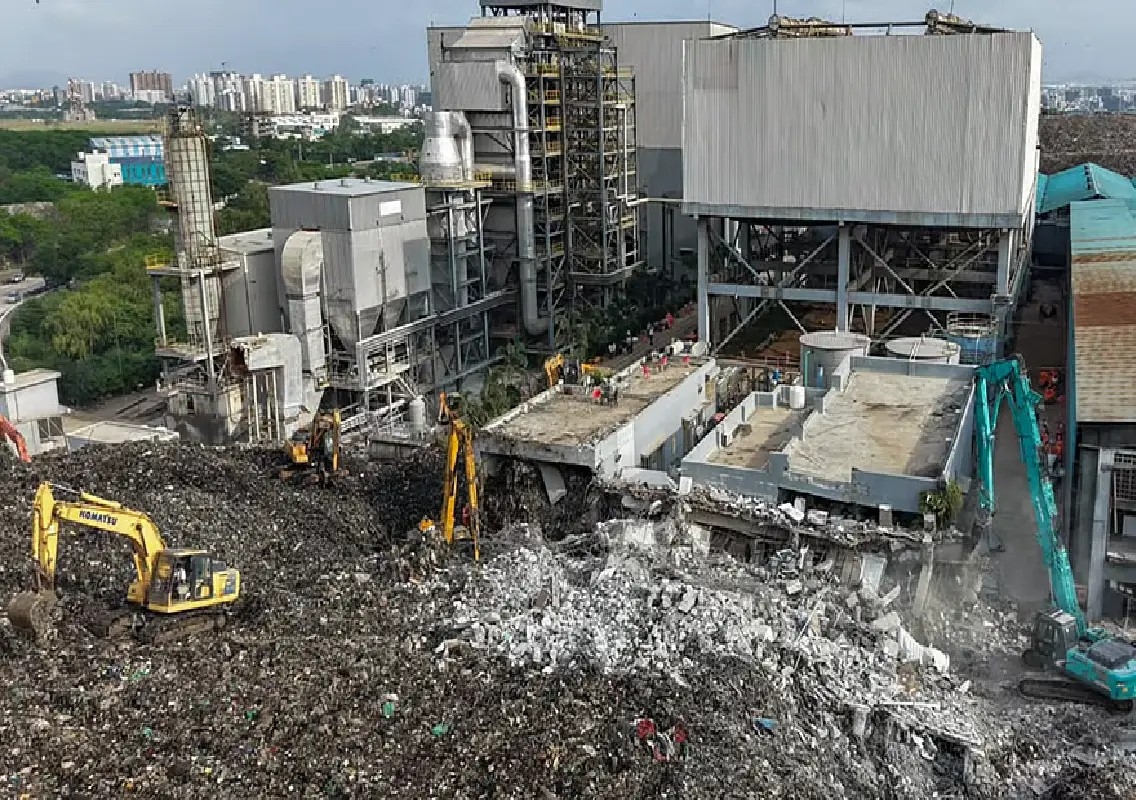


Mysuru: Mysuru City Corporation (MCC) has cleared 5,14,824.06 tonnes of legacy waste through its ‘Biomining and Bioremediation’ project at the Sewage Farm dumpsite in Vidyaranyapuram.
The project aims to clear more than 6,00,948 tonnes of solid waste that had accumulated at the 22.4-acre dumpsite for over a decade.
The work began in March 2024 and was taken up with a project period of 22 months. The remaining waste is expected to be cleared by November, according to MCC Assistant Executive Engineer (Environment) K.S. Mruthyunjaya.
Rs 59.54 crore project
The biomining and bioremediation project has been taken up at a cost of Rs 59.5483 crore.
Of the total project cost, Rs 10.9072 crore is being borne under the Swachh Bharat Mission by the Central government, while the state government is contributing Rs 7.2715 crore.
The remaining Rs 41.3696 crore is being borne by the Mysuru City Corporation.
The project is aimed at scientifically processing the old waste accumulated at the dumpsite and recovering materials that can be recycled or reused.
How biomining works
Under the project, the old waste is excavated and segregated into heaps known as windrows.
The waste is then exposed to air and treated with bio-culture to accelerate the decomposition process. The method, known as bio-cultural aeration, enhances microbial activity and helps speed up the breakdown of organic matter.
After being treated for around 30 to 45 days, the material is screened using trommel machines.
The screening process separates different types of material from the legacy waste. Plastics, metals and glass are segregated and sent for testing through National Accreditation Board for Testing and Calibration Laboratories (NABL)-approved facilities.
Materials found suitable for reuse are subsequently sent for recycling.
The bio-soil recovered during the process contains organic material and is used as compost. A seed germination test is conducted to assess its suitability.
Mysuru generates up to 580 tonnes of waste daily
Mysuru generates around 550 to 580 tonnes of solid waste every day, including approximately 302 tonnes of wet waste.
The city’s waste management infrastructure had earlier faced capacity constraints.
MCC had seven zero-waste management plants, each with a capacity to process only around five tonnes of waste per day.
The centralised solid waste management plant at Vidyaranyapuram, which is more than 28 years old and spread across 15 acres, had earlier seen its processing capacity decline from 200 tonnes per day to around 100 tonnes.
As a result, the city’s overall waste processing capacity had earlier been limited to around 135 tonnes per day, leaving a significant quantity of waste to be dumped at the Vidyaranyapuram site.
Waste processing capacity expanded
MCC has now completed the remodelling of the centralised solid waste management plant at Vidyaranyapuram at a cost of Rs 13.66 crore.
The remodelling has increased the plant’s processing capacity to 200 tonnes per day.
Another solid waste management plant at Kesare, spread over 11 acres, has been established with a planned capacity of 200 tonnes per day. It is currently processing around 100 tonnes of waste daily.
A third plant at Rayanakere, spread across six acres and designed to process 150 tonnes per day, is currently handling around 120 tonnes daily.
The expansion of processing capacity is expected to reduce the pressure on dumpsites and improve the scientific management of municipal solid waste.
MCC focuses on segregation at source
MCC Commissioner M.K. Savitha said the corporation was working to streamline waste collection and segregation at source.
She said the objective was to ensure that waste generated in the city is collected, segregated and processed systematically and scientifically.
The MCC has also held meetings with urban local bodies around Mysuru city to coordinate waste management efforts and address issues related to waste generated in areas surrounding the city.
The coordination is aimed at preventing waste management problems in areas on the outskirts from affecting the city’s overall cleanliness.
Cleanliness drive ahead of Dasara
With Mysuru preparing for the Dasara festivities, the MCC is also undertaking special cleanliness drives along the ring road and major roads connecting the city.
The civic body plans to focus on these routes to maintain cleanliness and improve the appearance of the city ahead of the festival.
Mysuru attracts a large number of visitors during Dasara, and the cleanliness initiatives are also intended to present the heritage city in a better manner to tourists.
The ongoing clearance of legacy waste, expansion of waste-processing capacity and efforts to improve source segregation are part of the corporation’s broader efforts to address the city’s long-standing solid waste management challenges.