







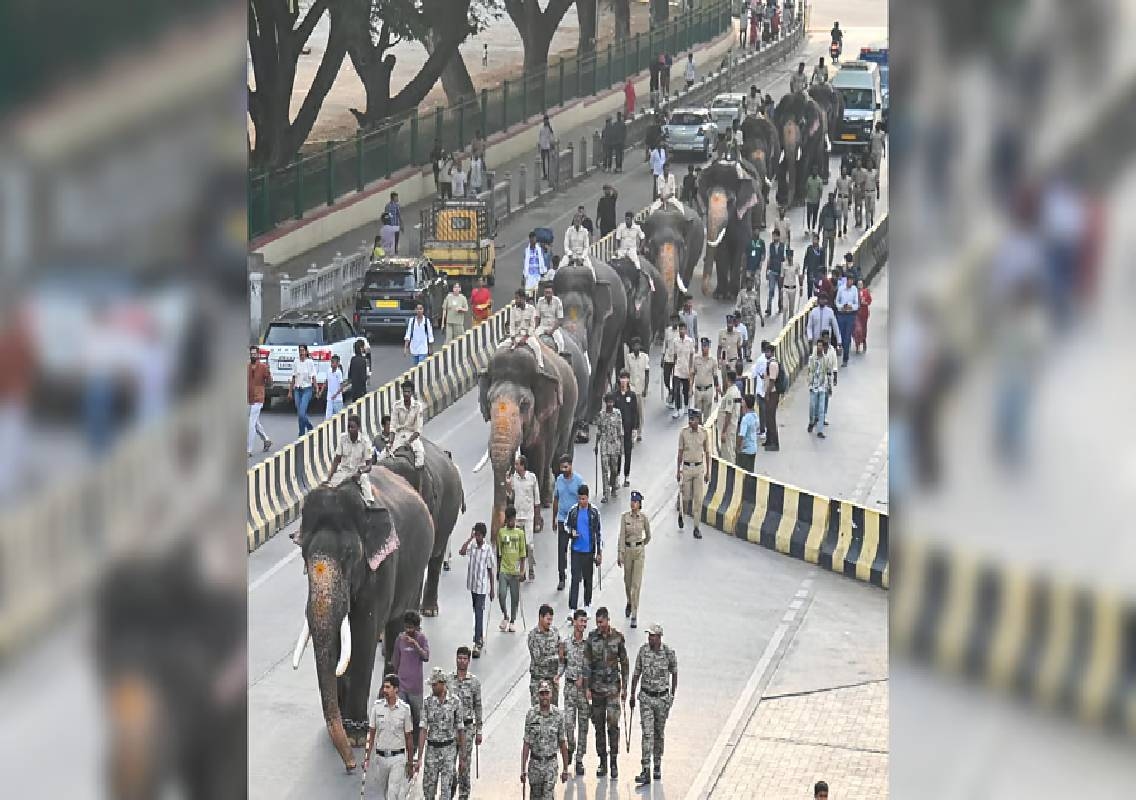


Mysuru: Dasara elephants in Mysuru have begun intensive weight-training sessions as the Forest Department prepares them for the Jumboo Savari procession on October 21. The training is aimed at identifying and preparing the elephant that will eventually carry the ceremonial golden howdah, while the animals are also being familiarised with city roads, crowds and traffic.
The elephants are being gradually introduced to heavier loads before the final howdah training. The official Mysuru Dasara website states that the golden howdah itself weighs around 750 kg, while the selected elephant must be capable of carrying the load steadily over the approximately five-kilometre procession route.
Recent training sessions have already seen Dasara jumbo Mahendra carry around 600 kg of sandbags along the Jumboo Savari route, covering about five kilometres from the Mysuru Palace to the Torchlight Parade Grounds in Bannimantap.
Elephants gradually introduced to heavier loads
The weight-training exercise is conducted progressively rather than immediately placing the full ceremonial load on an elephant.
During an earlier session, Mahendra was fitted with a cradle-like metal structure and loaded with approximately 600 kg of sandbags. The elephant was accompanied by kumki elephants Lakshmi and Cauvery as he walked through the city.
The exercise was intended to familiarise the elephant with the weight, route and surroundings that it will encounter during the final Dasara procession. According to the official Dasara website, the elephant selected to carry the golden howdah must also remain calm amid crowds, traffic, noise and other distractions.
The Forest Department will select the 2026 howdah elephant after the training period. The official website says that the selection involves assessing the elephant’s temperament, physical capability and ability to carry the load comfortably.
Training prepares elephants for crowded city route
The training is not restricted to carrying weight.
Dasara elephants are also taken through the city so they become accustomed to traffic, crowds, vehicles, music and the general atmosphere surrounding the annual procession. The official Dasara programme notes that the elephants are taken along the procession route as part of their preparation.
The importance of this preparation has increased as large crowds gather along the Jumboo Savari route every year. During a recent weight-training session, hundreds of people reportedly gathered along the route to watch the elephants and take photographs. Some spectators reportedly climbed vehicles and nearby structures, creating additional challenges for personnel managing the crowd.
Forest and police personnel therefore have to ensure that spectators maintain a safe distance from the elephants while allowing the animals to complete their training without unnecessary disturbance.
Forest staff and mahouts play key role
Mahouts, kavadis, veterinarians and Forest Department personnel remain closely involved throughout the training process.
The relationship between the elephants and their mahouts is an important part of Dasara preparations. Mahouts accompany the elephants during their city walks and help control them when they encounter unfamiliar situations.
The Forest Department has also strengthened surveillance around the elephants. Earlier this month, 14 CCTV cameras were installed around the Palace premises to monitor the animals round the clock, while public access to the elephant enclosure was restricted.
The elephants are also provided specialised food and veterinary supervision during their stay in Mysuru. The official Dasara website states that their diet includes rice, ragi, jaggery, coconut, horse gram and green fodder to help them build the energy required for the procession.
12 elephants participating in 2026 Dasara
The 2026 Dasara elephant squad comprises 12 elephants brought from different forest camps. The official Dasara website lists elephants including Kaveri, Roopa, Sugriva and Chaitra among the squad.
The elephants arrived in Mysuru after Gajapayana began from Veeranahosahalli on August 26. They entered the Mysuru Palace on August 28, where the traditional Gajapuja was held.
The elephants are scheduled to return to the forest on October 22, a day after the Jumboo Savari procession.
With veteran howdah elephant Abhimanyu having retired from the role, attention is now on identifying his successor. Abhimanyu had carried the 750-kg golden howdah in recent editions of Dasara. The selection process for the new howdah elephant is expected to continue through the training period.
Insurance cover changed for 2026
The Forest Department has also made a significant change to the insurance arrangement for this year’s Dasara elephant squad.
Unlike previous years, the 12 elephants themselves have not been included in the 2026 insurance policy. Instead, the department has substantially increased accident insurance for the people responsible for handling and caring for the animals.
The revised policy covers 39 personnel, including 12 mahouts, 12 kavadis, 10 special mahouts and Forest Department officers and staff. Each person has accident insurance of ₹20 lakh, taking the total personal accident cover to ₹7.8 crore.
The insurance is valid from August 25 to October 22, covering the period from the elephants’ departure from their camps through their stay in Mysuru, training and the Jumboo Savari.
Public property insurance doubled to ₹1 crore
While the elephants have been removed from individual insurance coverage, protection against third-party incidents has been increased.
The cover for injury, death or damage to third-party property caused by an elephant has been raised from ₹50 lakh to ₹1 crore. The Forest Department has paid a premium of ₹5,900 for this component.
The overall insurance cover for personnel and third-party liability therefore stands at ₹8.80 crore, with a combined premium of ₹28,208.
Forest Department officials have explained that the decision to exclude the elephants followed questions over how an insurance claim would be made when the animals themselves are owned by the department. Previous Dasara years had included insurance for the elephants alongside cover for handlers and public property.
For comparison, all 14 elephants participating in the 2025 Dasara were covered along with 43 staff members and public property under a combined policy worth ₹2.04 crore.
Safety remains focus during Dasara preparations
The ongoing training is aimed at ensuring that the elephants are physically prepared and comfortable before the final procession. At the same time, crowd management remains an important part of the exercise.
The recent training sessions demonstrated the scale of public interest, with large crowds gathering along roads to watch the elephants. Forest and police personnel will need to maintain adequate distance between spectators and the animals as training progresses.
The elephants will continue their daily walks and weight-training exercises before the Forest Department makes the final selection of the howdah elephant.
As Mysuru prepares for the grand Jumboo Savari on October 21, the coming weeks will be crucial for the Dasara elephant squad. The gradual increase in training loads, veterinary monitoring, crowd familiarisation and enhanced protection for handlers and the public are all part of preparations for one of Karnataka’s biggest annual cultural processions.