







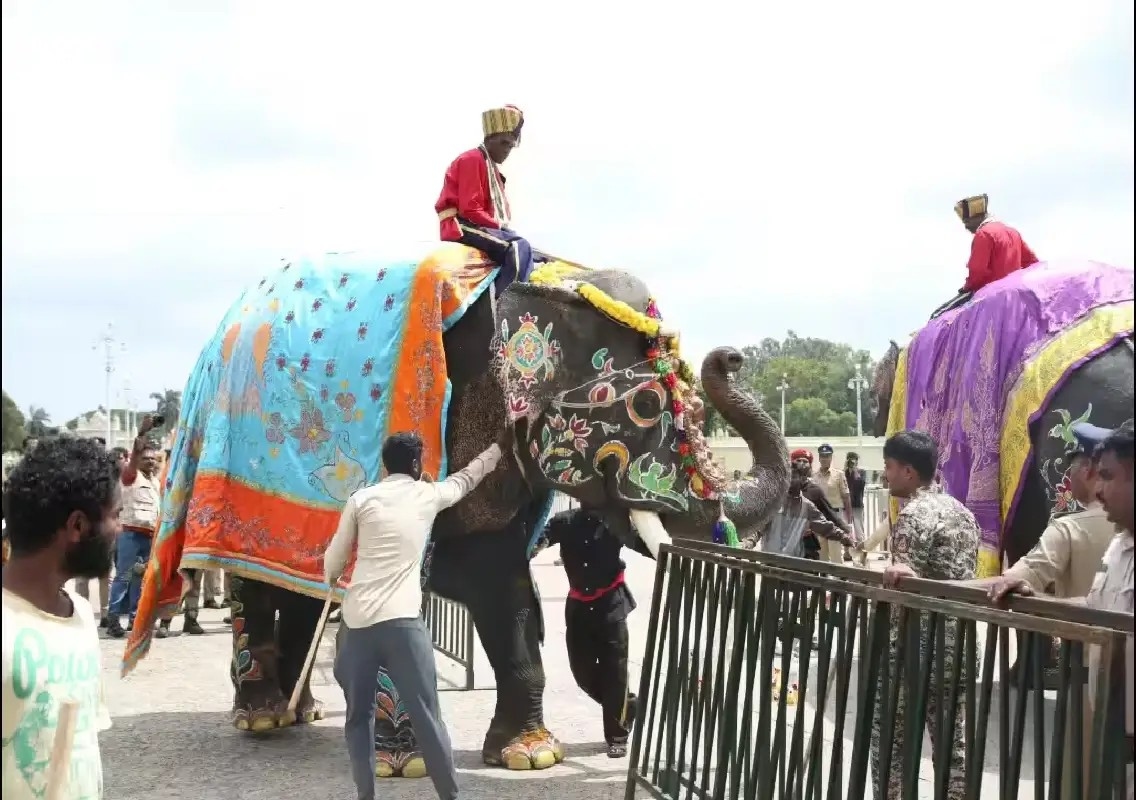


Mysuru: A brief scare at the Mysuru Palace on Friday highlighted the importance of careful preparation and acclimatisation of Dasara elephants ahead of the grand Jamboo Savari procession.
Dasara jumbo Srirama, who was reportedly calm moments earlier, suddenly panicked when musicians began beating drums loudly behind him. His mahout and kavadi quickly intervened and brought the elephant under control.
The incident served as a reminder that even trained elephants can react unexpectedly to unfamiliar or sudden sounds. It also underlined the importance of the weeks of training and acclimatisation undertaken by the Dasara jumbos before they participate in the Vijayadashami procession.
The Forest Department, veterinarians, mahouts and kavadis work together to prepare the elephants physically and mentally for the demanding festivities.
Elephants gradually introduced to city environment
The Dasara elephants undergo a carefully planned acclimatisation process after arriving in Mysuru.
As part of their preparation, the jumbos are taken on regular walks along the Jamboo Savari route between the Mysuru Palace and Bannimantap.
These walks help the elephants gradually become familiar with the environment in which they will participate in the procession.
During the walks, the elephants encounter traffic, vehicles, pedestrians and other everyday sights and sounds associated with the city.
The gradual exposure is intended to reduce the possibility of the animals becoming startled when they encounter large crowds, traffic or loud music during Dasara.
The preparation becomes particularly important because the Jamboo Savari attracts huge crowds and involves several sights and sounds that are not part of the elephants’ normal routine.
Load training prepares elephants for procession
Physical conditioning is another important part of Dasara preparation.
The elephants are gradually trained to carry the loads they will bear during the procession. The training allows them to become accustomed to additional weight without placing sudden physical strain on their bodies.
Special attention is given to the elephant selected to carry the Golden Howdah.
The weight used during training is increased gradually so that the elephant can adjust to the demanding responsibility of carrying the ceremonial structure during Jamboo Savari.
Such conditioning is carried out over a period of time rather than immediately before the procession, allowing the elephant’s body to adapt to the workload.
Sound training helps prevent panic
Exposure to loud sounds forms another key part of the preparation.
The elephants are gradually exposed to sounds associated with Dasara celebrations, including music, crowds and cannon-firing rehearsals.
The aim is to help them become familiar with sudden and loud noises that could otherwise cause fear or agitation.
Friday’s incident involving Srirama demonstrates why such preparation is necessary. Although the elephant had remained calm, the sudden sound of drums from behind triggered a brief panic.
The quick response from the mahout and kavadi helped prevent the situation from escalating.
The incident also shows that training does not completely eliminate an elephant’s natural response to unexpected stimuli. Instead, repeated exposure and familiarity help reduce risks and allow handlers to respond effectively when an elephant becomes unsettled.
Special diet designed for each elephant
Nutrition plays an equally important role in preparing the Dasara elephants.
The elephants are provided meals based on factors such as their age, weight and workload.
Their diet includes green fodder, sugarcane, rice, wheat, pulses, vegetables, jaggery and coconut.
The food requirements are monitored to ensure that the elephants receive adequate nutrition while undergoing regular training and walks.
The workload of an elephant participating in the Jamboo Savari can be considerably different from its normal routine. Therefore, the diet is adjusted to support its physical conditioning and energy requirements.
Veterinarians monitor health closely
Veterinary care is an essential component of the Dasara preparation programme.
Veterinarians regularly monitor the elephants’ food intake, appetite, digestion, movement and behaviour.
Any changes in an elephant’s physical condition or behaviour can provide important indications about its health and readiness for training.
Regular observation also enables veterinarians and handlers to identify issues early and take appropriate measures before the elephants are exposed to the demands of the procession.
The health monitoring continues throughout their stay in Mysuru.
Bathing and grooming form daily routine
The daily routine of the Dasara elephants includes more than training and feeding.
Bathing, grooming and massages are part of their regular care.
Mahouts and kavadis remain closely involved in the elephants’ everyday routine, attending to their food, hygiene, exercise and behaviour.
This daily interaction also strengthens familiarity between the handlers and elephants.
The relationship is particularly important during demanding situations when an elephant needs to respond to the instructions and presence of its mahout.
Trust between elephants and handlers
Behind the spectacle of Jamboo Savari is a close relationship between elephants, mahouts and kavadis.
The handlers spend weeks feeding, bathing and walking with the elephants. They also communicate with them regularly and observe their behaviour closely.
This prolonged interaction helps establish familiarity and trust.
For elephants participating in a major public event, the bond with their handlers is an important part of the overall safety arrangement.
Mahouts and kavadis are familiar with the individual temperament and behaviour of the elephants under their care. Their experience enables them to identify signs of discomfort, fear or agitation and respond accordingly.
12 elephants selected for Dasara 2026
For Dasara 2026, a team of 12 elephants has been selected, with the first batch already arriving in Mysuru.
The elephants will undergo weeks of training, nutrition management, veterinary monitoring and acclimatisation before the Jamboo Savari.
Their preparation is intended to ensure that they are comfortable with the city’s environment and capable of handling the crowds, sounds and physical demands associated with the festival.
Regular walks along the procession route will continue to familiarise them with the surroundings.
The elephants will also undergo sound and load training as part of the preparations.
Safety remains the priority
The grandeur of the Jamboo Savari depends heavily on the careful preparation of the elephants that form its centrepiece.
While the animals are trained to cope with the sights and sounds of Dasara, their safety and well-being remain important considerations throughout the process.
The brief incident involving Srirama is a reminder that unexpected reactions can occur even after extensive preparation.
By Vijayadashami, the Dasara jumbos are expected to have undergone weeks of physical conditioning, specialised nutrition, healthcare and acclimatisation.
The combined efforts of the Forest Department, veterinarians, mahouts and kavadis are aimed at ensuring that the elephants are adequately prepared for the procession while protecting both the animals and the thousands of people who gather to witness the spectacle.
The careful preparation behind the scenes is therefore as important as the grandeur seen on the day of Jamboo Savari.